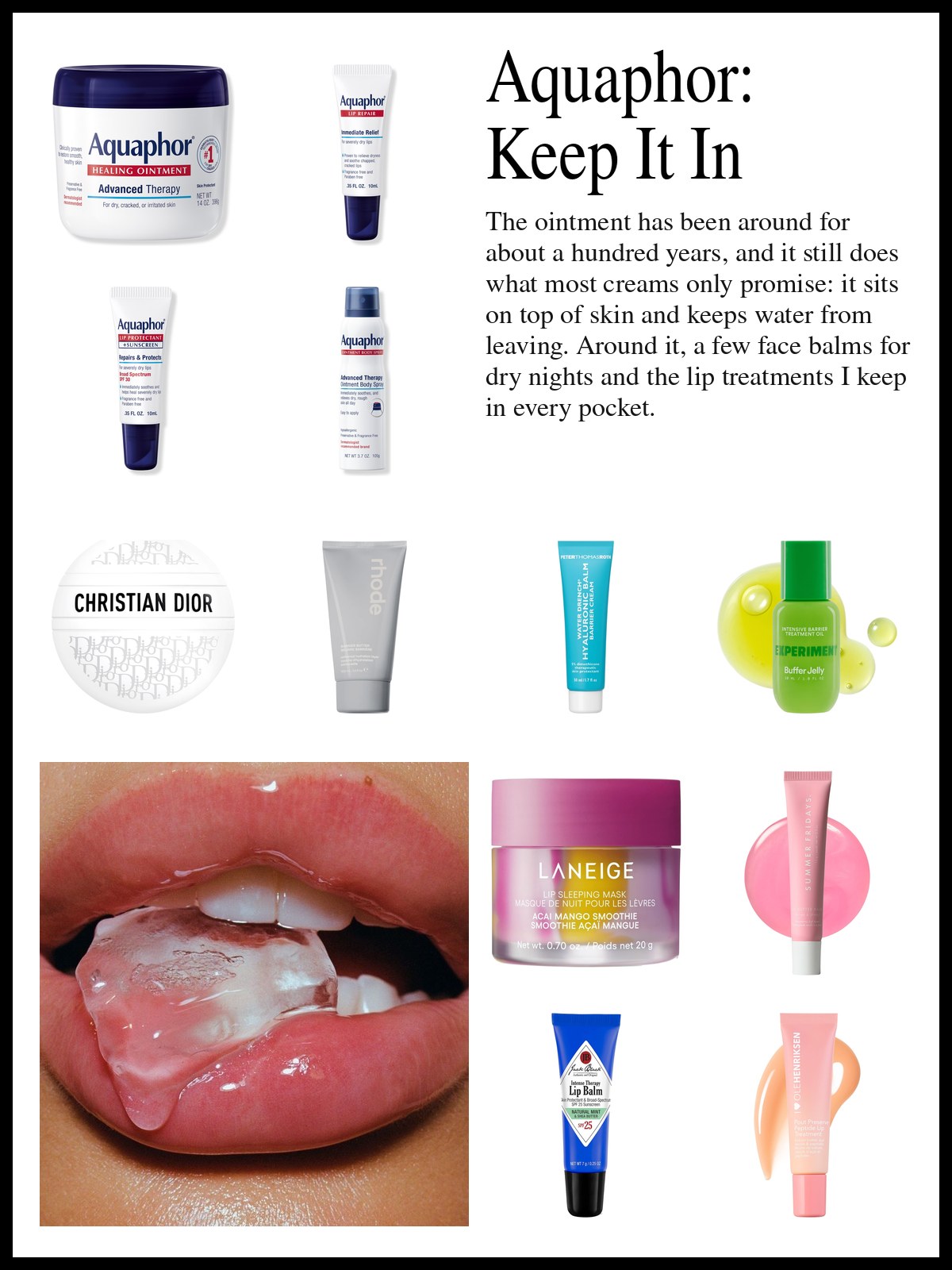
Aquaphor started life in 1925 as an ointment for doctors and pharmacists, and it still does one plain job: it helps keep moisture in. Here is the original jar and its lip and body spinoffs, the richer face balms that follow the same idea, and the lip treatments I rotate through winter.
Aquaphor Was a Pharmacist's Secret Long Before It Was Ours
Aquaphor was developed in 1924 in Beiersdorf's American laboratories, and for most of its life you could not simply pick it up on a shopping trip. From 1936 it was offered to doctors, pharmacists and hospitals, and it only reached ordinary shelves in 1982. That history explains the packaging, which still looks like something a nurse would hand you, and the formula, which is not trying to be pleasant. It is trying to work, and for dry, stubborn skin it still does.
The Healing Ointment is built on petrolatum, with a little glycerin and panthenol. It does not add much water to skin. What it does is sit on top and slow down how fast water leaves, which is why it is so good on anything dry, cracked or windburned. I use the jar on knuckles, heels and the sides of my nose during a cold, and a thin layer over my usual moisturizer on the worst winter nights.
The lip line came much later, in 2011. Lip Repair is the ointment idea in a softer, lip-sized tube, and the Lip Repair balm with SPF 30 is the one to use in daylight, since a bare occlusive on lips in strong sun is not doing them any favors. The Ointment Body Spray is the spray format, a fine mist for backs, shins and anywhere a jar gets messy. It is surprisingly good straight after a shower, on damp skin, before you towel off completely.


When a face needs more than ointment
Ointment is wonderful on a heel and a bit much on a whole face, at least before you leave the house. When my skin is dry but I still want to look like a person in public, I move to a balm, which borrows the same idea of sealing moisture in but feels more like skincare.
Dior's Le Baume is a thick multi-use balm, the one I keep for dry patches around the nose and eyebrows and on the backs of my hands. Gucci's multipurpose balm is similar in spirit, rich and all-over, as happy on cuticles as it is on cheeks. rhode's Barrier Butter is an intensive balm, made for skin that feels tight by the afternoon.
Peter Thomas Roth's Water Drench balm pairs a barrier cream with hyaluronic acid, so it adds water and then holds it, useful if your skin feels both dry and red. Experiment's Buffer Jelly is an oil-gel with ceramides, lighter than the others and the one I would try first if heavy balms feel like too much. Ranavat's Moonseed balm is the evening one, an overnight soothing treatment full of Ayurvedic botanicals that feels more like a ritual than a step. First Aid Beauty's Ultra Repair Rescue balm works as a daytime balm or a thick overnight mask, and Erborian's Centella Barrier Cream is the cica balm I would pick for skin that feels raw as well as dry.
The test for any of them is the next morning. If your skin feels soft and not greasy when you wake up, you used the right amount. If the pillowcase got most of it, use half next time.
Face balms and barrier treatments

Le Baume Revitalizing Multi-Use Balm
Dior
$63

Barrier Butter Intensive Moisturizing Balm
rhode
$36

Water Drench Hyaluronic Balm Barrier Cream Moisturizer for Redness and Dry Skin
Peter Thomas Roth
$35

Buffer Jelly Facial Oil-Gel for Barrier Support with Ceramides
Experiment
$32

Multipurpose Hydrating and Nourishing Balm
Gucci
$55

Overnight Soothing Treatment Moonseed Balm with 30 Ayurvedic Adaptogens
Ranavat
$125

Ultra Repair Rescue Skin Barrier Balm + Mask with Dimethicone
First Aid Beauty
$39

Centella Barrier Cream Cica Repair Balm, Strengthen Skin Barrier & Soothe Skin
Erborian
$35
Lips, all winter
Lips have very little oil of their own, which is why they are the first thing to crack when the heating comes on. Any good lip product does two things: it softens, and it keeps what moisture you have from evaporating.
Laneige's Lip Sleeping Mask is the overnight one most people know, a thick layer you put on at bedtime and find still there in the morning. Rare Beauty's Find Comfort balm works as a daytime butter and an overnight mask, so it is a good pick if you only want one tube. Summer Fridays' Lip Butter Balm is glossier and comes in a few tinted shades, the one I wear instead of gloss on weekends.
fresh's Sugar Advanced Therapy is a treatment lip balm. Ole Henriksen's Pout Preserve adds peptides and a soft shine. Tatcha's Kissu lip mask is a plumping overnight treatment, and Nécessaire's The Lip Balm is made for instant relief on dry, chapped lips, the closest of the group to the Aquaphor idea. Jack Black's Intense Therapy balm with SPF 25 is the practical one, the balm to keep in a coat pocket for long walks, ski days and anything outdoors.
What I would skip: licking your lips to wet them, which dries them out faster, and strongly flavored balms if you catch yourself doing exactly that. I would also skip scrubbing lips that are already cracked. Wait until they have calmed down, then exfoliate gently, once a week at most.
Lip balms and overnight masks

Lip Sleeping Mask – Intense Hydration Lip Treatment with Vitamin C
Laneige
$25

Lip Butter Balm Treatment for Hydration + Nourishing Shine
Summer Fridays
$24

Intense Therapy Lip Balm SPF 25
Jack Black
$10

Pout Preserve Hydrating Peptide Lip Treatment
Ole Henriksen
$24

Find Comfort Lip Butter Balm + Overnight Mask with Hyaluronic Acid Butter
Rare Beauty by Selena Gomez
$18

Sugar Advanced Therapy Treatment Lip Balm
fresh
$28

The Kissu Hydrating & Plumping Lip Mask
Tatcha
$29

The Lip Balm – Instant Relief For Dry, Chapped Lips
Nécessaire
$28
How I actually use it
The simplest routine is the one that actually happens. I keep the Aquaphor jar by the bed, a lip balm in every coat and bag, and one richer face balm for the week my skin decides it has had enough of winter.
Put ointment on slightly damp skin, since it seals in whatever water is already there. Use a thin layer, less than you think, and give it a few minutes before you get dressed or lie down. On a long flight, a little on the lips and around the nostrils makes dry cabin air much easier to live with. And if a patch stays cracked, sore or red for more than a week or two despite all of it, show it to a doctor rather than piling on more product. Ointment is a good habit for dry skin, not a diagnosis. Keep the lid on the jar and the jar within reach, and you will use it without thinking about it.
For the lips on their own, I also wrote about Aquaphor lip balm and the thick repair balms to pair with it.