A Barbour jacket starts with a story from South Shields in 1894, and this edit sorts the waxed jackets, the quilted ones and the lighter, hooded layers. I go through the shapes by name and how each one wears, with a note on rewaxing.
Barbour Jacket: Waxed, Quilted and Lighter Ways to Wear the Classic
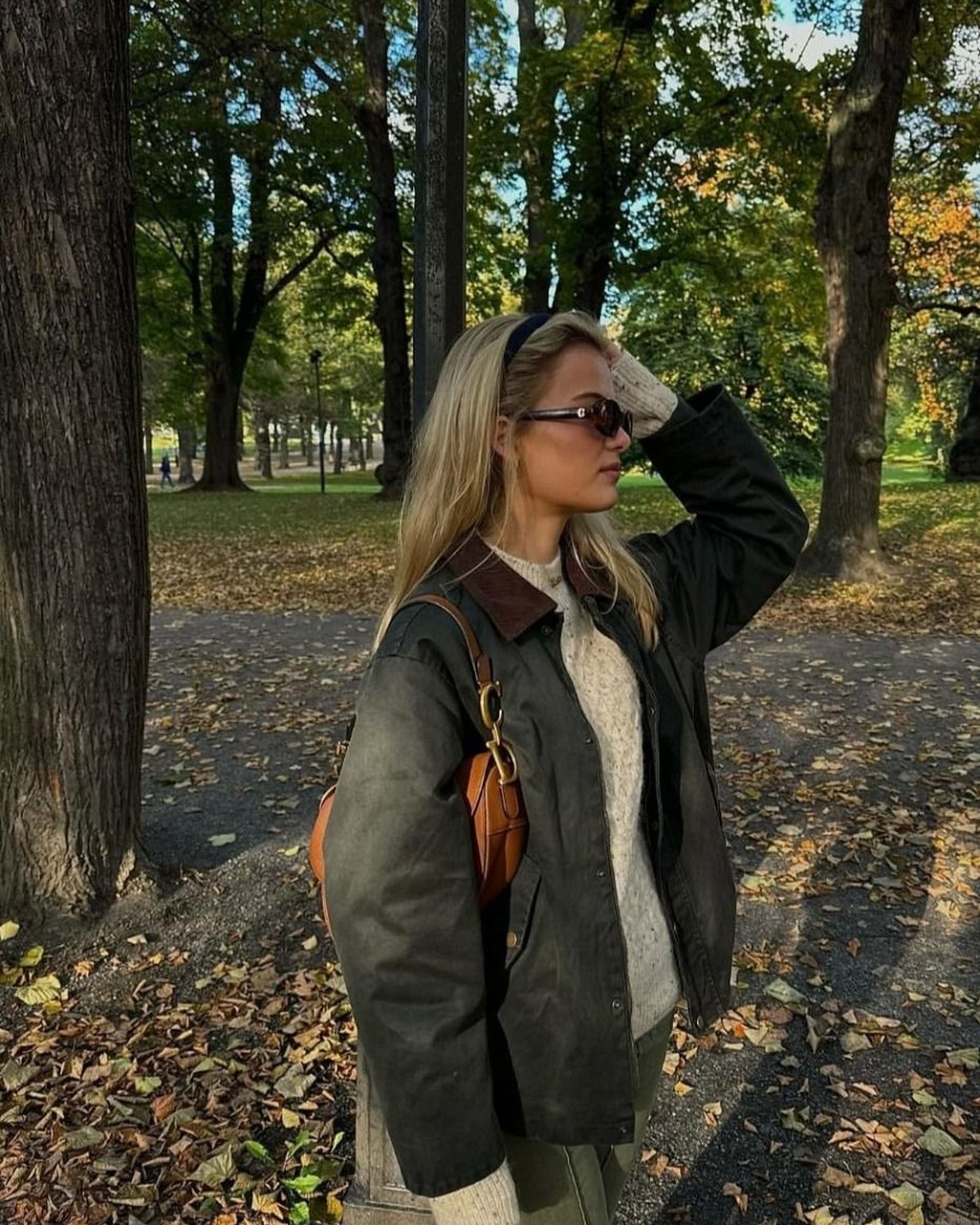
The Barbour story begins in 1894 in the Market Place in South Shields, in the North East of England. Barbour says John Barbour, a Scotsman, set up there to supply oilskins and other garments that protected sailors, fishermen and mariners from the worst of the British weather. That is a long way from a city sidewalk, but you can still feel it in the way a Barbour jacket is built: practical first, handsome second. If you want a Barbour jacket women can wear in town as easily as in the country, the groups below are sorted by weight.
The brand later collected three Royal Warrants, the first in 1974 from the Duke of Edinburgh, the second in 1982 from the Queen and the third in 1987 from the Prince of Wales. I like that history, but what I really care about is the shape of the jackets, and a surprising number of them trace back to Margaret Barbour. She joined the board after John Barbour's sudden death and became Chairman in 1973. She also designed the Bedale, a lightweight thornproof short jacket made for riding, introduced in 1980.
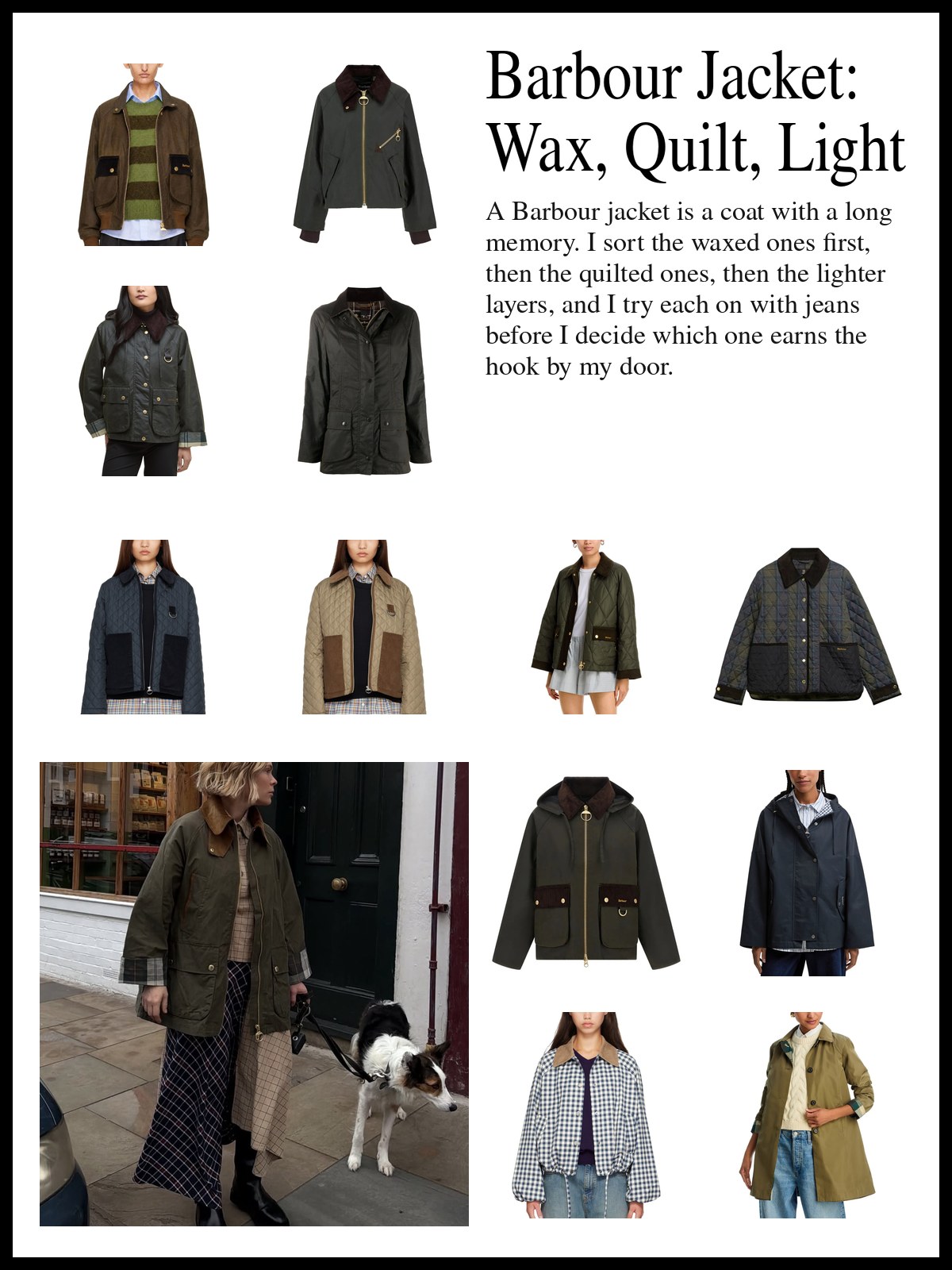
So start with the waxed group, because it is the heart of the edit. The Green Bedale Waxed Jacket is the one with the 1980 origin story: Barbour says the shorter length was ideal for riding, which is also why it sits so neatly with jeans. The Beadnell followed in 2010, based on the Bedale and cut to a slimmer silhouette. The Modern Beadnell is the slimmer cut, and there is a Cropped Beadnell too if you want a hem that clears your belt.
If you like a longer line, the Waxed-cotton coat and the Allerston Waxed Coat are the ones to try over a dress or tailoring. For something nearer to a classic field jacket, look at the Carville Waxed Cotton Jacket, the Hazelwood Waxed Cotton Jacket, the Ashby waxed cotton jacket and the Reighton Wax Jacket. The Khaki Ivybridge Waxed Jacket is the softest color of the group, and the Arlene, the Buttoned waxed jacket and the Willowmere Waxed jacket give you different closures and collars. The Icons tartan-collar waxed jacket is the small detail I would pick if you want a touch of pattern near your face. The Mary wax jacket is a shorter, rustic cut and the Adina comes in tan. Further along the grid are the Georgette, Acorn, Highclere, Felton, Cottingham and Patchwork Transport waxed jackets and the Icons Modern Spey, with the corduroy-collar ones adding a softer line at the neck.
Waxed jackets

Khaki Ivybridge Waxed Jacket
Barbour
$480

Carville Waxed Cotton Jacket
Barbour
$525

Arlene waxed jacket
Barbour
$420

Buttoned waxed jacket
Barbour
$388

Reighton Wax Jacket
Barbour
$378

Waxed-cotton coat
Barbour
$339

Allerston Waxed Coat
Barbour
$500

Green Bedale Waxed Jacket
Barbour
$270

Hazelwood Waxed Cotton Jacket
Barbour
$560

Modern Beadnell Waxed Jacket
Barbour
$468

Waxed cotton jacket
Barbour
$338

Ashby waxed cotton jacket
Barbour
$456

Cropped Beadnell waxed jacket
Barbour
$425

Willowmere Waxed jacket
Barbour
$636

Icons tartan-collar waxed jacket
Barbour
$515

Mary Wax Jacket
Barbour
$480

Adina Wax Jacket
Barbour
$480

Patchwork Transport Waxed Jacket
Barbour
$497

Icons Modern Spey Corduroy-Collar Waxed-Cotton Jacket
Barbour
$446

Georgette Waxed Jacket
Barbour
$617

Acorn Waxed Jacket
Barbour
$460

Highclere Waxed Jacket
Barbour
$470

Felton Waxed Cotton Jacket
Barbour
$625

Cottingham Waxed Corduroy-Collar Jacket
Barbour
$509
Quilted jackets for the in-between weeks
Quilted jackets are the other half of the Barbour wardrobe, and they are the ones I reach for when a waxed jacket feels like too much. They are lighter in attitude, softer through the shoulder, and they slip under a scarf more easily. In this group the shapes are mostly short, which makes them easy over a long skirt or high-waisted trousers.
The Liddesdale gives this group some history. Barbour introduced it in 1994, named it after the Liddesdale Valley in the Scottish borders, and originally designed it for equestrian use. The Icons cropped Liddesdale quilted jacket is the cropped take, so try it with a high waist and check that the hem meets your waistband without pulling up when you raise your arms.
Then there are the Aylesby jackets, the Navy Aylesby Quilted Jacket and the Khaki Aylesby Quilted Jacket. Navy is the one I would wear with gray trousers or dark denim, and khaki is closer to the waxed jackets above, so the two work as a pair if you like to change the mood. The two Annandales are close cousins, so try both on the shoulder before you choose.
The Beadnell has its own quilted versions: the Beadnell quilted jacket and the Beadnell Polarquilt Jacket. If you already know the slim fit of the waxed Beadnell, these are the familiar Beadnell name in a quilted version. The Kilnwick Quilted Jacket, the Kirby Quilted Jacket and the Flyweight Cavalry Quilted Jacket are the others to check, and the Flyweight name tells you the idea: a lighter quilt for layering. The Quilted corduroy-trim jacket brings in a textured collar, and Barbour International has the Ainsdale checked quilted jacket, the motorcycle-rooted line, in a checked quilt that stands apart from the plain ones.
Further along the grid, the Ava and Spey Icons quilted jackets, the Diamond-Quilted Corduroy-Collar Jacket and the longer Ravensden Quilted Parka Coat give you more ways to wear the stitch.
Quilted jackets and coats

Navy Aylesby Quilted Jacket
Barbour
$280

Khaki Aylesby Quilted Jacket
Barbour
$280

Kilnwick Quilted Jacket
Barbour
$330

Ainsdale checked quilted jacket
Barbour International
$490

Flyweight Cavalry Quilted Jacket
Barbour
$200

Annandale Quilted Jacket
Barbour
$220

Beadnell quilted jacket
Barbour
$395

Kirby Quilted Jacket
Barbour
$168

Quilted corduroy-trim jacket
Barbour
$500

Beadnell Polarquilt Jacket
Barbour
$295

Annandale diamond-quilted jacket
Barbour
$293

Icons cropped Liddesdale quilted jacket
Barbour
$311

Ava Quilted Corduroy-Collar Jacket
Barbour
$342

Ravensden Quilted Parka Coat
Barbour
$432

Spey Icons Quilted Jacket
Barbour
$511

Diamond-Quilted Corduroy-Collar Jacket
Barbour
$265
Lighter layers and hooded jackets
The last group is for days when you do not want wax at all. These are lighter layers, showerproof and hooded jackets, fleeces and a few quilted layers, and the point is to give you a Barbour that works in the weeks between coats.
The Babbity Jacket is the longer mac of the group, so I would wear it over a dress or tailoring. The Carville jacket is the one I would wear the way I wear a shirt jacket: over a knit, open, with the sleeves pushed up. The Kingswood Hooded Jacket and the Terrington Hooded Jacket are for anyone who wants a hood built in. Pull the hood up in the fitting room, because some hoods sit well and others fall back, and you want one that stays where you put it. The Delilah Checked Showerproof Jacket and the Baiton Casual Jacket are the easy layers, and the Denim Modern Beadnell Casual Jacket is the lighter take on the Beadnell shape.
The Blue & White Ovingham Gingham Casual Jacket is the playful one. It looks best with white jeans or a plain tee, and I would let the gingham do the talking, with no other pattern in the outfit. If you want warmth without wax, the Kirklees Tartan Fleece Jacket, the Arlene Fleece-Texture Jacket and the Elenora Fleece Zip-Up are the cozy end of the grid.
What I would skip: buying a lighter jacket and expecting it to behave like the waxed ones in the first group. These are layers, and I would not count on any of them for a downpour. I would also skip hooded jackets that are too snug in the shoulders, since you will probably wear a sweater under them. Try them with the thickest layer you own, and pick the size that lets you lift your arms without the hem rising.
Lighter layers and hooded jackets

Babbity Jacket
Barbour
$325

Carville jacket
Barbour
$493

Kingswood Hooded Jacket
Barbour
$203

Blue & White Ovingham Gingham Casual Jacket
Barbour
$305

Barbour Delilah Checked Showerproof Jacket
Barbour
$325

Baiton Casual Jacket
Barbour
$315

Denim Modern Beadnell Casual Jacket
Barbour
$400

Terrington Hooded Jacket
Barbour
$410

Sally Tartan-Check Jacket
Barbour
$500

Kirklees Tartan Fleece Jacket
Barbour
$235

Arlene Fleece-Texture Jacket
Barbour
$236

Elenora Fleece Zip-Up Jacket
Barbour
$309

Bowes Fleece-Texture Gilet
Barbour
$221

Cavalry Polarquilt Quilted-Finish Zip-Up Jacket
Barbour
$299

Quilted Reversible Jacket
Barbour
$376

Deveron Quilted Jacket
Barbour
$172
How I would choose and care for one
Here is how I would choose. Start with the weather you actually have. Waxed if you want the classic, quilted if you want something softer, lighter if the season is changing. Then check the length against your usual outfit: a short Bedale-style cut for jeans, a longer coat for dresses and tailoring.
Care is part of owning one. Barbour recommends re-waxing your wax jacket annually, depending on wear and use, and it says re-waxing and repairs first appeared in its 1921 catalogue. Over 75,000 wax jackets are re-waxed and repaired globally through its service. Wax for Life is the umbrella name for those services, and Barbour Re-Loved lets customers return old jackets, which are cleaned, re-waxed and repaired for a new home.
For me, that is the best argument for a Barbour jacket: you are not buying a season, you are buying something meant to be looked after. Hang it up, brush off the mud, and follow the brand's own care advice. If you want to keep browsing, I also put together Barn Jacket Edit and Best Quilted Jackets and Quilted Down Jackets, Compared.