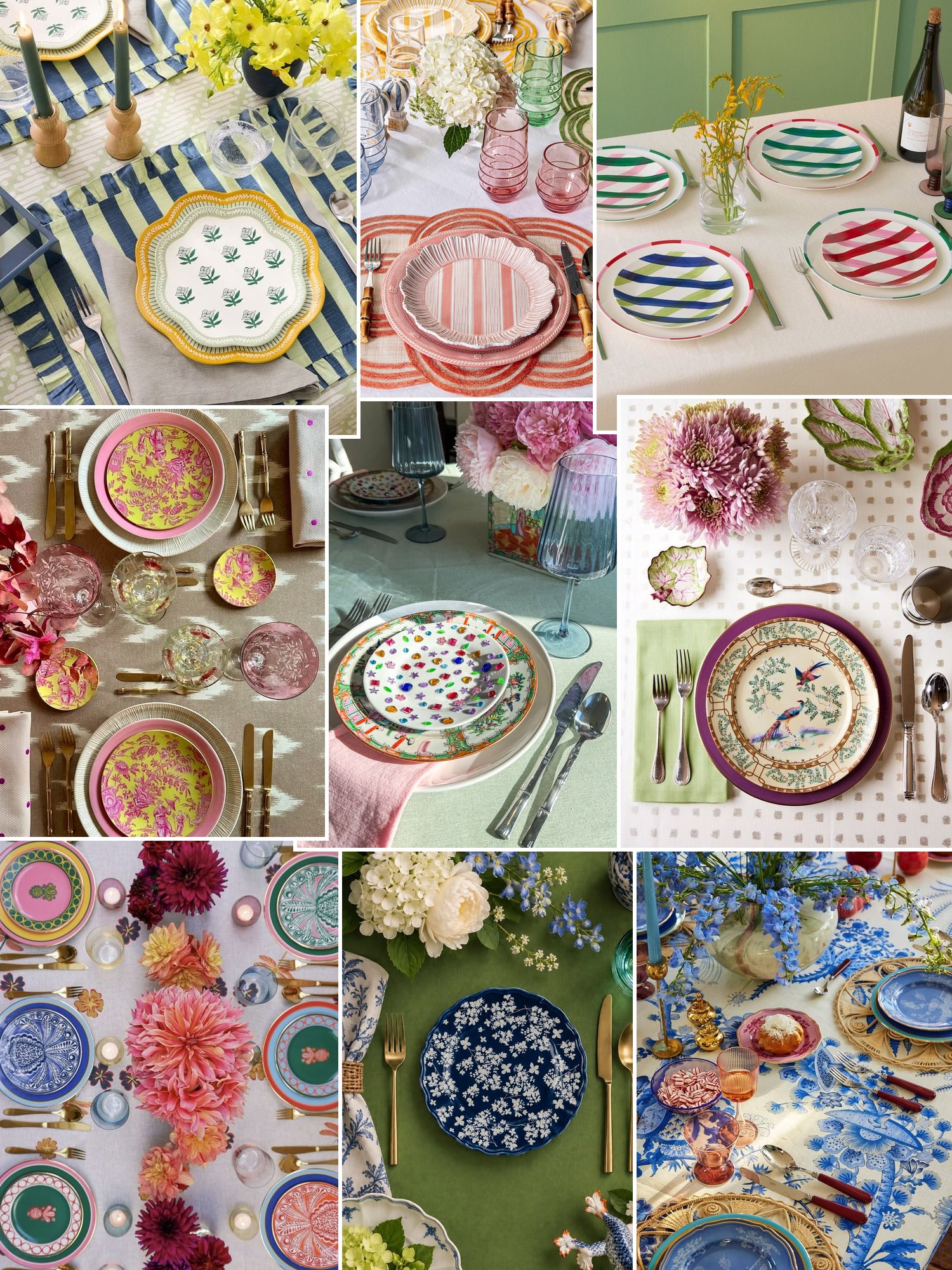
This Ginori plates dupe edit gathers dinner plates, salad plates, rimmed plates, platters and teacups from other labels that share a dense botanical in one bold color. I would build a table from them the way Ginori’s own porcelain is meant to be mixed.
Ginori Plates Dupe: Dense Botanical Plates in One Bold Color
The plate with the carnation on it
Ginori was founded in 1735 outside Florence by Marquis Carlo Andrea Ginori, who set out to make Italy’s finest porcelain, working what the house called “white gold.” Gio Ponti was its artistic director from 1923 to 1933, and Architectural Digest says the most recognizable pattern, Oriente Italiano, dates back to that era: a Chinoiserie-inspired floral design in saturated tones, rimmed in gold. That is the plate people have in mind when they search for a Ginori plates dupe.
What defines it is the flower. Port Magazine describes a stylised carnation from Florentine majolica, painted in a rapid stroke that reads like watercolor, the gradient dissolving into the background color. Each piece takes its contours from the all-white Antico Doccia shape and arrives in one of ten colorways, with iris and citrine among the shades. Color is airbrushed on, so it gathers on the embossed areas and gives the plate depth. Plenty of people want that look in a size, a color or a finish the original does not offer, and that is the whole idea of this Ginori plates dupe edit: pieces from other labels that share the one detail that sells it, a dense botanical in a single bold color.
For dinner plates, I would start with the Hartley Casiano, where cobalt scrollwork covers the whole face of a white round plate. The Vida Faenza has a scalloped edge and a dense indigo botanical in the center. The Poppy plates put one large red poppy on cream, and the Drucilla fills the plate with a warm orange botanical. If you like a rim, the Garden Grove adds blue bouquets and a fine gold line, which echoes the original’s gold edge.
My test: hold the plate at arm’s length and squint. One color should win, and the white should read as the background, not the star. Then check where the pattern stops at the edge.
Hand-painted-look dinner plates

Hartley Casiano Dinner Plate, 10.6 in
Birch Lane
$54.99

Bloomington Road Dinner Plates, 10.5 in
Noritake
$45.99

Garden Grove Dinner Plate
Lenox
$44.95

Vida Faenza Dinner Plate, 11 in
Beatriz Ball
$102

Gabrielle Rose Porcelain Dinner Plate, Set of 6
Certified International
$47.96

Vintage Indigo Bone China Dinner Plate, Set of 4
STP Goods
$41.48

Poppy Plates, Set of 4
Red Barrel Studio
$58.99

Drucilla Plates, Set of 4
Dakota Fields
$57.99
Salad plates with a smaller bouquet
A pattern that sings at eleven inches can turn busy at eight, so smaller plates are where density gets tested. Ginori’s own stroke is described as a gradient that dissolves into the background, which tells you what to look for: color that carries across the whole face, not a motif floating in the middle with a lot of empty white around it.
The Herman dessert plate is my closest match here, with cobalt botanical scrollwork over white. The Bloomington Road salad plates keep it lighter, a blue floral blossom border on white porcelain. The Vancasso set of four gives you assorted blue botanical prints, which suits a table that is collected rather than matched. The Tracton plates add blue-and-gold medallions for a little shine, and the Gabrielle Rose salad plates bring the single red of a rose toile on a scalloped edge.
For red, I would also look at the Wild Poppy Bloom bone china plates and the Poppy Red side plates, where one large painted-look poppy does all the work. In my fashion-minded way, I think of red plates like a red lip: one is plenty, and everything else on the table can stay quiet.
Before you buy, check the print against the rim. A scalloped edge should frame the pattern, not slice through it. Turn the plate over too: porcelain and bone china should feel thin and smooth, and the glaze should look even.
What I would skip: a salad plate with three or four colors competing. The look depends on one bold color, and a crowded palette reads as a different idea.

Herman Dessert Plate, 9.1 in
Birch Lane
$46.99

Bloomington Road Salad Plates, 8.25 in
Noritake
$39.99

4 Piece Floral Print Dessert Plate Set, 8.25 Inch
Vancasso
$24.61

Tracton Porcelain China Dessert Plate, 7.5 in, Set of 4
Darby Home Co
$41.99

Gabrielle Rose Porcelain Salad Plate, Set of 6
Certified International
$45.35

Bone China Wild Poppy Bloom Salad/Dessert Plates, 7.5 in
Grace's Tea Ware
$39.8

Poppy Red Side Plates, Set of 4
Wildon Home
$64.99

4pk 8.625 in Salad Plate, Blue Pattern
Threshold designed with Studio McGee
$25
Colored rims and painted bands
The original is rimmed in gold, so the edge matters. A colored rim is the quieter way to borrow the feeling: you keep the one-color idea, but the pattern shrinks to a border.
The Halcyon Days scalloped plate is white porcelain with a navy painted rim, and the Canvas Home Abbesses plate keeps to a fine blue line. The Colorwave rim plates go the other way, with a wide blue rim around a deep blue center, in stoneware. For a bit more ornament, the Menorca Palace dinner plates carry a wide green and yellow patterned rim on ivory, and the Iris Drop ruffle plate has blue brush-stroke marks around a ruffled edge. The Festive Scallop is a thin red rim on a scalloped white plate, the Sitio Stripe has Delft blue stripes that look hand-painted around the rim, and the Bistro Blue Band set gives a navy band across plates and bowls for service for four.
I would mix these with a patterned plate on top. Set a rimmed dinner plate underneath a smaller dense floral and the two colors start to talk to each other. Ginori’s porcelain is made to mix and match, and that habit works with look-alikes from different makers.
At the table, run a finger around the rim. A painted band should feel flat and even, with no ridge where the color stops. Check that the line keeps an even width all the way around.
What I would skip: a thin painted line if you want drama. It is a polite look, and the plate will not read as a bold botanical from across the room.

10 in Scalloped Plate
Halcyon Days
$98

Menorca Palace Set of 4 Dinner Plates, 10-3/4 in
Noritake
$109.99

Colorwave Rim Dinner Plates, 11 in
Noritake
$79.99

Abbesses Colored Rim Porcelain Salad Plate
Canvas Home
$43.99

Iris Drop Ruffle 11 in Dinner Plate
Coton Colors by Laura Johnson
$46.95

Festive Scallop Dinner Plate
Red Barrel Studio
$23.99

Sitio Stripe Dinner Plate
Juliska
$52

Everyday White Bistro Blue Band 12-Pc Dinnerware Set, Service for 4
Fitz and Floyd
$73.99
Platters with an all-over print
Vogue notes that every Oriente Italiano piece takes its contours from the plain white Antico Doccia, which means the shape is quiet and the pattern does the talking. That rule holds on a platter, and a roast or a tray of autumn vegetables looks better on a big surface with a dense print than on a plain one.
The English Garden platter is the boldest here, round and covered in dense emerald botanical print. The Le Jardin oval is a green botanical toile in stoneware, 16 by 12 inches, and the Verdura oval brings painted-look artichokes. For blue, the Moonlight Rose oval has a deep blue rose and leaf border, and the Vila oval has a scalloped blue floral trim around the edge. The Hertford oval carries pink rose clusters and a gold rim, the closest nod to the gold edge on the original. The Stafford Blooms platter keeps flower sprigs along the rim, and the Stukes tray is a rectangular porcelain tray with a red toile scene.
Set the platter on the counter before you commit: it should sit flat, with no rocking. Lift an edge to feel the weight, since a platter you cannot pass with one hand will stay in the cabinet. Look at the print where it meets the rim. On a good one the pattern is crisp and the glaze is smooth over it.
What I would skip: a pictorial toile scene if the botanical is the point. The red Stukes tray is lovely, but it tells a story, while the original is all flower.

Emerald English Garden Serving Platter
MacKenzie-Childs
$99.95

Stukes Porcelain Serving Tray
Charlton Home
$28.99

Le Jardin 16 x 12 Inch Oval Platter
Certified International
$36.01

Moonlight Rose Pattern Oval Platter
Lark Manor
$82.99

Hertford Oval Platter
Noritake
$176.99

Vila Oval Platter
Costa Nova
$118

Verdura Oval Platter
Certified International
$39.39

Stafford Blooms Platter, 14 in
Spode
$72.71
Teacups and mugs, painted small
On the original, the last step is hand-finishing: Port Magazine says pieces are hand-treated with tiny brushstrokes called “ritrovature,” on the mug handles, for example. So with a cup, I look at the handle and the saucer before the pattern.
The Delamere teacup and saucer is bone china with a dense brown botanical toile, a seven-ounce cup that suits an afternoon pot of tea. The Botanical Treasure set of four has bone china cups painted with botanical sprigs and gold trim, and the Heritage Botanical Garden set of two is a lighter flower print on white china. The Butterfly Meadow espresso cups add painted butterflies and wildflowers, for after dinner. For mugs, the Bella Blue mug is white porcelain with a blue floral chinoiserie pattern and a blue handle, the Heidi mug is footed with folk wildflowers and a beaded rim, and the Wild Rose mug is pink with painted roses and a gold rim. The Legacy Heirloom mug keeps it simple with an all-over pink floral.
Porcelain, as Architectural Digest puts it, is fired at the highest temperatures of any ceramic, so its build is thin and delicate yet durable. That is what a good cup should feel like: light in the hand, a smooth rim, a handle that fits a finger.
For October, I would stack a patterned mug on a plain saucer, or pair a teacup with a rimmed salad plate for a small tea table.
What I would skip: a tall mug if you are chasing the teacup look. The shape is half of it.

Delamere Teacup and Saucer, 7 oz
Spode
$99

Bone China Botanical Treasure Teacups and Saucers, Set of 4
Astoria Grand
$52.99

Heritage Botanical Garden Teacups and Saucers, Set of 2
Bloomsbury Market
$39.99

Butterfly Meadow Espresso Cup and Saucer, Set of 4
Lenox
$65.95

Bella Blue White Chinoserie Mug
Ten Strawberry Street
$29.99

Heidi Mug
Juliska
$48

Wild Rose Mug
MacKenzie-Childs
$59.95

13.34 fl oz Legacy Heirloom Mug, Pink Floral
Threshold
$6
How I would set the table
I would begin with one color and pick it first: cobalt, red or orange. Then I would choose a dense botanical dinner plate, add a smaller patterned plate or a rimmed one underneath, and bring in a platter and a few cups in the same color family.
Check the edge, the glaze and the flatness before anything else. Then let the table be a little uneven, because Ginori’s own porcelain is made to mix and match.
Somewhere in Florence, a carnation is still being brushed across a plate in a single rapid stroke. I would put my own one on the table, and let everyone ask where it is from. If you want to keep browsing, I also put together How Many Sets Of Plates Do You Actually Need.