Italian menswear has gone soft, with unstructured knits, garment-dyed overshirts and corduroy trousers taking over from the stiff suit. I went through the houses with real histories, from Piacenza 1733's wool mill in Biella to Rubinacci's Naples tailoring, and kept the pieces that earn their place. Here is how to wear the look without losing the polish.
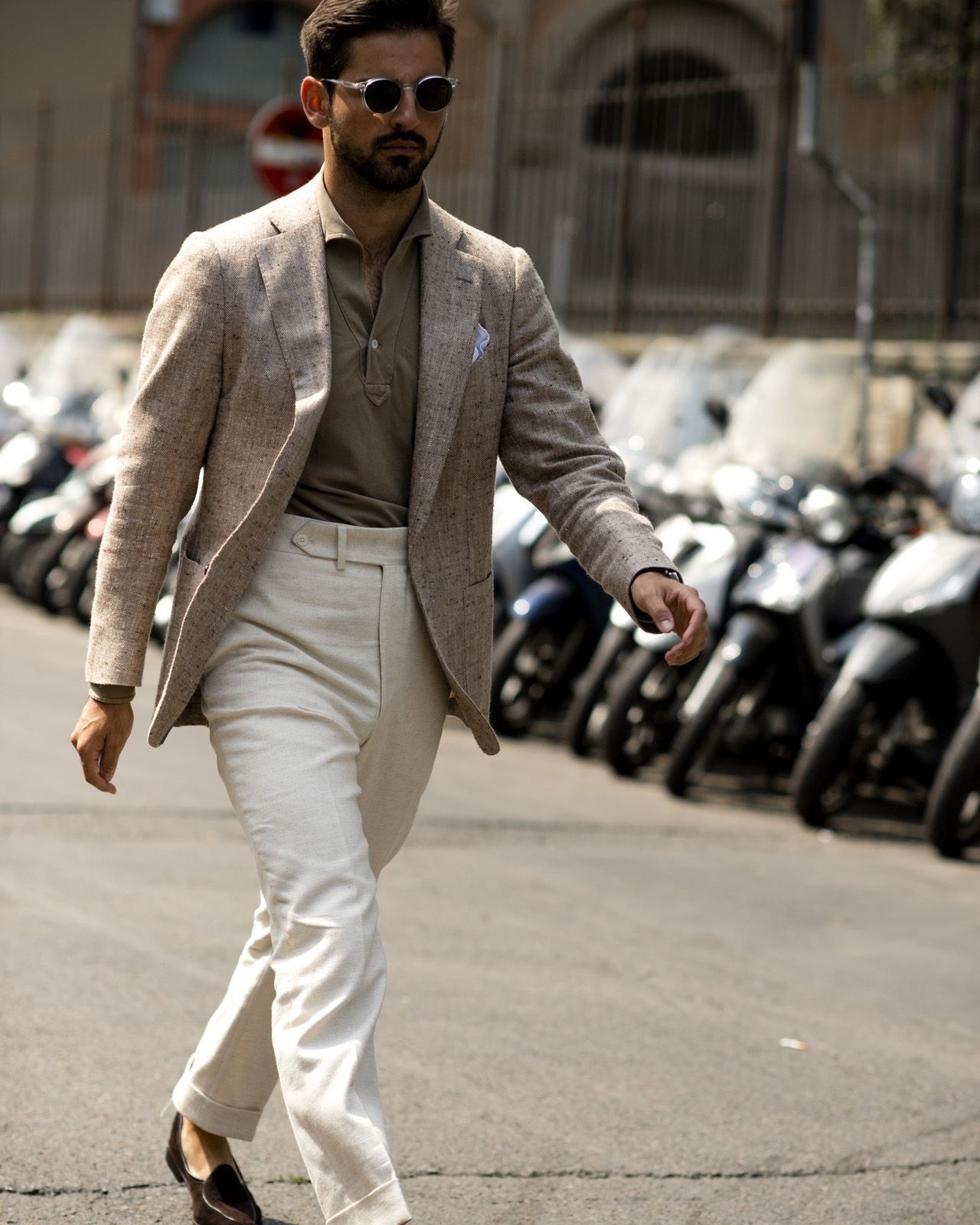
Italian Menswear: The Labels Behind the Softer Side
Sweaters, Half-Zips and Cardigans in Wool and Cashmere
Pitti Uomo, the menswear trade fair in Florence, held its first edition in September 1972, according to Pitti Immagine's own history page. It is still the room where Italian menswear shows its hand. Vogue reported that the June 2026 edition continued to perform well, with 730 global brands exhibiting, and UKFT's report on the 110th edition counted over 11,000 buyers at the Fortezza da Basso. When that many buyers walk the same fort, you can be sure of one thing: the stiff suit is no longer the point. Softness is. Start with the knit. Piacenza 1733 is a wool mill in Pollone, in the Biella textile district, with an official founding date of 1733, still family-run and old enough to belong to Les Henokiens. Its ribbed gray cashmere sweater is the one I would buy first. Altea began in 1892 when Giuseppe Sartori opened a tie shop in Milan, and its core business today is men's knitwear, so the half-zip in black virgin wool and the cream ribbed cardigan are the real specialty. Wear a half-zip under an unlined jacket. What I would skip is the orange Stone Island Ghost sweatshirt if the rest of the outfit is tailoring, since it belongs to a different conversation.
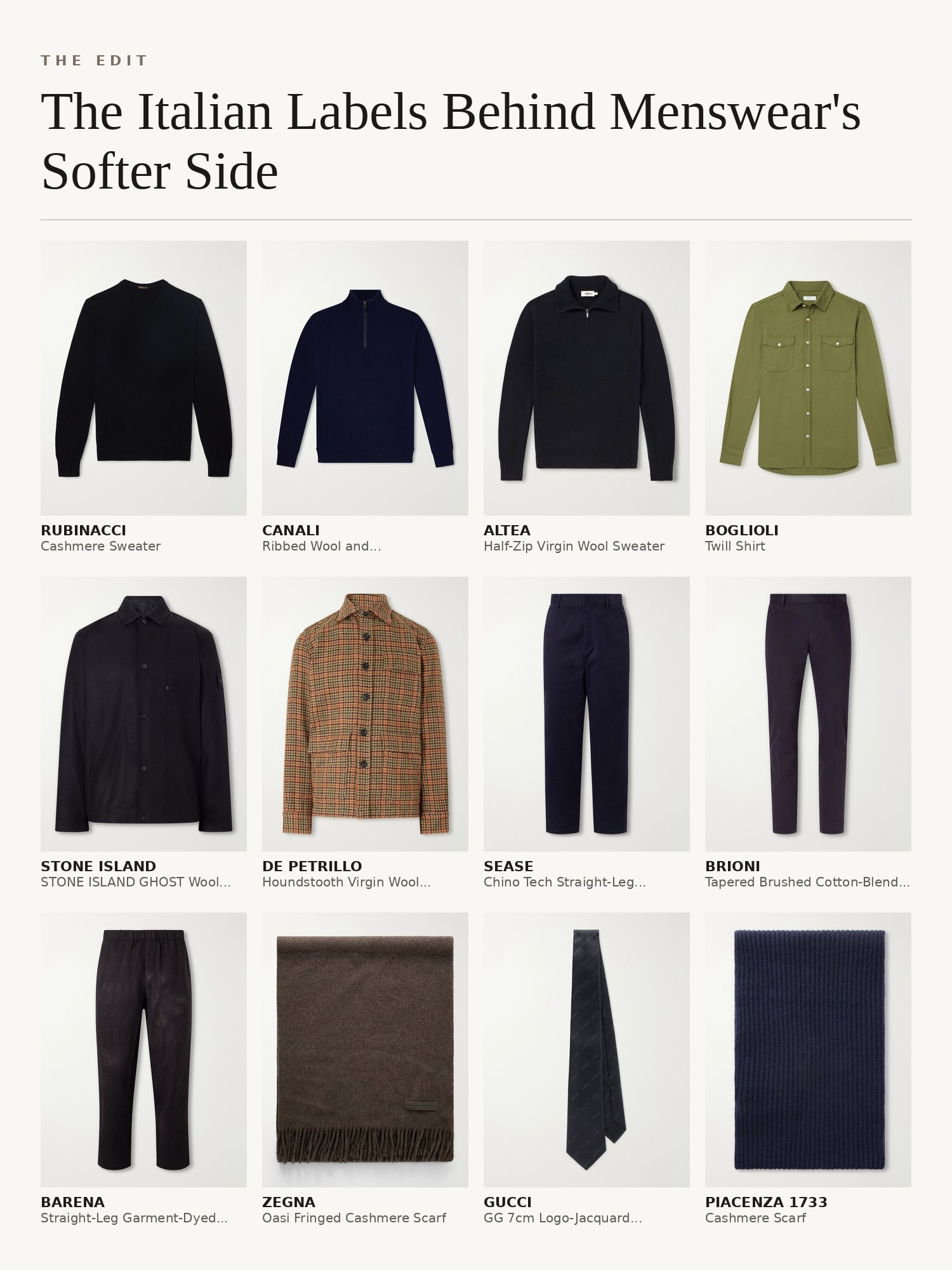

Cashmere Sweater
Rubinacci
$515

Ribbed Wool and Cashmere-Blend Half-Zip Sweater
Canali
$875

Half-Zip Virgin Wool Sweater
Altea
$440

Ribbed Merino Wool and Cashmere-Blend Cardigan
De Petrillo
$995

Ribbed Cashmere Sweater
PIACENZA 1733
$885

Wool Sweater
Canali
$495

Ribbed Virgin Wool Cardigan
Altea
$540

STONE ISLAND GHOST Garment-Dyed Stretch-Cotton Jersey Sweatshirt
Stone Island
$480
Shirts, Overshirts, Polos and T-Shirts
The shirt is where Italian softness turns into something you can wear on a weekday. Boglioli was founded in 1974 by brothers Mario and Stefano Boglioli in Gambara, Brescia, and it is known for tailoring and garment-dyed jackets, which explains why its green twill shirt feels relaxed without looking sloppy. Stone Island came out of Massimo Osti's Ravarino workshop in 1982, born from a heavy resin-printed military canvas called Tela Stella, and the name nods to Joseph Conrad's sea novels. Its black Ghost flannel overshirt is the one to wear instead of a jacket. De Petrillo's brown houndstooth wool overshirt does the same job with more Naples in it. For polos, Zegna's leather-trimmed piqué in white is the clean one, and Rubinacci's Sea Island cotton polo in black is the one for evenings. Bottega Veneta introduced Intrecciato in 1975, and Vogue says the weave began because the early workshop could not sew thick leather, so thin strips were woven instead. Wear a polo under a navy blazer with the top button open. What I would skip is the Zegna denim shirt with jeans, because double denim in the same wash looks like a uniform.

Twill Shirt
Boglioli
$455

STONE ISLAND GHOST Wool and Nylon Flannel Overshirt
Stone Island
$925

Godfrey Padded Garment-Dyed Stretch-Cotton Twill Overshirt
Altea
$975

Houndstooth Virgin Wool Overshirt
De Petrillo
$915

Denim Shirt
Zegna
$950

Leather-Trimmed Cotton-Piqué Polo Shirt
Zegna
$595

Sea Island Cotton Polo Shirt
Rubinacci
$365

Ribbed Cashmere Polo Shirt
PIACENZA 1733
$965

Cotton-Jersey T-Shirt
Brioni
$545

Cotton-Jersey T-Shirt
Canali
$550

Intrecciato Suede-Trimmed Cotton-Jersey T-Shirt
Bottega Veneta
$950

Sea Island Cotton-Jersey T-Shirt
Rubinacci
$345
Wool and Corduroy Trousers, Plus a Few Jeans
Trousers are where I judge an Italian label, and what I look for is simple: a soft waist and a leg that moves. Canali was founded in 1934 by brothers Giovanni and Giacomo Canali in Triuggio and is still independent, now in its third generation. Its tapered stretch-wool gabardine in navy is the dependable pair. Rubinacci began in Naples in 1932 as London House, was renamed in 1963 by Gennaro's son Mariano, and is now led creatively by grandson Luca. The Modaluca corduroy in navy is the pair I would buy for autumn. Barena takes its name from the barene, the marsh islands of the Venetian Lagoon, and says its clothing is Made in Venice, so its black garment-dyed houndstooth wool has a lot of character. De Petrillo's dark brown corduroy sits well with an oatmeal knit. Zegna's green Roccia jeans are the good option on Fridays. Pair corduroy with a smooth knit and flannel with a rougher one. What I would skip is the Stone Island wide-leg cargo trousers under a tailored overcoat, because the proportions fight.

Tapered Stretch-Wool Gabardine Trousers
Canali
$895

Chino Tech Straight-Leg Cotton-Blend Twill Trousers
Sease
$555

Straight-Leg Herringbone Cotton-Blend Twill Suit Trousers
Boglioli
$640

Modaluca Tapered Cotton-Corduroy Trousers
Rubinacci
$555

Tapered Brushed Cotton-Blend Gabardine Trousers
Brioni
$795

STONE ISLAND GHOST Tapered Wool and Nylon-Blend Flannel Drawstring Trousers
Stone Island
$755

Straight-Leg Cotton-Blend Corduroy Trousers
De Petrillo
$750

Straight-Leg Garment-Dyed Houndstooth Wool Trousers
Barena
$480

Renee Straight-Leg Stretch-Wool Flannel Trousers
Altea
$695

Straight-Leg Stretch-Cotton Twill Trousers
Canali
$550

Mindset Straight-Leg Wool-Flannel Drawstring Trousers
Sease
$620

Straight-Leg Cotton and Modal-Blend Corduroy Suit Trousers
Boglioli
$560

Manny Tapered Mélange Virgin Wool-Twill Trousers
Rubinacci
$555

Wide-Leg Garment and Mineral-Dyed Panama Cotton and Lyocell-Blend Cargo Trousers
Stone Island
$945

Slim-Fit Stretch-Cotton Corduroy Suit Trousers
De Petrillo
$795

Straight-Leg Cotton-Satin Trousers
Barena
$540

Tapered Wool-Blend Gabardine Trousers
Canali
$895

Straight-Leg Pleated Virgin Wool-Flannel Suit Trousers
Boglioli
$930

Convertible Tapered Drawstring Virgin Wool-Flannel Trousers
Rubinacci
$555

Straight-Leg Wool and Cashmere-Blend Suit Trousers
De Petrillo
$715

Tapered Pleated Wool-Twill Trousers
Canali
$625

Roccia Slim-Fit Garment-Dyed Jeans
Zegna
$875

Meribel Straight-Leg Jeans
Brioni
$795

Roccia Slim-Fit Straight-Leg Jeans
Zegna
$875
Ties, Scarves, Beanies and Caps
Small things are where Italian houses show their age. Brunello Cucinelli started in 1978 with colored cashmere knitwear, which was unusual then, and in 1985 bought a ruined fourteenth-century castle in Solomeo, Umbria, as the company headquarters. Altea, remember, began as a tie shop, so its brushed gray cashmere beanie has some family pride behind it. Zegna's fringed Oasi scarf in brown takes its name from Oasi Zegna, the 100 square kilometer natural territory in the Biellese Alps that Ermenegildo Zegna shaped from the landscape around his mill. Piacenza 1733's navy cashmere scarf is plainer and I like it more. Gucci's first boutique opened in Florence in 1921, and its blue Vintage Feeling jacquard tie is the loud one in the grid. Rubinacci's printed silk tie in blue is the safer one. Mikia, a Japanese label founded in 1998 by Aki Mitsubayashi, supplies the bracelet, which is a good thing to wear with a plain shirt. Put the scarf on first, then the coat. What I would skip is the Sease cashmere baseball cap with a tie, because those two do not belong in the same outfit.

8cm Printed Silk-Twill Tie
Rubinacci
$170

Oasi Fringed Cashmere Scarf
Zegna
$730

GG 7cm Logo-Jacquard Silk-Twill Tie
Gucci
$250

Cashmere Scarf
PIACENZA 1733
$470

Logo-Appliqué Cable-Knit Virgin Wool Scarf
Moncler
$710

7cm Wool Tie
Brioni
$310

STONE ISLAND GHOST Ribbed Cashmere Beanie
Stone Island
$365

Wool Baseball Cap
Canali
$450

8cm Striped Silk-Jacquard Tie
De Petrillo
$345

Logo-Debossed Leather Passport Holder
Brunello Cucinelli
$880

3.0 Cashmere Baseball Cap
Sease
$430

Brushed Cashmere Beanie
Altea
$225

Full-Grain Leather Gloves
Zegna
$990

7cm Vintage Feeling Logo-Jacquard Silk Tie
Gucci
$250

Ribbed Cashmere Beanie
PIACENZA 1733
$225

Sterling Silver, Black Diamond and Desert Pearl Beaded Bracelet
Mikia
$460
Softness Is Mostly a Matter of Cloth
The thing I keep noticing about the Italian houses is how little they rely on a logo. A cashmere sweater from Piacenza, a corduroy trouser from Rubinacci and a garment-dyed shirt from Boglioli all earn their place by feel. If you are putting this look together, I would go in this order: one good knit, one soft shirt or overshirt, a pair of corduroy or wool-flannel trousers, and then a scarf. That is a full outfit and it will run from October through March. Wear the overshirt open over the knit and keep the shoes simple. Add the polo once the weather warms, and the tie for the evenings you actually need one. Let everything stay a little rumpled. Rubinacci's Neapolitan jacket is said to fold up to eight times, and a jacket that packs that easily is one you will wear more often, and the same goes for the rest of it.
More Trousers, Knits and Soft Finishing Pieces
Softness is a matter of cloth, so I looked for more pieces where the fabric does the talking. Trousers are the strongest group: the Canali straight-leg wool and tapered stretch cotton-twill, the De Petrillo cotton and silk-blend twill and the Stone Island mineral-dyed cotton gabardine-TC. Up top, the De Petrillo merino wool and cashmere-blend rollneck and the Altea virgin wool polo sweater are the knits, and the Zegna cotton and cashmere-blend twill shirt can sit over either. The Stone Island Ghost cotton-jersey tee keeps it casual. For the finish, there is the Brioni silk-jacquard tie, the Gucci Web-intarsia wool scarf and the Zegna Oasi cashmere baseball cap. What I would skip: the Brioni tie with the rollneck, since a tie wants a collar.

Straight-Leg Wool Trousers
Canali
$750

Tapered Stretch Cotton-Twill Trousers
Canali
$550

Tapered Cotton and Silk-Blend Twill Trousers
De Petrillo
$725

Merino Wool and Cashmere-Blend Rollneck Sweater
De Petrillo
$575

Cotton and Cashmere-Blend Twill Shirt
Zegna
$950

Virgin Wool Polo Sweater
Altea
$460

STONE ISLAND GHOST Cotton-Jersey T-Shirt
Stone Island
$320

Loro Piana Fabric Wool & Cashmere Twill Regular Fit Sport Coat - Exclusive
The Men's Store at Bloomingdale's
$798

Oasi Logo-Embellished Cashmere Baseball Cap
Zegna
$650

Straight-Leg Mineral-Dyed Cotton Gabardine-TC Trousers
Stone Island
$720

8cm Silk-Jacquard Tie
Brioni
$395

Web-Intarsia Wool Scarf
Gucci
$590