Louis Vuitton passport holder styles range from familiar Monogram and Damier patterns to quiet leather and vivid city-guide covers. I compare the finishes by how I would travel with them and what I would check inside.
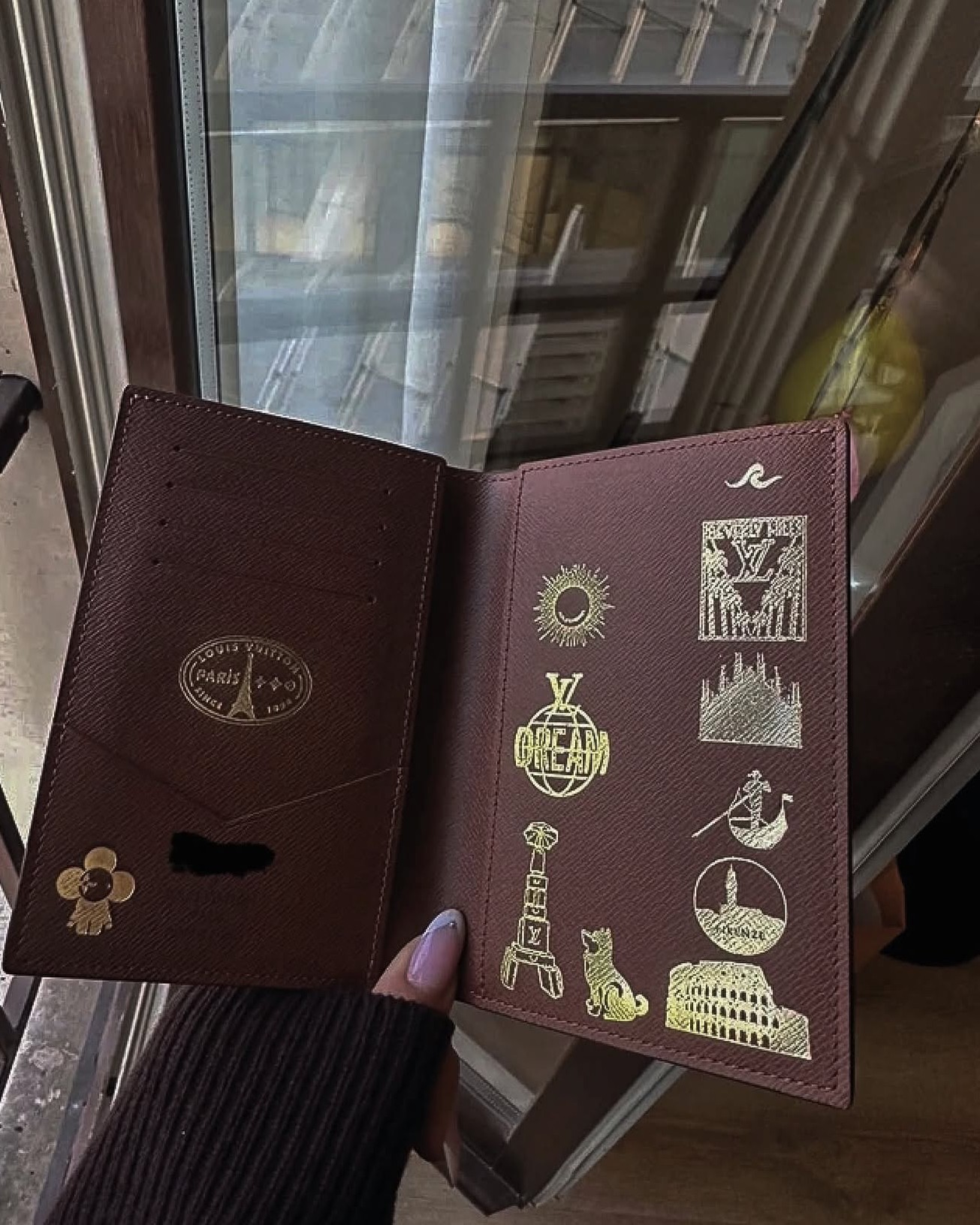
Louis Vuitton Passport Holder: Monogram to City Guides
Louis Vuitton opened its first workshop in Paris in 1854, near Place Vendôme. The house began with luggage, and that feels like a useful place to start with a passport cover. I like an object that remembers what it is for.
The Louis Vuitton passport holder takes the house's travel language and makes it small enough to slip into a bag. Georges Vuitton designed the interlocking initials and floral repeat in 1896 as a way to brand the luggage business. Here, that familiar pattern moves across coated canvas, embossed leather, suede, and a few much brighter ideas.
The Monogram Canvas cover repeats the brown flower-and-initial motif and has a cowhide lining. Monogram Eclipse and Monogram Midnight turn the repeat darker, one black and charcoal, the other a subdued all-over black. Khaki Green Monogram Eclipse is quieter still, with pale edging that breaks up the military color.
Frozen Grenadine Red adds a frosted checker over the pattern, while Tennis Clay brings brick-red sporting graphics. The black Monogram Shadow option trades the coated-canvas surface for embossed cowhide. Red Monogram Suede is the tactile outlier. I would choose by the finish I want to see every time I reach for a passport, then check that the four card slots and passport pockets fit the way I actually carry travel papers.
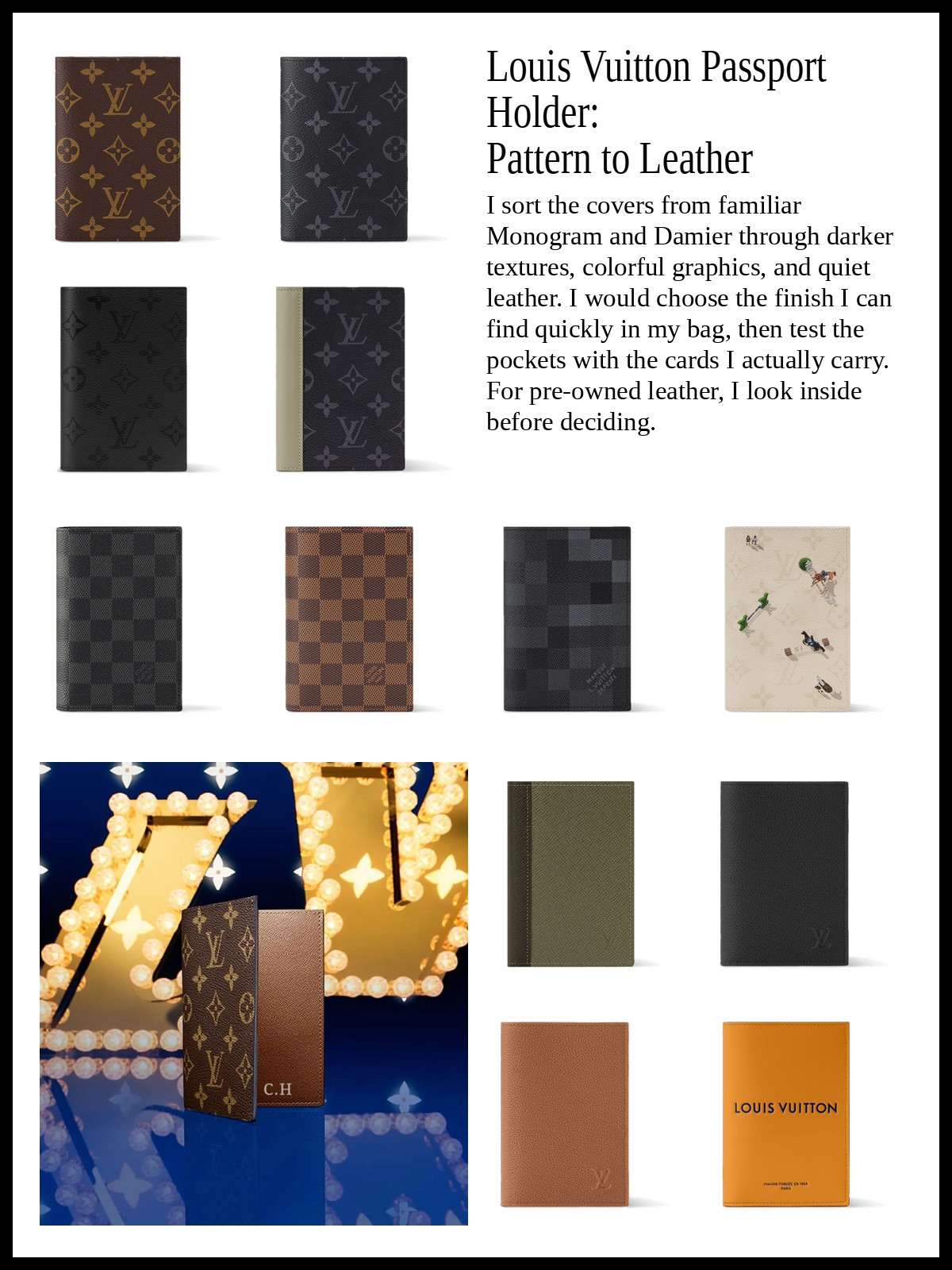
Monogram passport covers

Passport Cover in Monogram Canvas
Louis Vuitton
$400

Passport Cover in Monogram Eclipse Canvas
Louis Vuitton
$400

Passport Cover in Monogram Midnight Canvas
Louis Vuitton
$475

Passport Cover in Khaki Green Monogram Eclipse Canvas
Louis Vuitton
$475

Passport Cover in Frozen Grenadine Red Monogram Ice Cubes
Louis Vuitton
$510

Passport Cover in Monogram Shadow Leather
Louis Vuitton
$510

Passport Cover in Tennis Clay Monogram Canvas
Louis Vuitton
$505

Passport Cover in Red Monogram Suede
Louis Vuitton
$645
Checks, camouflage, and color
A pattern can be quiet from a few feet away and much busier in your hand, so I would look at these covers both ways before deciding. Damier Graphite is the restrained charcoal checker, while Damier Ebene warms the same idea into brown and tan. Both have a slim profile, but the pocket layout differs, so I would check what else needs to travel with the passport.
Black Damoflage mixes a high-contrast checker with a camouflage-like monogram texture. It is the pattern I would let stand alone beside a plain black bag. The G74 Passport Cover in Horse Riding Beige has sand-toned equestrian graphics; Ice Hockey Blue switches to ice-blue team imagery. Those are playful without asking the rest of the outfit to join in.
The yellow and red perforated checkerboard covers let the color read first, with the motif following. Navy Monogram Suede has an embossed repeat and a glossy finish, a subtler way into texture. I would pair it with a dark coat and let the surface do the talking.
Before settling on one, open it and count the pockets you will use. Check that your most-used cards slide in without bulging the fold, and that the passport stays easy to remove. For a shorter trip I would keep the inside simple. For a longer itinerary, those extra document pockets start to matter. What I would skip: pairing the most graphic cover with an already busy carryall. I would let the passport sleeve be the one patterned thing.
Damier and patterned passport covers

Passport Cover in Damier Graphite Canvas
Louis Vuitton
$400

Passport Cover in Damier Ebene Canvas
Louis Vuitton
$400

Passport Cover in Black Damoflage
Louis Vuitton
$400

G74 Passport Cover in Horse Riding Beige
Louis Vuitton
$505

G74 Passport Cover in Ice Hockey Blue
Louis Vuitton
$505

Passport Cover in Yellow Monogram Grid
Louis Vuitton
$535

Passport Cover in Red Monogram Grid
Louis Vuitton
$535

Passport Cover in Navy Monogram Suede
Louis Vuitton
$645
Leather, with a city tucked in
Leather changes the feel of a passport cover without changing the small, practical job it has to do. Khaki Taiga is olive and quietly grained; Black Aerogram keeps the branding subtle on waxed calfskin. Tan Aerogram is warmer, and I would put it with a camel coat or a brown leather carryall.
Saffron Packaging Leather is the colorful interruption, with playful packaging-inspired graphics. Tan Epi brings a fine wave texture, while the New York City Guide cover stamps yellow artwork across cowhide. The Tokyo City Guide cover makes that travel souvenir idea pink and much harder to miss. I would choose one of those when I want my passport sleeve to be easy to find in a crowded tote.
The pre-owned Black Taiga cover has a more discreet look, but its listing notes interior scuffing and initials stamped inside. I would inspect the lining, corners, edges, and any personalization closely before deciding that the condition works for me. That is part of buying pre-owned, not a detail to discover after it arrives.
Try loading your usual cards and travel papers before you judge the fold. The cover should close without forcing the leather, and the passport should come out without a tug. A smooth outside is no substitute for a useful inside.
Leather and travel passport holders

Passport Cover in Khaki Taiga Leather
Louis Vuitton
$510

Passport Cover in Black Aerogram Leather
Louis Vuitton
$510

Passport Cover in Tan Aerogram Leather
Louis Vuitton
$510

Passport Cover in Saffron Packaging Leather
Louis Vuitton
$650

Passport Cover in Tan Epi Leather
Louis Vuitton
$475

New York City Guide Passport Cover in Yellow Leather
Louis Vuitton
$645

Tokyo City Guide Passport Cover in Pink Leather
Louis Vuitton
$645

Pre-Owned Black Taiga Leather Passport Cover
Louis Vuitton
$225

Nomade Passport Cover
Louis Vuitton
$318.5

Monogram Flight Mode Keys Passport Cover
Louis Vuitton
$795

Reverse Monogram Passport Cover
Louis Vuitton
$795

20th Year Murakami Celebration Passport Holder
Louis Vuitton
$742.5

Coated Canvas Passport Cover
Louis Vuitton
$755.25

Empreinte Monogram Passport Cover
Louis Vuitton
$725

Damier Graphite Stamps Passport Cover
Louis Vuitton
$395.25

LV X TM Monogram Cerises Passport Cover
Louis Vuitton
$895
How I would pick a cover
I would start with what I carry: passport alone, or passport plus a few cards and loose travel papers. That tells me whether the simpler pocket layout is enough or whether I want extra document space.
Then I would choose the surface. Monogram and Damier make the pattern the point; Taiga, Aerogram, and Epi keep things more restrained; a city-guide cover is the one I would spot quickly in a bag. I would check the inside before settling on the color.
For a pre-owned piece, I would inspect the lining, corners, and initials with the same care as the outside. A little travel object ought to make the next departure easier, not turn the security line into a rummage. If you want to keep browsing, I also put together Louis Vuitton Cosmetic Pouch Dupe and Louis Vuitton Wallet.