This MacKenzie-Childs dupe edit rounds up look-alike check plates, pumpkins, planters, trays and mugs from other labels that share the black-and-white check and gold trim. I would build it slowly, one glossy hero and a few quiet checks.
MacKenzie-Childs Dupe: A Black-and-White Check Look for Your Fall Table
A black-and-white check with a farmhouse past
In 1983 Victoria and Richard MacKenzie-Childs started their company in the village of Aurora, in Cayuga County, New York. The check that made it famous, Courtly Check, was inspired by chess boards and the black-and-white tiles of Westminster Abbey. It reached the shelves as a collection in 1995, after turning up on an armoire in 1993, and ceramics joined the enamelware in 2005. Picture a kitchen counter in October and you can see why it stuck.
What defines the original is craft you can see. The enamel pieces start as raw steel, get shaped, glazed and fired in kilns, and the checks are hand-painted with a gold or bronzed rim to finish. Victoria trained in ceramics at Alfred University, and her brother has said the family liked the check best as an accent. I find that useful, because it is exactly how a MacKenzie-Childs dupe should be used: a few pieces, spaced out, not a whole house of squares.
So this edit is a set of look-alikes from other labels, not the brand itself. Each piece shares one defining detail: the black-and-white check, the glossy painted finish, the gold stem, the painted planter. Start at the table. The Lenox gingham dinner plates, with their black check rim on white porcelain, are the closest to a dinner plate, and the Spode mug and spoon set adds a checkerboard band with a check-handled spoon. The Greta stoneware mug and dessert plate have a painted, uneven check that reads handmade. For a larger gesture, the buffalo check tablecloth and the Abode melamine bowls (they do well outdoors) do the pattern work.
My test: turn the plate over and look at the rim. A good check has crisp edges and sits flat under the glaze, and the white stays white next to the black.
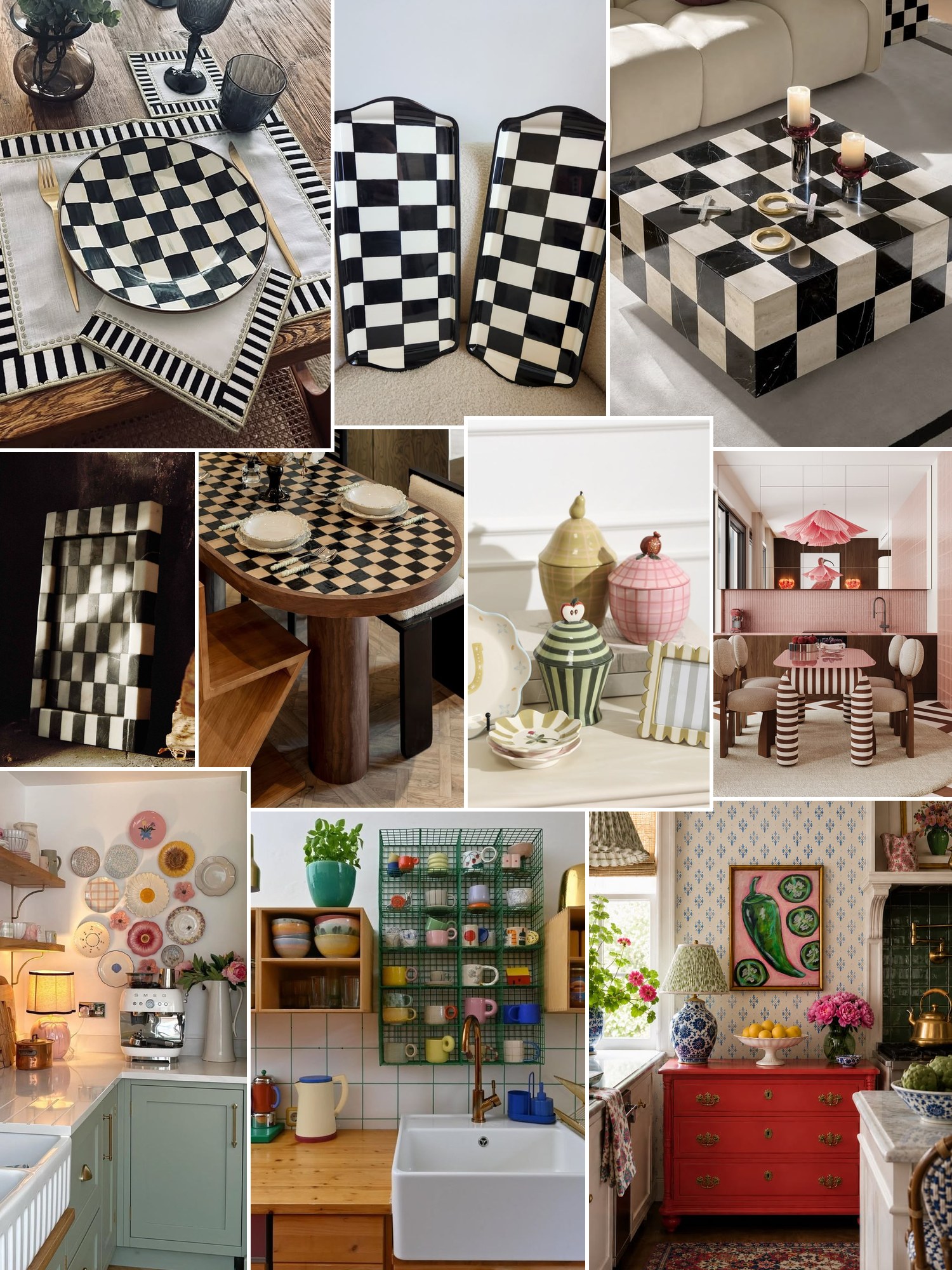
Black and white check tabletop

Gingham Black Dinner Plates, Set of 4
Lenox
$49.95

Vintage-Like Black Buffalo Check Melamine Bowls, Set of 6
Abode Homewares
$60.8

Greta Stoneware Mug
Anthropologie
$16

Greta Stoneware Dessert Plate
Anthropologie
$16

Black & White Mug and Spoon Set
Spode
$19.54

Checkers Tablecloth, 52 x 52 Inch
Design Imports
$32.45

6-Piece Black Check Heavyweight Dishtowel and Dishcloth Set
Gracie Oaks
$15.99

Annie Buffalo Check Tea Towel
VHC Brands
$19.95
Check and stripe pumpkins for the mantel
Pumpkins are where the original gets playful: hand-painted checks, a glossy finish and a gold leaf stem. That last detail does most of the work, and it is the one to check first on any alternative. A good stem is a clean gold curl, not a flat yellow blob.
The Ebern Designs hand-painted resin pumpkin has black-and-white stripes and a gold curled stem with leaves, which puts it nearest in spirit. The August Grove lidded candy box is a ceramic pumpkin with bold vertical stripes and a gold stem, so it works on a coffee table with candy inside. The Cosmos Gifts salt and pepper shakers are tiny ceramic pumpkins in black-and-white patterns, ideal for an October dinner.
For softness, I would mix in fabric. The Three Posts trio and The Holiday Aisle pair are plaid pumpkins with leaf accents and fabric stems, and the Birch Lane houndstooth one adds a second pattern, which is the mix-it-up idea the brand itself likes. The Blaine pillow in sage check is a pumpkin you can lean on, and the Crate and Barrel gingham pot holder makes a quiet black-and-cream check by the stove.
What I would skip: a pumpkin whose stripes bleed or whose stem looks like an afterthought. Pick one hard, glossy one for the focal point and let the fabric ones fill in around it.

Set of 3 Fabric Black and White Plaid Pumpkins With Leaves
Three Posts
$39.99

Fabric Plaid Pumpkin Decor, Set of 2
The Holiday Aisle
$46.99

Blaine Check Pumpkin Shaped Pillow
Pottery Barn
$34.99

Adel Patterned Pumpkin
Birch Lane
$43

Hand Painted Black White Resin Pumpkin Decor
Ebern Designs
$36.99

Black And White Pumpkin Candy Box
August Grove
$48.99

Black & White Pumpkin Salt and Pepper Shakers
Cosmos Gifts
$18.99

Fall Gingham Organic Cotton Pot Holder
Crate & Barrel
$14.95
Painted planters with a checkerboard glaze
The original also paints its pots: a check-painted steel garden pot, rimmed in bronzed stainless steel, meant for primroses, pansies and petunias. For a look-alike, what matters is the hand-painted feel and a clean rim, and the pattern scale. Big squares read bold, tiny ones read busy.
The Caitlin pot has a large terracotta-and-cream checkerboard glaze and is the most graphic of the group. The Ebern Designs stoneware planters in black and white come with matching saucers, which saves a floor from water rings. The small lilac-and-white checkerboard pot from the same label is a lovely desk plant holder. If you want painted but not checked, the Ophelia and Co. coral stripe pots have scalloped rims, and the Terrain Italian painted cylinder in blue and white carries the hand-decorated idea with florals.
Check the drainage before anything else. Painted ceramic with no hole is a cachepot, so plan on a nursery pot inside. Turn the planter over and look at how the glaze meets the base, since an unglazed foot is fine but a chipped one is not.
What I would skip: a pattern pot with a tiny opening for a plant that wants room. For October, a mum or a small herb in the checkerboard, with the Red Barrel Studio daisy pair on a windowsill, and you are done.

Caitlin Checkerboard Ceramic Pot Planter
AllModern
$33

Jamesjoseph Stoneware Ceramic Planters With Saucers
Ebern Designs
$33.99

Checkerboard Pot, 5 x 5 Inch
Ebern Designs
$29.99

Ceramic Outdoor Planters, Striped Flower Pots With Scalloped Edge
Ophelia & Co.
$37.99

Pottery and Cement Planters With Decorative Design
Red Barrel Studio
$51.99

Italian Painted Floral Cylinder Planter
Terrain
$68

Rose Vine Terracotta Bowl Planter
Terrain
$39.95

Indigo Floral Low Jar Planter
Anthropologie
$32
Check trays, boards and platters
Serving pieces are where a check earns its place, because a pattern behind food is a frame. The original sells the idea in glossy enamel, so what I look for in an alternative is a high-contrast surface and a border that stays tidy.
The Benjara pair of trays in black-and-white checkered diamonds and chevrons is the boldest, and the Orren Ellis nesting set has a checkered inlay border for a coffee table or ottoman. The Dakota Fields stoneware platter is painted in a colorful check, oval and wide enough for a roast. For something softer, the Gracie Oaks pair has a hand-painted look gingham in soft green, and the Ruby Clay trays are glossy ceramic in pastel gingham for rings and keys.
Boards need a different test. The Latitude Run marble-and-wood board has an inlaid check, and the SpiritHome checkered board works for cheese; run a thumb across an inlay and feel for ridges where the squares meet. The round marble trinket dish is a small gray-and-white checker that suits a bedside table.
What I would skip: an inlay board for anything wet or cut on, since a serving board is for resting food, not chopping. I would keep it for cheese and crackers on a fall table.

Decorative Coffee Table Tray With Checkered Inlay, Set of 3
Orren Ellis
$159.99

Set of 2 Serving Trays, Black and White Checkered and Chevron Pattern
Benjara
$53.99

15-3/4 Inch Oval Stoneware Platter With Checkered Pattern
Dakota Fields
$37.99

2-Piece Gingham 15 Inch Tray
Gracie Oaks
$38.99

Kalalou Rectangle Checkered Serving Board in Marble and Wood
Latitude Run
$63.99

Adair Checkered Cutting Board
SpiritHome
$55.99

Gingham Tray
Ruby Clay
$35.5

Round Marble Checkered Trinket
Anthropologie
$44
Whimsical ceramic mugs and canisters
The founders came from ceramics, and Victoria's training in majolica and ceramic sculpture shows in the odd shapes. That sense of play is what I would look for in mugs and canisters: gold trim, a funny silhouette, a check that wobbles a little.
The Ten Strawberry Street Dapper Rabbit canister is a ceramic rabbit in a harlequin top hat with gold trim, which is as whimsical as it gets. Its Bella canister, printed with black bows and topped with a bow knob, is quieter. The Godinger drum mug is red, banded in black-and-white check with gold bands, a good one for the holidays that are about to start. The Grace's Tea Ware set of four has black-and-white dots and stripes with gilded rims.
For checks that bend, the Ophelia and Co. pink gingham mug has a wavy handle and holds 18 ounces, and the George Oliver mug wraps a wavy brown-and-cream check around a big white body. The Alana mug and sugar pot carry a painted horse and a zigzag handle, no check at all, in the same hand-painted spirit.
Check the handle with your thumb, because a chunky mug can be heavy and a thin handle gets awkward. Gilded rims usually need hand washing, so look for that in the care line.
What I would skip: a canister set so matched it looks like a catalog, since the charm is in the one odd piece.

Toile Dots Stripes 12 Oz. Coffee Mug, Set of 4
Grace's Tea Ware
$34.99

Christmas Checkered Drum Mug
Godinger Silver Art Co
$17.99

10 Strawberry Street Dapper Rabbit Canister, Black & White
Ten Strawberry Street
$39.79

Bella Canister, Black Bow
Ten Strawberry Street
$28.99

18 Oz Artisan Checker Ceramic Mug
Ophelia & Co.
$17.99

Brown Wavy Check Pattern Coffee Mug
George Oliver
$24.99

Alana Stoneware Mug
Anthropologie
$11.2

Alana Stoneware Horse Sugar Pot
Anthropologie
$12.6
How I would put the look together
I would start with one hero: a glossy striped pumpkin or the rabbit canister, set where the light hits. Then add two quieter checks, a mug or a tray, and leave the rest of the shelf plain.
Then the table. The black-and-white plates and a check tablecloth go down once, not everywhere, which is the way the founders liked their check, as an accent.
Back to Aurora, then. A checkerboard that began with chess boards and an abbey floor now lives on a pumpkin by the stove. I find that rather lovely. If you want to keep browsing, I also put together Anthropologie Dupe.