NuFACE started in a San Diego garage in 2005 and is still the name most people say when they mean a microcurrent device. Here is how I think about the devices, the gels and mists that go underneath, and the LED and ultrasound tools that make a good second act.

NuFACE from Garage Start-Up to the Device Everyone Asks About
NuFACE began in 2005 in a garage in San Diego, California, which still sounds improbable when you hold one of the sleek handheld devices today. NuFACE says that in 2007 it became the first beauty device to receive FDA clearance. By 2009 it was building its reputation in luxury spas. I find that history reassuring. The whole business was built on people trying the thing in person, feeling it on their face, and coming back.
Microcurrent is a very low-level electrical current, meant to be felt as a faint tingle, if at all. The devices glide across the face with a conductive gel, and the habit matters more than any single session: a few minutes on most days, slow strokes, and a mirror.
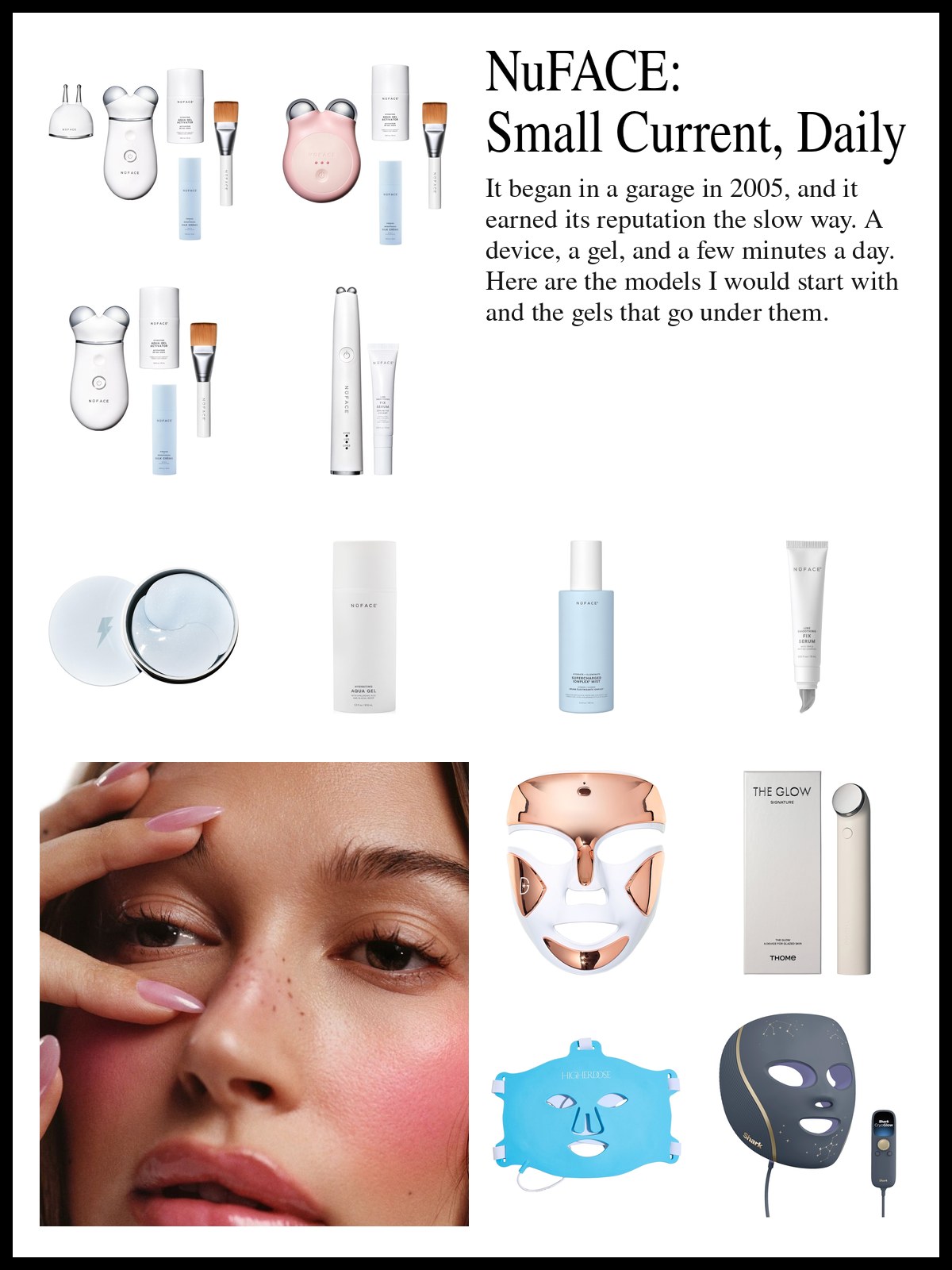
For the grid, the NUFACE TRINITY+ Starter Kit is the one I would begin with. It is the core device, built to lift and tighten, and it is the version that comes with the basics. The TRINITY+ Microcurrent + Targeted Toning bundle adds targeted toning to the core device, which makes sense if you already know you will use it. The NUFACE MINI+ Starter Kit is the small one, easy to pack, and the natural choice for travel or a first try. The NUFACE FIX MicroWand is the slim, pen-like tool, made for smaller, more precise areas than the larger devices reach.
Read the guidance that comes with yours, especially if you have a pacemaker or are pregnant. Ask a doctor first.


The gels and mists that make it work
A microcurrent device is only half the plan, because it needs a wet, slippery layer on skin to work properly. The gels and mists in this group are what I think of as the other half of the device, and I would not run one on dry skin. Think of it as the road the current travels on.
The Hydrating Aqua Gel is the classic: a clear, light layer that you spread over clean skin before you start. It is the one to buy first, because a device without it is a bit of a waste. The FIX Serum is the companion for the wand of the same name, so it makes the most sense if you own that one, and I would check the label for how to use it. The Supercharged IonPlex Facial Mist is a quick spray for topping up when skin dries out mid-session, and it is good to keep on a desk.
The IonPlex Hydra-Gel Power Patches are the surprise for me. They are hydrogel patches for the under-eye area that you wear for about five minutes, so they suit a person who would rather sit with a patch while answering email than stand at the mirror. You can use them on their own or alongside a device.
A few tips. Cleanse first and remove all makeup. Use enough gel that the device slides with no drag. Then finish with your usual moisturizer, since gel is not a moisturizer. I like to do it at night, when there is no rush and no makeup waiting, and I keep the mist chilled in summer because the cool spray feels wonderful. And if a session ever leaves your skin sore or blotchy, stop and rest it for a few days.


Other tools for the second act
One device is plenty for most people, but there is a wider world of light and sound tools, and some of them pair nicely with a gentler microcurrent habit. I think of them as different jobs rather than competing ones.
Dr. Dennis Gross's SpectraLite FaceWare Pro is a three-minute LED mask that you wear on the face, and its LipWare Pro is a small LED device made for the lips. Omnilux's Contour Face is a red and near-infrared LED mask, and HigherDOSE's Red Light Face Mask is another wearable option. Shark's CryoGlow is a mask that combines cooling with LED light for the eye area, which I would pick if puffiness in the morning is my complaint. Thome's The Glow is an ultrasound device, a different technology again, made for firming and radiance.
The pleasure of an LED mask is that you can lie back and let it run. It asks nothing of you but time, and I put a podcast on and forget about it. For a first try, Dr. Dennis Gross's version runs just three minutes, so it is easy to fit into a week.
What I would skip: using a microcurrent device, an ultrasound device and an LED mask all on the same evening, especially at the start. Skin gets sensitive if you overdo it. Choose one tool for two weeks, watch how skin feels, then add a second only if you want it. Wear the eye protection that comes with a light mask, and read the guidance if you take medication that makes skin sensitive to light.
Other microcurrent and LED tools

DRx SpectraLite FaceWare Pro 3-Minute LED Device
Dr. Dennis Gross
$455

The Glow SIGNATURE Professional-Grade Ultrasound Skincare Device for Firming, Radiance & Anti-Aging
Thome
$299

Red Light Face Mask for Fine Lines & Glowing Skin
HigherDOSE
$349

CryoGlow Under-Eye Cooling + LED Anti-Aging Red Light & Skin Clearing Mask
Shark
$299

Contour Face Antiaging Red and Near Infrared LED Mask
Omnilux
$395

DRx SpectraLite LipWare Pro LED Device
Dr. Dennis Gross
$148

TheraFace Mask Glo, Clinically Proven LED Skincare Mask
Therabody
$379.99

LED Light Therapy Mask
Mario Badescu
$150
How to keep it going
The routine that works is the one you do. I keep a device on the bathroom counter with the gel beside it, so the whole thing takes about five minutes, three or four times a week.
Photograph your face in the same light once a month, since you will not notice slow change in the mirror. Judge by how skin feels and looks over a couple of months, not after a single go. If you are unsure whether a device is right for you, or you have a skin condition, talk with your doctor or dermatologist before starting. Nothing here replaces that conversation, and the best results come from being consistent, gentle and a little bit bored. Wash the device head as the instructions say, let it dry, and put it back in its case, because a tool that stays clean is a tool you will keep using.
For a different kind of at-home facial, I looked at the Shark FacialPro Glow, which works with water instead of current.