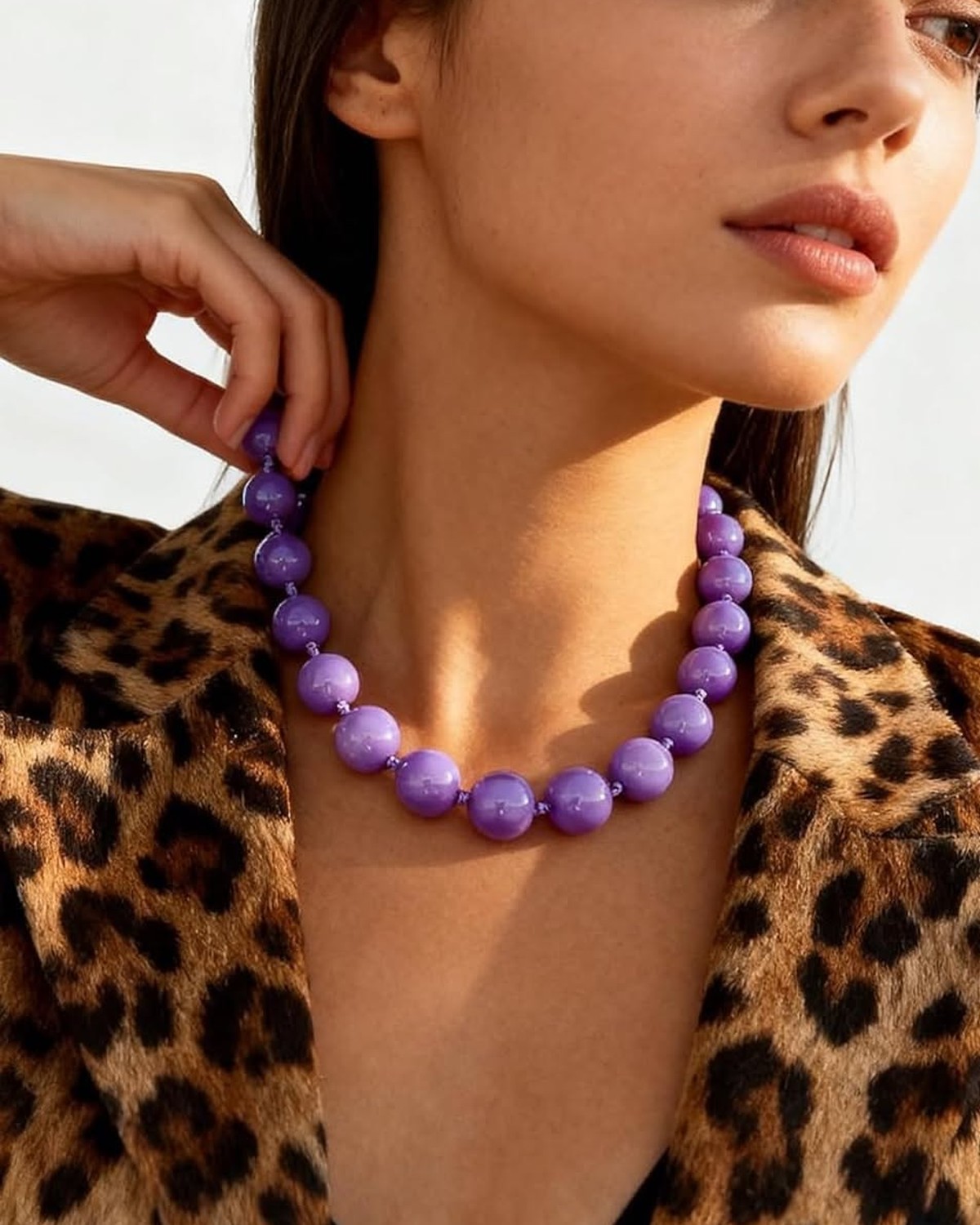
This purple necklace edit compares pendants, strands, collars, and longer lengths so you can choose how much color you want near your face. I would decide first whether the necklace should lead the outfit or quietly repeat a shade already in it.
purple necklace: A 1915 Amethyst With a Botanical Streak
A 1915 Amethyst With a Botanical Streak
Purple With a Point of View
At the Smithsonian’s National Museum of Natural History, a necklace designed by Louis Comfort Tiffany around 1915 centers on a 56-carat amethyst framed by vines, leaves, and grapes. It is a useful reminder that purple jewelry does not have to be a single bright stone on a chain. The color can carry a whole piece, or appear as one note in a more detailed design.
That is the choice I see in this purple necklace edit. The 2028 Floral Drop Pendant Necklace puts the color in a flower-shaped focal point, while the Worthington 17-inch strand spreads it around the neckline. Liz Claiborne’s 17-inch collar reads as a more compact band, and the a.n.a 22-inch strand gives the color a little more room to fall. I would choose by neckline first, then by how much purple I want visible against a top.
For a crewneck or a simple blouse, the 2028 pendant gives the eye one clear place to land. The Worthington strand and Liz Claiborne collar make more sense when the neckline is open and the rest of the outfit is quiet. The longer a.n.a strand could sit over a knit without feeling crowded. I would check the clasp and the listed length before deciding, especially if the necklace needs to clear a collar or sit above another chain. A small change in placement can make the same color feel either like the outfit’s subject or its punctuation.


Short Chains, Soft Color
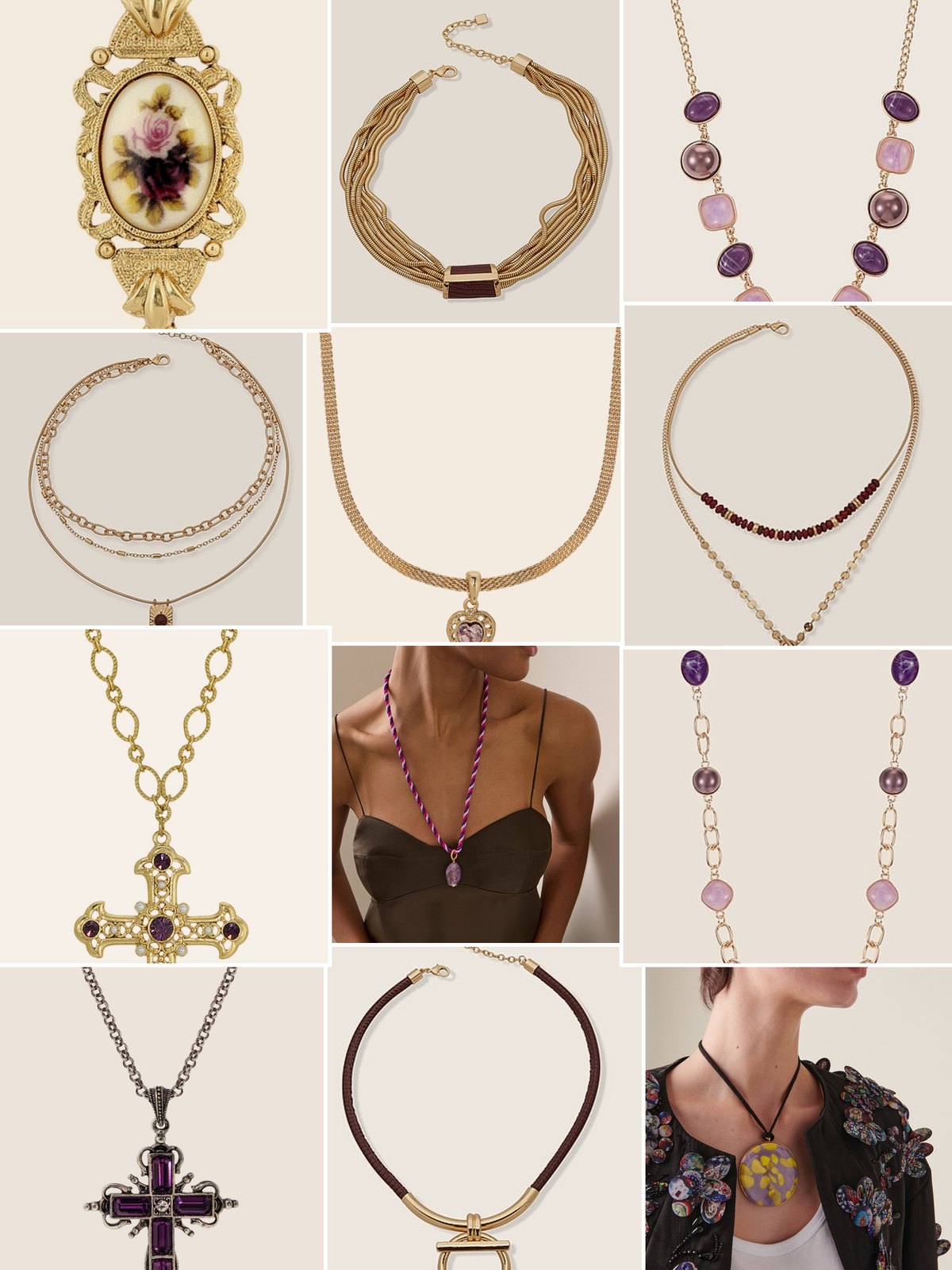
The second set makes the purple necklace idea more personal: a heart-shaped crystal mesh chain, two longer a.n.a strands, a cross pendant, and an amethyst design by Sylvia Toledano. I like that the 2028 Heart Crystal Mesh Chain gives the color texture rather than relying on one large drop. The a.n.a 23-inch strand is a quieter, longer line, while the 14K gold-dipped amethyst cross from Symbols Of Faith brings a recognizable pendant shape. Sylvia Toledano’s Amethyst Necklace keeps the stone itself at the center of the decision.
I would keep the styling simple around the crystal mesh chain, perhaps with a fine-knit crewneck or an open collar, so its surface has a little space. The longer strand can work over a smooth shirt, where its length does not get lost in a busy print. With the cross, I would let the pendant sit alone rather than stack it with another charm.
The fitting check is length and movement: hold the necklace against the neckline you plan to wear, then see whether its focal point lands where you want when you sit and stand. What I would skip is stacking several purple pieces just because their shades are close. A single clear pendant or one unbroken strand makes the color easier to read.


Long Lines and Enamel
The third set moves between a long Liz Claiborne strand, a purple crystal cross from Symbols Of Faith, a Worthington pendant, and an enamel design by Dries Van Noten. That variety gives this purple necklace edit a few different levels of formality without changing its central color. The 34-inch Liz Claiborne strand is the longest line here, so it can fall over a plain sweater or tunic. Symbols Of Faith keeps the cross shape in the mix, while the Worthington pendant offers a simpler center point. The Dries Van Noten Enamel Pendant Necklace shifts attention from a stone to a colored surface.
I would pick the long strand when the neckline is high and the fabric is smooth enough to let it lie flat. For a patterned blouse, a single pendant is easier to place, and enamel can give a cleaner, more graphic note than a cluster of stones. Before choosing, check the necklace length against the garment and look at the closure: a longer piece should hang without catching on the hem or folding into the neckline.
What I would skip is a busy collar, a printed scarf, and multiple pendants all competing at once. The strongest version is usually one long line or one distinct focal point, not every purple detail together.


Choose the Color’s Role
I would start with the neckline, then choose the scale: a compact collar for an open neck, a pendant when the outfit needs a center, or a longer strand over a clean knit. This purple necklace selection works best when the shade has one clear job.
The 1915 Tiffany design at the Smithsonian is the reminder I would keep in mind: a purple stone can feel botanical, graphic, or quietly simple depending on what frames it. Let the piece do one thing well, and leave it room to be seen.