Relaxed tailoring has been building since American Gigolo put Armani's soft suits on screen in 1980. I look at the suit jackets that carry that looser cut, with GQ and Esquire both saying it is easing.
Relaxed Tailoring: How Suit Jackets Are Getting Easier Again
Soft Jackets, Double-Breasted and Otherwise
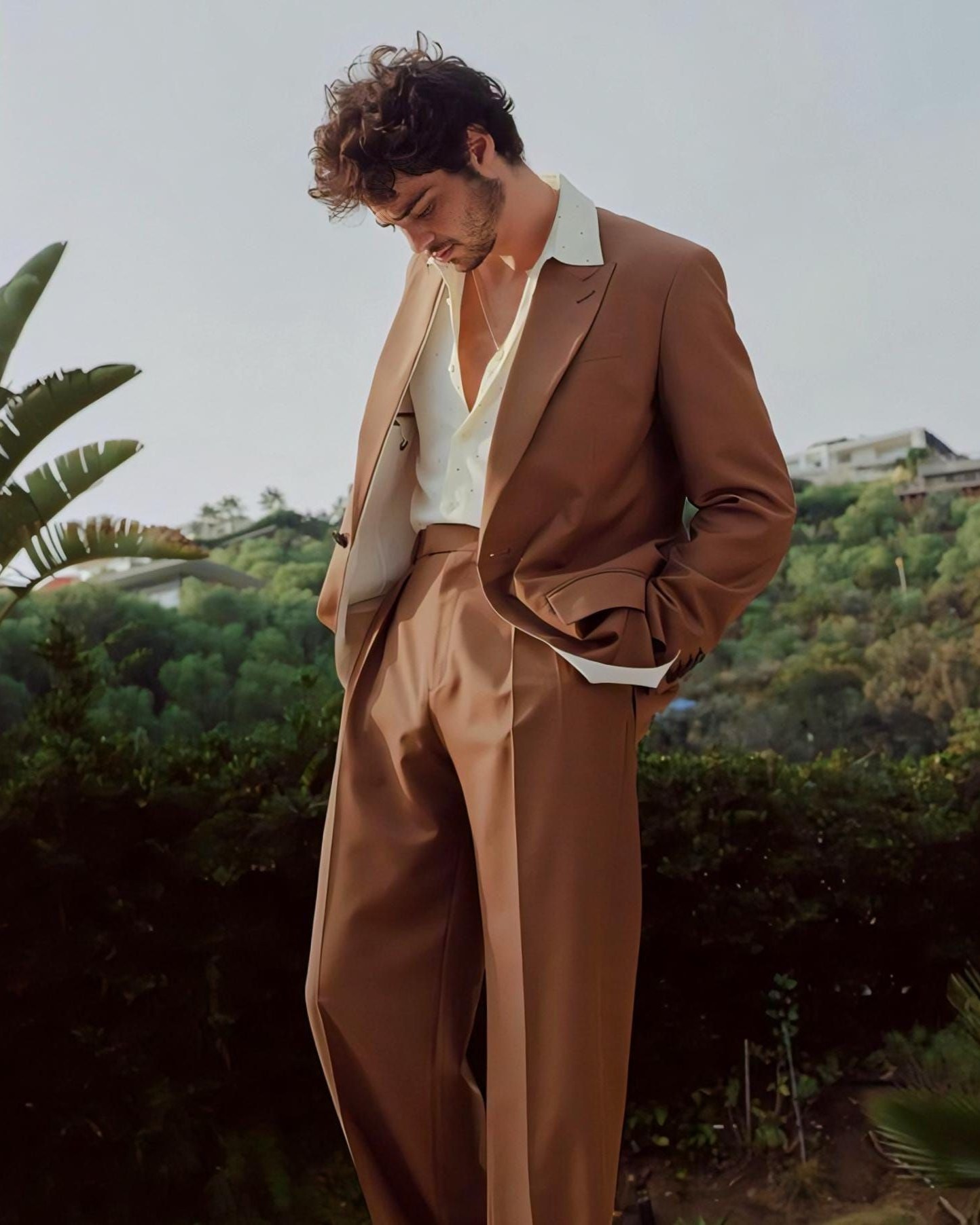
In Paul Schrader's American Gigolo, released in 1980, Richard Gere plays Julian Kay in suits by Giorgio Armani, soft and drapey, in cream, tan, taupe and anthracite. GQ has argued that the film helped establish Armani in Hollywood, and the lesson was that a suit could hang from the shoulder instead of standing up from it. Forty-some years later we are back there. GQ's best suits of 2026 guide says tailoring is returning, with the fitted silhouettes of the hashtag menswear era giving way to generous cuts and the soft, unpadded shoulders of southern Italy. Esquire told readers on 17 September to treat the suit as separates and look for softer construction, an easier cut and roomier trousers. Let me start with the jackets. NN.07, whose name stands for No Nationality, was founded by friends in Copenhagen in 2007, and its Jordin double-breasted in navy wool-blend twill is the one I would wear unbuttoned. Barena's brown corduroy blazer is the one I would wear on a Saturday. The Paul Smith linen suit jacket in blue is a spring idea, so I would skip it for an October dinner. Wear any of these with a plain white tee and decent trousers, and nobody will mention the lapels.
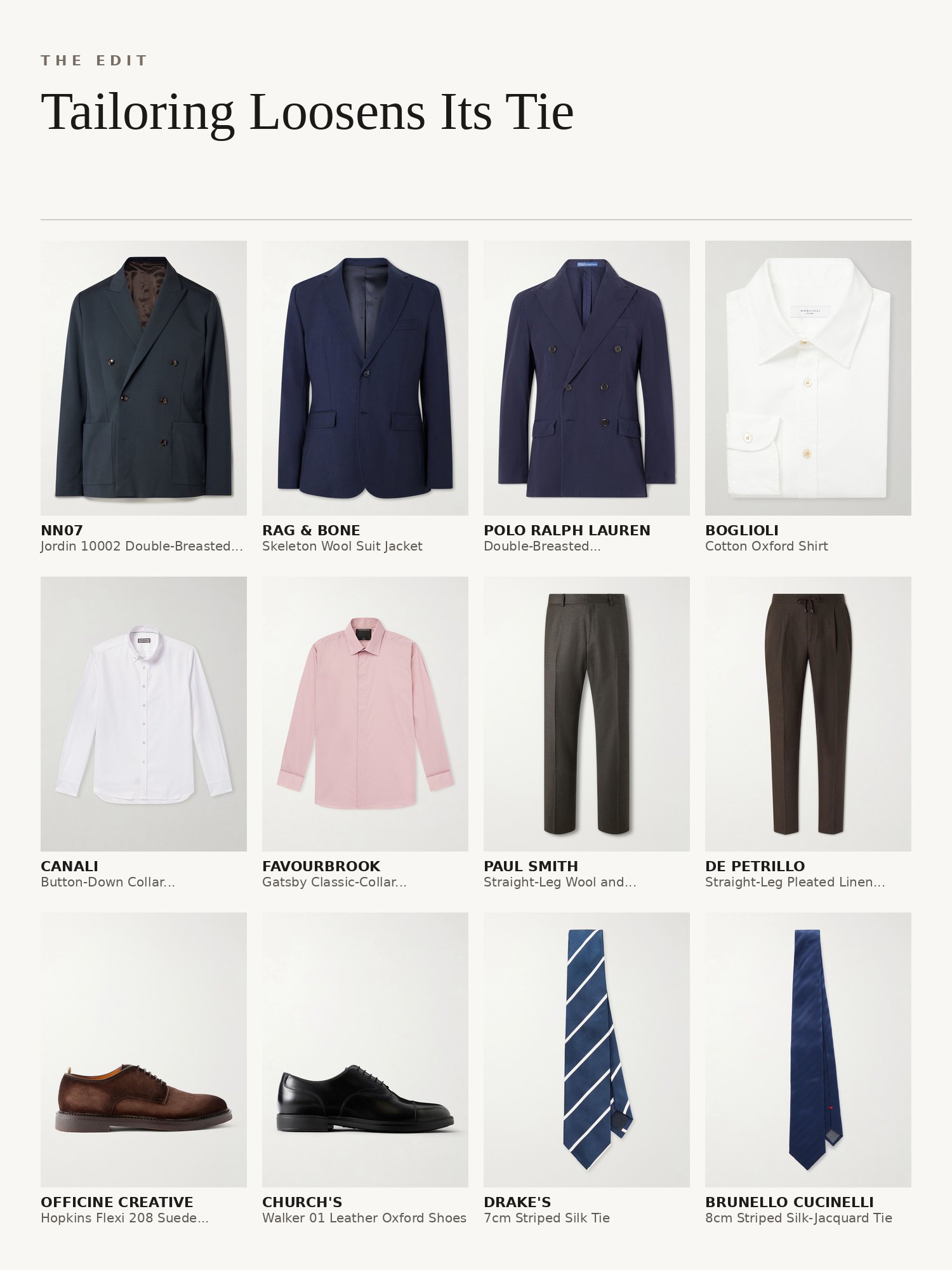

Jordin 10002 Double-Breasted Wool-Blend Twill Suit Jacket
NN07
$665

Skeleton Wool Suit Jacket
Rag & Bone
$700

Double-Breasted Cotton-Canvas Suit Jacket
Polo Ralph Lauren
$500

Wool and Linen-Blend Suit Jacket
Mr P.
$715

Cotton-Blend Corduroy Blazer
Barena
$870

Linen Suit Jacket
Paul Smith
$995

Wool and Cashmere-Blend Flannel Suit Jacket
Sunspel
$820

Jarod Double-Breasted Wool-Twill Suit Jacket
Hartford
$625

Nehru Cotton-Velvet Blazer
Favourbrook
$895

MHL. Minimal Cotton-Drill Blazer
Margaret Howell
$600

Somesh Cotton Suit Jacket
Kardo
$275

Shinji Virgin Wool Blazer
A Kind Of Guise
$690
Shirts to Wear Without a Tie, Plus One Polo
Charvet is credited as the first shop dedicated to shirts, opened in Paris in 1838 by Joseph-Christophe Charvet, and it has been at 28 Place Vendôme since 1982. Its white classic-collar herringbone is the dressy end of this grid, and I like it open at the neck with the jacket unbuttoned. Brioni, founded in Rome in 1945 by Nazareno Fonticoli and Gaetano Savini, makes the white cutaway here. Zegna's Trofeo cutaway in white poplin is the same color from a house that began as a wool mill in Trivero in 1910. For an easier shirt, the Mr P. blue striped seersucker with a button-down collar sits well under an unstructured jacket, and so does the Paul Smith seersucker in blue. TOM FORD's white piqué is the sharpest of the group. My pairing rule is simple: if the jacket is soft, let the shirt collar be firm, so the outfit has one crisp edge. What I would skip is the Polo Ralph Lauren striped navy polo under the double-breasted jackets above, because a knit collar and open placket flatten that big lapel. The polo is better on its own with the trousers below.

Cotton Oxford Shirt
Boglioli
$500

Button-Down Collar Cotton-Poplin Shirt
Canali
$425

Gatsby Classic-Collar Cotton-Poplin Shirt
Favourbrook
$170

Trofeo Cutaway-Collar Cotton-Poplin Shirt
Zegna
$775

Classic-Collar Cotton-Herringbone Shirt
Charvet
$750

Cutaway-Collar Cotton Shirt
Brioni
$675

Classic-Collar Cotton-Piqué Shirt
TOM FORD
$970

Button-Down Collar Striped Cotton-Seersucker Shirt
Mr P.
$240

Lyocell, Linen and Cotton-Blend Shirt
FRAME
$300

Striped Cotton-Seersucker Shirt
Paul Smith
$360

Classic-Collar Cotton-Chambray Shirt
Dunhill
$595

Logo-Embroidered Striped Cotton Polo Shirt
Polo Ralph Lauren
$180
Suit Trousers in Wool, Linen and Corduroy
Esquire's advice about roomier trousers is the part I would take first, since the trousers change the shape of an outfit more than the jacket does. Caruso was founded in 1958 by the Neapolitan tailor Raffaele Caruso, who brought that tradition to Soragna near Parma, and its blue pinstripe in wool and cashmere is the serious pair here. Barena's navy pleated virgin wool is the pair I would actually wear on repeat. The brand draws on workwear from the Venetian Lagoon and says its clothes are Made in Venice. De Petrillo's pleated linen in brown comes from a Neapolitan house named for the small island over the Bay of Naples. For corduroy, Polo Ralph Lauren's Chester in green is tapered, and Officine Générale's beige pair comes from a Paris label known for perfect-fit trousers. NN.07 earned a reputation for unconventional colors according to GQ, and the Justin wide-leg pleated linen in yellow is exactly that. Try a pair with a navy knit and the soft jacket from above. What I would skip is that yellow pair for a conservative office, where it will be all anyone sees.

Straight-Leg Wool and Cashmere-Blend Fresco Suit Trousers
Paul Smith
$525

Straight-Leg Pleated Linen Suit Trousers
De Petrillo
$495

Justin 1454 Wide-Leg Pleated Linen Suit Trousers
NN07
$375

Pinstripe Wool and Cashmere-Blend Suit Trousers
Caruso
$580

Straight-Leg Wool Suit Trousers
Rag & Bone
$400

Games Straight-leg Pinstriped Cotton and Linen-Blend Suit Trousers
Drake's
$595

Chester Tapered Cotton-Blend Corduroy Suit Trousers
Polo Ralph Lauren
$200

Straight-Leg Pleated Virgin Wool Suit Trousers
Barena
$510

Straight-Leg Linen Suit Trousers
Canali
$550

Straight-Leg Linen and Wool-Blend Suit Trousers
Mr P.
$355

Mid-rise Straight-Leg Wool-Twill Suit Trousers
Lardini
$765

Morton Straight-Leg Pleated Cotton and Linen-Blend Trousers
Oliver Spencer
$375

Straight-Leg Stretch Wool-Blend Flannel Trousers
Sunspel
$445

Straight-leg Wool and Cashmere-Blend Suit Trousers
Dunhill
$845

Pleated Straight-Leg Merino Wool Suit Trousers
ATON
$605

Straight-Leg Cotton-Corduroy Trousers
Officine Générale
$435
Derbies, Loafers and Brogues
Loosened tailoring wants shoes with a bit of give. Officine Creative, founded in 1968 by Nazzareno Di Rosa in the shoemaking town of Montegranaro, puts each pair through a process of over 100 steps designed to look authentically worn, so the Hopkins Flexi 208 in brown suede already looks broken in. MORJAS started in Stockholm in 2017, and according to Mr Porter each pair takes over eight weeks and 128 steps. The Split Toe derby in full-grain brown leather is the one I would pair with wide trousers. Church's Walker 01 in black leather is the single oxford here, and it is the one to wear if the room turns out dressier than you planned. Thomas Church opened his first factory in Northampton in 1873. For something more casual, the Mr P. split-toe suede penny loafer in brown is quietly good, and the Paul Smith Jason suede derby in tan brings some color. A practical test is to walk up a flight of stairs in them before you buy. What I would skip is the Mr P. beige suede brogue in wet weather, because pale suede is a dry-day decision.

Hopkins Flexi 208 Suede Derby Shoes
Officine Creative
$820

Murano Leather Loafers
Paul Smith
$595

Walker 01 Leather Oxford Shoes
Church's
$850

Split-Toe Suede Penny Loafers
Mr P.
$425

The Split Toe Full-Grain Leather Derby Shoes
MORJAS
$420

Bariton Flexi 001 Leather Derby Shoes
Officine Creative
$880

Jason Suede Derby Shoes
Paul Smith
$495

Suede Brogues
Mr P.
$525
Ties, Belts and the Small Things That Finish It
A tie is optional now, which is exactly why a good one matters. Drake's makes its ties by hand at its Haberdasher Street factory in London, and the navy striped silk at seven centimeters is the one I would start with. Brunello Cucinelli began in 1978 with colored cashmere knitwear and bought a ruined castle in Solomeo in 1985 as its headquarters, and the navy striped silk-jacquard tie wears that calm. TOM FORD's Prince of Wales check in navy is a handsome pattern for a soft jacket. Thom Browne's grey wool tie is the textured pick, and the Canali polka dot is the cheerful one. Belts matter more than people admit. Anderson's has made belts only in Parma, and its stud-embellished leather belt is a loud one. George Cleverley's black belt, from the Mayfair shoemaker that opened on Cork Street in 1958, is the plain answer. Match belt to shoe, and keep the Dunhill floral pocket square for a day without a tie. What I would skip is the Montblanc silver cufflinks unless your shirt has double cuffs, since they only work with a shirt made to take them.

7cm Striped Silk Tie
Drake's
$275

8cm Striped Silk-Jacquard Tie
Brunello Cucinelli
$390

7cm Prince of Wales Checked Silk-Jacquard Tie
TOM FORD
$390

Floral-Jacquard Silk Pocket Square
Dunhill
$275

Rayures 7cm Striped Silk Tie
SAINT LAURENT
$370

8cm Silk and Wool-Blend Tie
Paul Smith
$175

Striped 8cm Wool Neck Tie
Thom Browne
$290

3cm Stud-Embellished Leather Belt
Anderson's
$235

Ever 90030 3cm Leather Belt
NN07
$165

3.5cm Leather Belt
George Cleverley
$335

8cm Polka-Dot Silk-Twill Tie
Canali
$225

Silver Cufflinks
Montblanc
$360
Build the Suit Out of Separates
The point of all this is that a suit no longer has to arrive as a set. Armani figured that out in 1980, and the industry is catching up. Buy the jacket you will actually reach for first, and make it a soft one with a natural shoulder in navy or brown. Then add trousers in a different fabric, so the two never quite match, a corduroy or a pleated linen. Choose two shirts, one white and one blue, and a single pair of leather shoes you can walk in. Ties and belts come last. The idea is that each piece should be wearable alone, so the jacket works over a tee and the trousers work with a sweater. When you do put them together, they look like a suit, but they feel like clothes. That is the version of tailoring worth wearing in 2026, and I think it will outlast the current moment. If the room is formal, add the tie. If not, leave it on the table and keep the shirt open.
More Trousers, Shirts and Finishing Pieces
If a suit is really a set of separates, the trousers are where I would put the most thought, so this last shelf leans on them. The NN07 Kay pleated linen and wool-blend pair and the Mr P. James herringbone linen-blend are the ones I would try with a navy jacket, and the Paul Smith tapered cotton and linen-blend gives you a slimmer line. Canali has two shirts here, the camp-collar cotton and linen-blend for open-neck days and the cutaway-collar poplin for when you want a little more structure. Finish with the Common Projects leather derby shoes, the Brioni wool tie and the TOM FORD reversible leather belt. What I would skip: the Rag & Bone Skeleton jacket if you already own a soft navy one, since two of them will start to look like a uniform.

Kay 10027 Straight-Leg Pleated Linen and Wool-Blend Suit Trousers
NN07
$340

Slim-Fit Tapered Cotton and Linen-Blend Suit Trousers
Paul Smith
$455

James Tapered Herringbone Linen-Blend Suit Trousers
Mr P.
$325

Linen Delave Check Slim Suit Trousers
Mr P.
$325

Skeleton Wool and Linen-Blend Suit Jacket
Rag & Bone
$700

Camp-Collar Cotton and Linen-Blend Shirt
Canali
$675

Impeccabile Cutaway-Collar Cotton-Poplin Shirt
Canali
$425

Printed Wool Pocket Square
Zegna
$450

7cm Wool Tie
Brioni
$310

Straight-Leg Woven Trousers
Lardini
$705

Leather Derby Shoes
Common Projects
$760

4cm Reversible Leather Belt
TOM FORD
$850