This scarf dress edit covers scarf-print midis, tie necks, handkerchief hems, halters and silk squares. I would start with the print and then check the neckline.
Scarf Dress: How a Square of Parachute Silk Became a Print

A scarf dress starts with a square of silk
Dear Friends, in 1947 Vera Neumann and her husband George, working in New York, came across an enormous surplus of parachute silk left over from World War II. Vera adapted her hand-painted designs to that light, flowing fabric and made what became her most famous product, the Vera scarf. A wartime leftover became a square you could print anything on, and that is still the idea here: a painting you wear.
So what is the lesson for us. A scarf dress borrows the logic of the square, with mirrored panels, a border, a medallion in the middle, and it works because the print is composed, not scattered. (There is a longer story in the silk carré, which Hermès introduced in 1937, but that is for the last section.) Below are modern options for every mood.
Let me start with the midis. The MISA Sheila in the Majorelle scarf print has orange, green and cream foulard panels mirrored down the body, thin straps and an uneven scarf-point hem, and it is the one I would book a dinner around. The Zimmermann Aster is strapless pink paisley with a twisted bodice knot and a front leg slit, a party dress with a sense of humor. The Attico paisley midi runs a light blue bandana panel across a white body. For October sleeves, the Reiss Ellie is cream with rope and shell motifs and a neck tie bow.
The MISA Thara in sapphire satin carries a medallion print and the Reiss Samira is a navy and white block print with a tie belt. My tip: stand in front of a mirror and look at where the print lands at the waist and the hem. A good scarf print should frame you, not cut you in half.
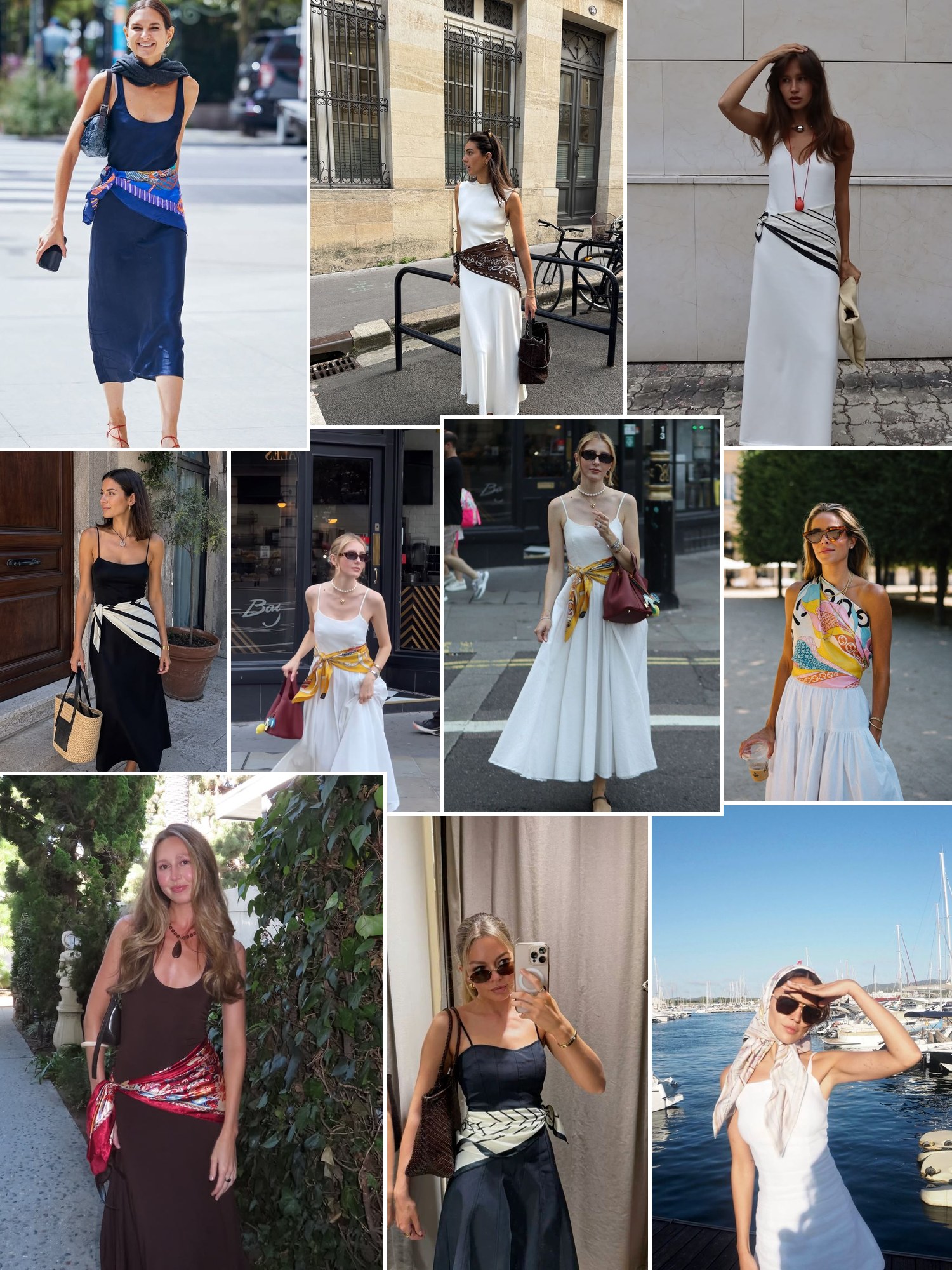
Scarf-print midi dresses

Sheila Midi Dress
MISA Los Angeles
$252

Aster Scarf Midi Dress
Zimmermann
$1,148

Paisley Midi Dress
The Attico
$525

Thara Midi Dress
MISA Los Angeles
$385

Ellie Placement Scarf Print Midi Dress
Reiss
$322

Rio Souvenir Mixed Scarf Print Satin Midi Dress
FARM Rio
$173.6

Samira Scarf Print Dress
Reiss
$229

Becky Dress
CAMI NYC
$403
Tie-neck and scarf-collar dresses
The easiest version to wear in October is the one where the scarf is attached. A tie at the neck gives you a finished outfit with no accessory to lose on the train.
The SRG Jude is a sleeveless storm-gray satin column with a draped scarf collar falling over one shoulder, quiet and very evening. The Elodie Lane in red dahlia has an attached tie-neck scarf that falls down the front, and the Line & Dot Gloss in ivory is a satin mini with a skinny scarf that ties at the neck. For cold days, the AEXAE wool funnel scarf dress is a sleeveless gray knit midi, so I would layer a fine long-sleeve under it. Rowen Rose makes a rust sheer mini with a bow-tie neck and trailing ends, and the Courtney Zheng aubergine silk-satin gown has a halter bow and a flared hem for a wedding or a gala.
Picture her at a long table in late autumn, the scarf ends moving a little each time she turns. That movement is the point. Before you buy, tie and untie the neck three times. Check that the knot sits flat, that the ends are long enough to re-tie without fraying, and that the fabric holds a bow rather than slipping out of it.
What I would skip: a tie-neck over a heavy necklace. The neck is the detail, so leave it alone, and add earrings at most.

Jude Dress
SRG
$120

Elodie Lane Scarf Dress
Elodie the Label
$148

Gloss Scarf Mini Dress
Line & Dot
$129

Wool Funnel Scarf Dress
AEXAE
$490

Bow Neck Mini Dress
Rowen Rose
$1,271

Silk Satin Tie Neck Gown
Courtney Zheng
$1,085

Rosmira Floral Scarf Neck Midi Dress
Cinq à Sept
$495

Crinkle Georgette Tie Neck Midi Dress
Lauren Ralph Lauren
$245
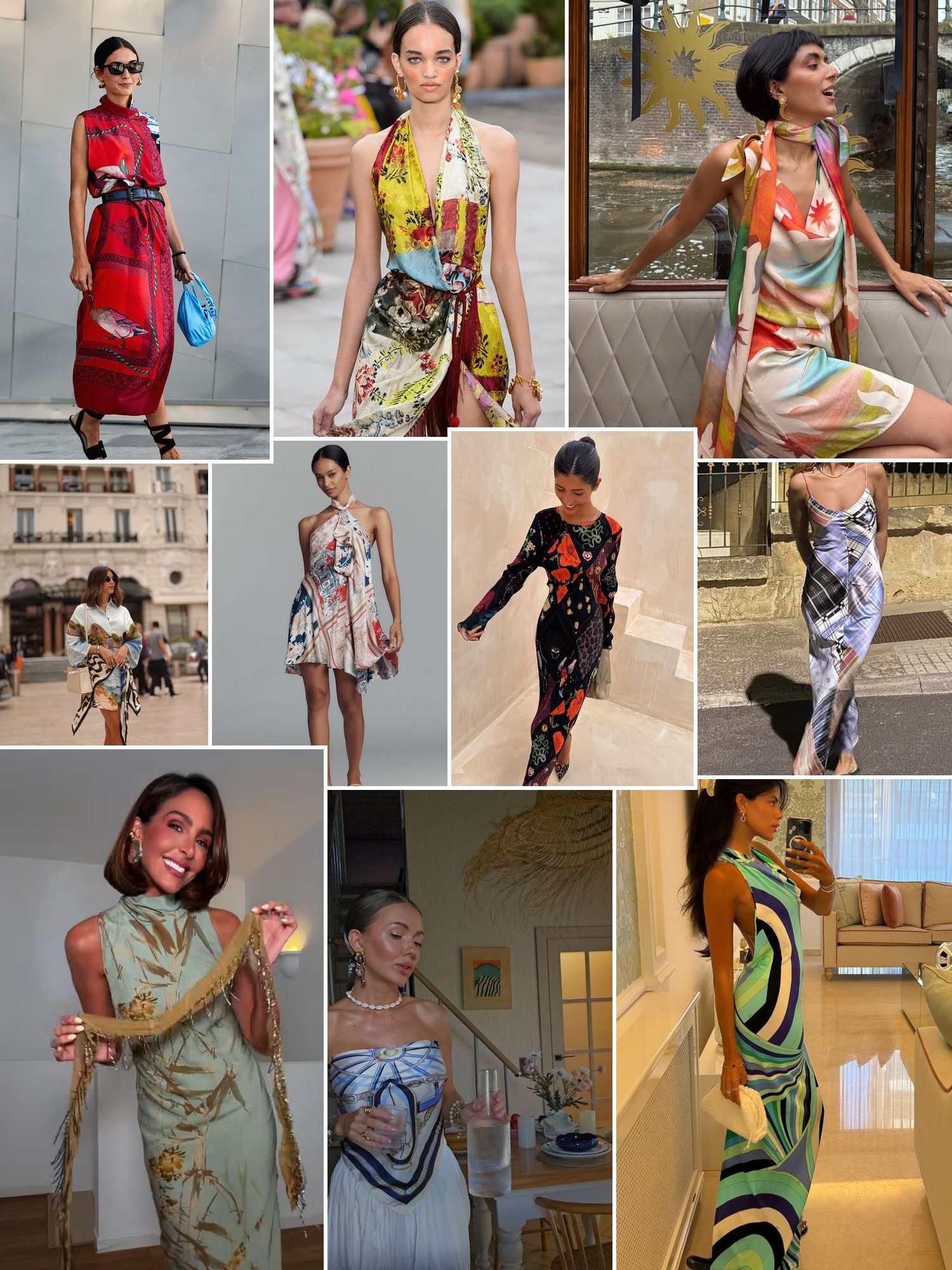
Handkerchief-hem dresses with a point
Fold a square scarf corner to corner and you have the handkerchief hem: points that fall at different lengths, so the skirt moves in layers. It is a shape borrowed straight from the scarf, and it suits anyone who likes a little swing.
The MISA Jansen is a halter mini in Aegean blue geometry with a pointed hem. The ET OCHS Ramona is pale yellow, a knit-top dress with a drop waist and a pointed skirt, and the Verandah handkerchief mini is a slip-style pale yellow with a floral scarf panel. For a longer line, the Kate Barton halterneck in light blue floats, while the Lauren Ralph Lauren paisley georgette in cream and blue ties at the waist. Then the darker ones: the Helmut Lang black silk slip with a sheer layered hem, the BOSS Doloh windowpane shirt dress with a belt, and the Amanda Uprichard Monterey, a blue pinstripe midi with a corset-seamed bodice and ruffled uneven hem.
In my fashion dreams it is a windy afternoon on a ferry deck, and the points of the hem lift one after another. Test it by walking up a stair in the fitting room: the longest point should clear your heel, and the shortest should not creep above where you are comfortable.
What I would skip: a handkerchief hem with a very full skirt underneath. Choose one source of movement and let it do the work.

Ramona Dress
ET OCHS
$245

Jansen Mini Dress
MISA Los Angeles
$270

Monterey Dress
Amanda Uprichard
$299

Handkerchief Mini Dress
Verandah
$336

Halterneck Handkerchief Dress
Kate Barton
$273

Paisley Georgette Handkerchief Hem Dress
Lauren Ralph Lauren
$195

Silk Handkerchief Hem Dress
Helmut Lang
$598

Doloh Handkerchief Hem Dress
BOSS
$249.5
Halter scarf dresses that tie at the neck
Zimmermann started in 1991 with Nicky selling dresses at the Paddington markets in Sydney, and the brand became known for bold original prints and intricate detailing. A halter is a good place to look for that kind of detail.
A good halter ties at the back of the neck like a scarf, and the best ones leave long ends. The Tiger Mist Indi is a leopard and pink floral mini with a ruffled hem, the SIR. Rioja is a blue striped maxi with a keyhole halter, and the ELLIATT Mira is a red mini with a long trailing scarf tail at the back. Hemant and Nandita make an orange, yellow and blue scarf-print halter with a fringed hem. The two Rococo Sand high-low dresses are the ones with a point: burgundy bandana print with a plunging neck, and yellow and pink retro print with a tie neck. Norma Kamali's convertible dress in snow white has straps that tie at the neck, and the Steve Madden Dalina is a white eyelet halter midi with a pointed hem. Kamali, for the record, made a Parachute collection in 1974 from actual silk parachutes, so the idea of a tie-up silk shape has a good pedigree.
Try it with a strong back in mind: raise your arms, turn, and see that the tie holds without pulling. A halter needs a snug band under the bust or at the waist, otherwise the neck takes all the weight.
What I would skip: a bandana-print halter with a statement necklace or a scarf in the hair. The dress is already the accessory.


Silk square scarves to wear with any dress
Emilio Pucci founded his brand in 1947 and opened his first boutique in Capri in 1950, and he became known as The Prince of Prints. A square is the simplest way to borrow that, since it needs no fitting at all.
In this edit the squares are Gucci's printed silk twill with a stirrup and ribbon print on cream, a deep blue and gold Saint Laurent paisley with a framed border, and the pale blue Pucci Iride with a zigzag border. Christopher Esber's has a bold painterly floral and Alémais has a bright scenic border. The Longchamp Eiffel Tower bandana has a blue frame and a caramel border, the Sandro is a navy and gold paisley bandana medallion, and the Ferragamo Felindra Gancini has leopard and Gancini motifs in olive and tan. Ferragamo developed its silk and accessories collection in 1971. The Hermès carré, first made in 1937, is most commonly a 90 cm square, so use that as your reference size.
My modern options: knot one at the neck of a plain slip, tie one to a bag handle, or fold a square diagonally and wear it as a belt over a shirt dress. The scarf then does what the dress prints do, only smaller. Check the edge stitching, the weight of the twill, and that the print is clear at the corners.
What I would skip: a busy square with a busy print dress. Let one carry the pattern and make the other a solid.


Start with the square, then wear the dress
I like that it all began with a leftover. Vera Neumann looked at parachute silk after the war and saw a canvas, and nearly eighty years later we are still wearing her idea.
If I were choosing, I would pick the print I would happily wear on a Tuesday, then the neckline, then the hem, and I would hold a square against the dress before deciding to wear them together. The print, the neck and the hem should each get a moment, and none of them should have to compete.
Picture a Tuesday in October, a plain coat, one knotted silk at the neck of a printed dress. That is the whole lesson, and it started with a parachute.
With love, and a knotted silk,






