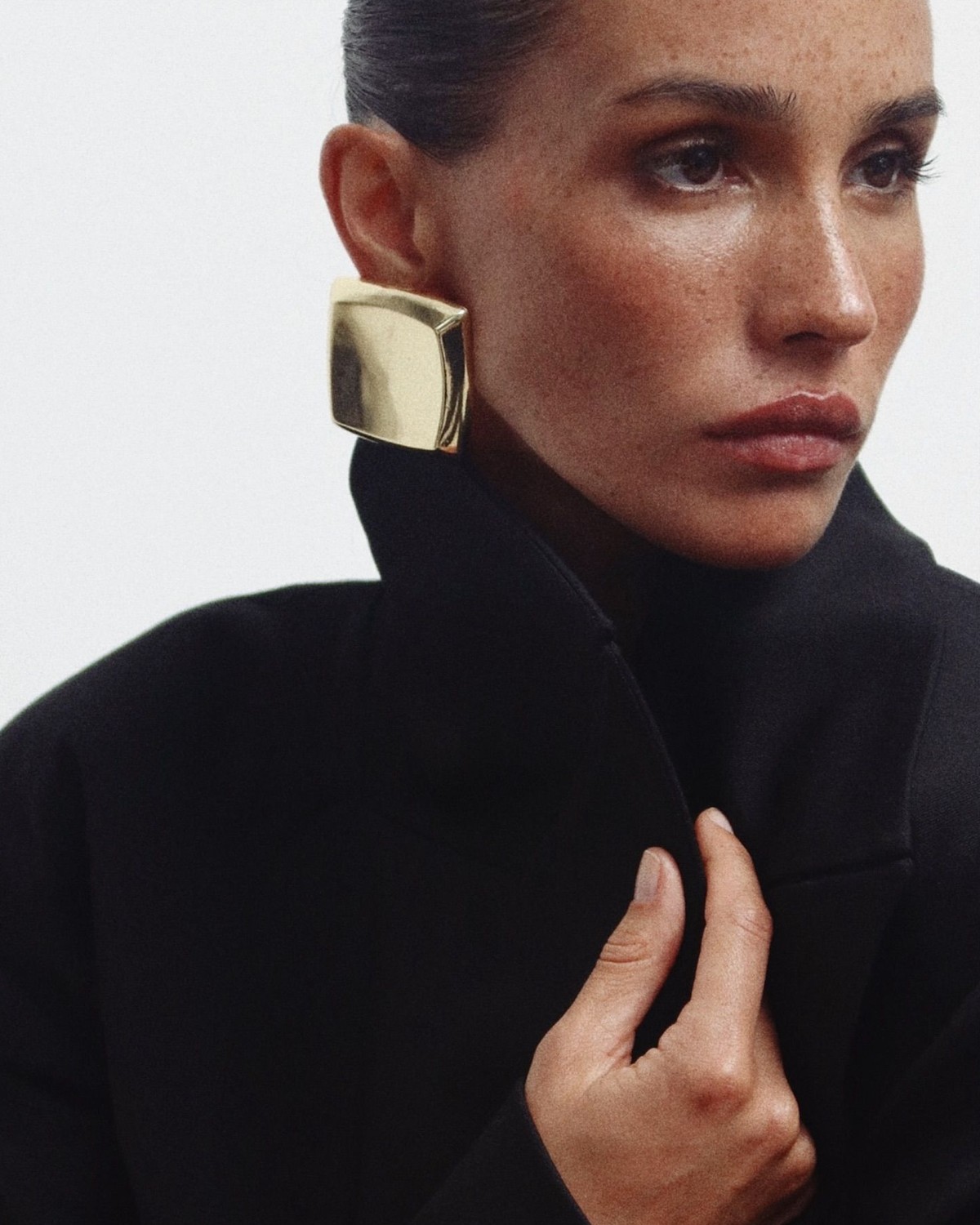
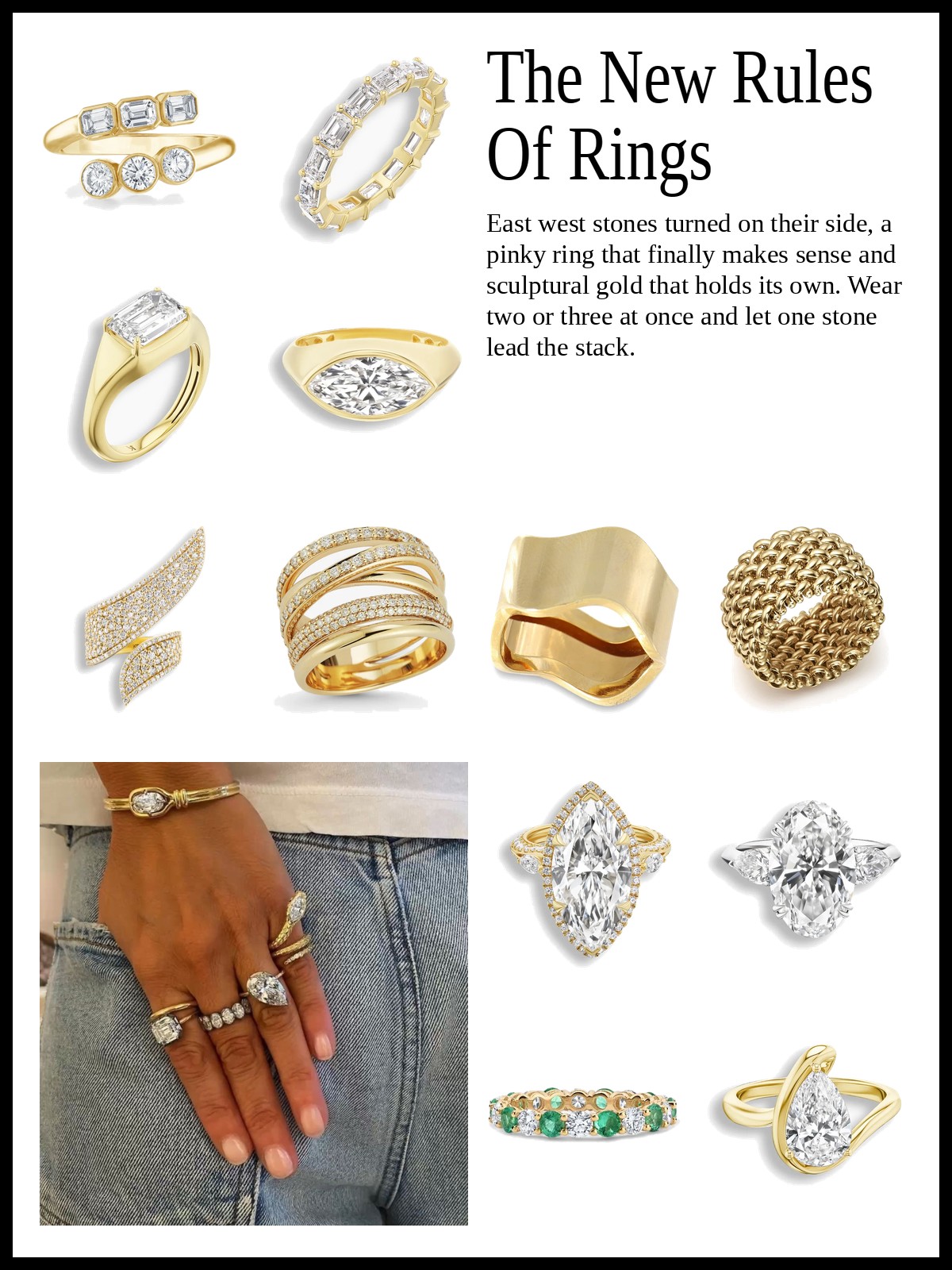
The new ways women are wearing rings: east-west settings, pinky rings, sculptural gold and statement stones in unexpected cuts from Anita Ko, KBH Jewels and Stephanie Gottlieb. Plus a shelf of pinky rings, signets and sculptural bands to wear on any finger.
The New Rules Of Rings
Rings Stopped Being Symbolic
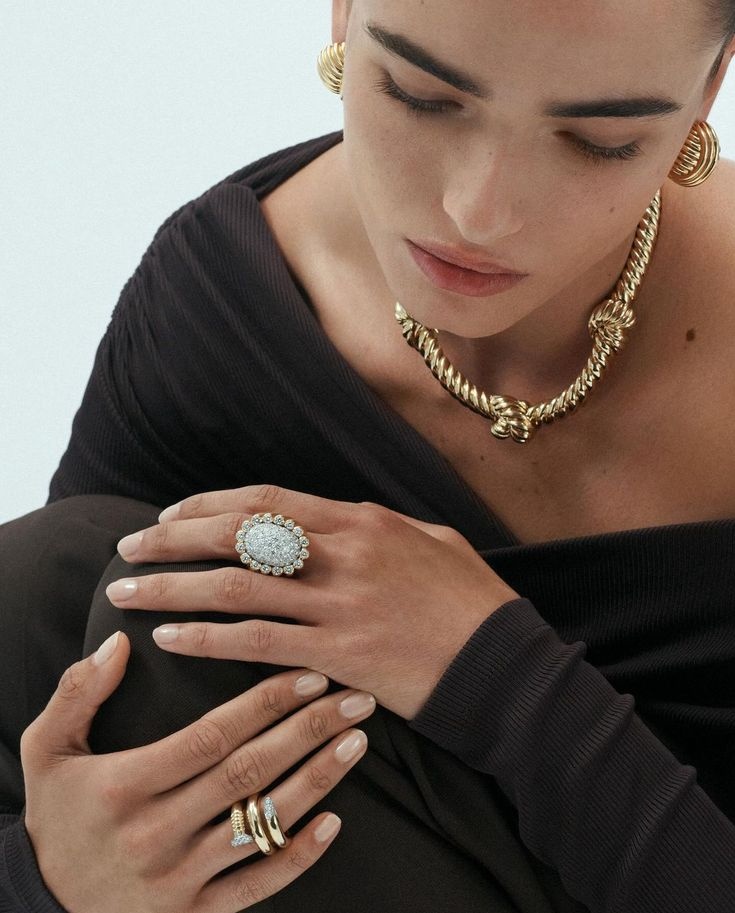
Something has shifted in how fine jewelry rings are designed and bought. For a long time the ring was the most loaded object in a jewelry box, tied to a specific finger and a specific meaning. That framework is loosening. The designs gaining ground now treat the ring as a sculptural object to be placed wherever it looks best on the hand.
This edit follows three of those directions. Stones set east to west across the finger instead of along it. Gold worked into domes, wraps and signets with no stone as the focus. And large stones cut in shapes that sit outside the traditional hierarchy. The pieces come from Anita Ko, KBH Jewels, Stephanie Gottlieb and a few other fine jewelers. Several are built on settings that were until recently reserved for one particular kind of ring and are now simply being worn, which is the most interesting thing happening in the category.
The first shelf is the easy way in: signets, polished domes, two-stone settings and linked bands from AUrate, Spinelli Kilcollin, Khaite and the Bloomingdale's Fine Collection.
Rings To Start Your Stack

Toi et Moi Gemstone Classic Ring in 14k Yellow Gold
AUrate
$888

Wave Ring
Sophie Buhai
$695

Calliope Sterling Silver, 18K Yellow and Rose Gold Ring
Spinelli Kilcollin
$990

Bubble Gold Vermeil Ring
Completedworks
$277

Bold Polished Dome Ring in 14K Yellow Gold
Bloomingdale's Fine Collection
$931

Square Signet Ring in 14k Yellow Gold
AUrate
$788

Puffy Ring
Jennifer Fisher
$175

Lotus 18K Gold-Plated Brass Ring
Khaite
$580

Chunky Signet Ring
Stone and Strand
$475

Diamond Heart Pinky Ring in 14K Yellow Gold, 0.08 tcw
Bloomingdale's Fine Collection
$800

Flora Ring
AGMES
$270

Pearl Toi et Moi Ring in 14k Yellow Gold
AUrate
$888

14k Horizontal Emerald Baguette Ring
Zoë Chicco
$465

Gaia Triple Twist Ring
IVI
$795

14K Yellow Gold Diamond Triangle Ring
WWAKE
$532.5

Scarab Signet Ring
Pamela Love
$270

Mini Quilted Gold Ring in 14k Yellow Gold
AUrate
$858

Jelly Ring
Faris
$358

Pierrot Aventurine Ring
Pascale Monvoisin
$805

Long Watercolour Ring
Dinosaur Designs
$220

Curb Chain Ring in 14K Yellow Gold
Bloomingdale's Fine Collection
$595

Solid Gold Wave Ring
Bondeye Jewelry
$650

Crossover Ring in 14k Yellow Gold
AUrate
$978

Kundan 18K Yellow Gold Vintage Diamond Ring
Amrapali
$840

Tidal Ring in Cobalt
Lizzie Fortunato
$220

Orion Ring in 14K Gold, 0.19ctw Lab Grown Diamonds
VRAI
$690

Tate Signet Ring
Jenny Bird
$128

Mini Signet Ring in 14k Yellow Gold
AUrate
$758

Caged Pearl Ring
WWAKE
$490

Pearl Signet Ring
Marina Moscone
$275

Molten Gold Dome Ring
Alexis Bittar
$145

14K Yellow Gold Figaro Link Ring
Zoe Lev
$330

Gentry Onyx Band
Loren Stewart
$440

Diamond Brooklyn Bridge Ring in 14k Yellow Gold
AUrate
$508

Baby Vine Enameled 9K Yellow Gold Peridot Ring
Bea Bongiasca
$690

Classic Signet Ring
Kinn
$620

Double Knot Ring in 14K Yellow Gold
Moon & Meadow
$367.5

Large Stone Ellipse Ring
Annika Inez
$245

Baroque 22K Gold-Plated Pearl Ring
Sylvia Toledano
$360

Twin Tusk Ring
Gabriela Artigas
$340

Diamond Double Row Band Ring in 14K Yellow and White Gold, 0.12 ct .t.w.
Bloomingdale's Fine Collection
$875

Mushroom Tarallo Enamel Ring
Bea Bongiasca
$550

Stackable Twist Ring in 14k Yellow Gold
AUrate
$158

22kt Yellow Gold Plated Dakota Ring
Sylvia Toledano
$300

Bague Biseau Ring
Charlotte Chesnais
$495

Exclusive Pill Tarallo Sterling Silver Enamel Ring
Bea Bongiasca
$550

Lucky Ring
Cult Gaia
$198

Bosco 18K Gold-Plated Pewter Resin Ring
Paola Sighinolfi
$525

14k Dual Diamond Birthstone Ring
Ariel Gordon
$465

Amanda 18K Gold-Plated Pewter Resin Ring
Paola Sighinolfi
$345

The Zoe Ring
Lié Studio
$440

Ilsa 18K Gold-Plated Ring
Paola Sighinolfi
$410

Enamel Brass Signet Ring
Chloé
$450

Kelsey Pinky Ring
Galley Los Angeles
$168

Tarallo Enameled Sterling Silver Ring
Bea Bongiasca
$480

Lapis Donut Ring
Sophie Buhai
$750

Wild Poppy Pearl Ring
Oscar de la Renta
$340

Coil Zirconia Gold Vermeil Ring
Completedworks
$318

Thalita 22K Gold-Plated Pearl Ring
Sylvia Toledano
$210

Semi-Precious Emerald Signet Ring
Jennifer Fisher
$295

9K Yellow Gold and Silver Black Enamel Quartz Ring
Bea Bongiasca
$680

Emerald Bonbon Merge Ring
Stone and Strand
$480

Synergy Sterling Silver Ring
AGMES
$420

Gaia Gold-Plated Signet Ring
IVI
$685

Chloe Ring
AGMES
$450

Aurelia Gold-Plated Sterling Silver Signet Ring
IVI
$350

14k Gold Small Mariner Link Ring
Zoë Chicco
$400

Raneth Sterling Silver Ring
Spinelli Kilcollin
$550

Radius Ring
Pamela Love
$250

The Amelia 18K Gold-Plated Ring
Lié Studio
$210

Caldera Ring
Faris
$425

Stone Dots 22K Gold-Plated Pearl Ring
Sylvia Toledano
$210

Solarium 18K Yellow Gold, Sterling Siver Ring
Spinelli Kilcollin
$690

Pebble Duo Ring
Dinosaur Designs
$230

Large Heart Ring
Oscar de la Renta
$390

Audrey Pavé Diamond Ring
Bondeye Jewelry
$650

Callie 12K Gold-Plated Brass Ebony and Amethyst Ring
Eddie Borgo
$250

Tate Ring
Jenny Bird
$138

Butterfly Sterling Silver Labradorite Ring
Chan Luu
$650

Gold Lands Stack Ring
WWAKE
$290

Sapphire Thumb Ring
Chan Luu
$490

Bonbon Crystal Teardrop Lucite Ring
Alexis Bittar
$195

Curve Ring
Chan Luu
$525

Gaia Rhodium-Plated Signet Ring
IVI
$655

Baby Signet Ring
Loren Stewart
$230

Leopard Vine 9K Gold Topaz and Enamel Ring
Bea Bongiasca
$760

Hera Sculptural Ring Stack
Kinn
$460

Stella Studded Sterling Silver Peridot and Enamel Ring
Bea Bongiasca
$690

Cigar Band Ring
Annika Inez
$210

Double X Crossover Ring in Sterling Silver with 18K Yellow Gold, 13mm
David Yurman
$525

17mm Oval Ring
Gabriela Artigas
$380

Belmont Curb Link Narrow Ring
David Yurman
$275

Sterling Silver Petite Starburst Station Ring with Diamonds
David Yurman
$495

Evil Eye Crystal and Enamel Ring
Bea Bongiasca
$760

Sterling Silver & 14K Yellow Gold Renaissance Ring with Diamonds
David Yurman
$495

Surma Ring
Charlotte Chesnais
$550

Sculpted Cable Pinky Ring in Sterling Silver, 10mm
David Yurman
$275

Ball Ring
Sophie Buhai
$550

DY Mercer Two Row Ring in Sterling Silver, 8mm
David Yurman
$375

Floe Blue Resin and Silver Ring
Completedworks
$265

Pearl Classics Ring in Sterling Silver with Diamonds, 2mm
David Yurman
$395

Petite Cable Open Ring in Sterling Silver with 14K Yellow Gold and Gemstones, 3.4mm
David Yurman
$325

Semi-Precious Heart Ring
Jennifer Fisher
$275

18K Gold and Sterling Silver Luna Ring with Cultured Freshwater Pearl
LAGOS
$650

XL Hollow Cigar Band
Stone and Strand
$540

14K Yellow Gold & Sterling Silver Signature Caviar Diamond Stack Ring, 0.05 tcw
LAGOS
$575

Turner Ring
AGMES
$700

Blue Sapphire & Diamond Bezel Stacking Ring in 14K Yellow Gold
Bloomingdale's Fine Collection
$750

14k Prong Turquoise Quad Ring
Zoë Chicco
$450

Diamond Pavé Pinky Ring in 14K White Gold, 0.10 tcw
Bloomingdale's Fine Collection
$550

Persephone Ring
Pamela Love
$180

Polished Wave Ring in 14K Yellow Gold
Bloomingdale's Fine Collection
$703

Polished Triple Wave Statement Ring in 14K Yellow Gold
Bloomingdale's Fine Collection
$725

Gem Plate Signet Ring
Faris
$286

Diamond Open Trio Ring in 14K White Gold, 0.2 tcw
Bloomingdale's Fine Collection
$725

Assembly Required Ring
Bondeye Jewelry
$295

14K Yellow Gold Paperclip Ring
Zoe Lev
$300

Liquid Lucite Wave Ring
Alexis Bittar
$295

10K Yellow Gold Diamond Signet Ring, 0.025 tcw
Moon & Meadow
$520

Mini Garnet Signet Ring
Loren Stewart
$565

14K Yellow Gold Diamond Cluster Pinky Ring, 0.10 tcw
Meira T
$760

Pebble Gemstone Cocktail Ring
Chan Luu
$325

The Estate Signet Ring
Kinn
$520

Cleopatra Ring Band
Capucine De Wulf
$88

Thick Hexagon Ring
Gabriela Artigas
$440

Eternity Ring - Celine
Ana Luisa
$75

Round Trip Ring
Charlotte Chesnais
$650

Heart Ring - Leia
Ana Luisa
$65

Soggy Envelope Gold Plated Ring
Completedworks
$375

Sculpted Bamboo Stack Ring in 18K Gold Plated
Anabel Aram
$82.5

Bamboo Stone Statement Ring in 18K Gold Plated
Anabel Aram
$82.5

Roca Signet Ring Small
Faris
$165

Laya Crystal Filigree Cocktail Ring
Ramy Brook
$93.75

Bague Shima Ring
Charlotte Chesnais
$730

Bamboo White Stone Statement Ring in 18K Gold Plated
Anabel Aram
$82.5

Ribbed Oval Signet Ring
AQUA
$112
The Easy Way Into The New Rules
AUrate began, by its founders' own telling, over a weekly brunch in 2015 and a shared complaint about gold rings that turned fingers green. Sophie Kahn and Bouchra Ezzahraoui wanted real gold with a modern line, built to take everyday wear, and the rings here are all solid 14k. The Square Signet is the one I would reach for first. It is flat enough to engrave, heavy enough to feel like a decision, and it sits well beside the Toi et Moi Classic, which sets two stones side by side instead of circling one with a halo. The Mini Quilted ring and the Crossover do the sculptural work with no stone at all.
Spinelli Kilcollin started in 2010 in a garage on the east side of Los Angeles, after Yves Spinelli's father, a weekend jeweler, linked thin bands into a single ring. The Calliope is the gentlest way into that idea, sterling silver with 18k yellow and rose gold, joined so it moves when your hand does. Khaite's Lotus, in 18k gold-plated brass, and IVI's coiled Gaia Triple Twist bring the same weight. From the Bloomingdale's Fine Collection, the Bold Polished Dome and the Curb Chain are pure metal, and the Diamond Heart Pinky is the easiest pinky ring on this page to wear daily.
The grid above now runs further into sculpture. Alexis Bittar bought his first block of Lucite in 1990 and carved it by hand to sell on the streets of SoHo, and his Liquid Lucite Wave still looks poured. Dinosaur Designs started at Sydney's Paddington Markets in 1985 and still makes its resin by hand in Sydney, which is why the Long Watercolour Ring looks like a drop of water. Charlotte Chesnais made her first piece of jewellery, a stackable cuff, while designing ready-to-wear for Nicolas Ghesquière at Balenciaga, and her Surma and Round Trip rings play with proportion the same way. Faris Du Graf trained in architecture before building her Seattle label, and her Caldera looks like molten metal that set with the stones still caught inside.
My test: put the ring on and type for a minute. If it catches on the keyboard or knocks the ring next to it, choose a lower profile.
What I would skip: buying a whole stack at once. Start with one signet or dome on your index or pinky finger, wear it for a month, then add the stone.
East-West Stones And The New Pinky Ring

Grace Pearl and Emerald Toi et Moi Ring
Stephanie Gottlieb
$8,495

Undecided Round and Emerald Bypass Ring
Stephanie Gottlieb
$7,095

Madison Domed Pave Pinky Ring
Stephanie Gottlieb
$5,000

East West Emerald Cut Diamond Eternity Band
KBH Jewels
$3,490

East West Emerald Cut Diamond Meridian Ring
KBH Jewels
$2,390

Marquise Diamond East West Evil Eye Pinky Ring
KBH Jewels
$2,250

Sideways Pear 18-karat gold diamond ring
Anita Ko
$2,200

Swoop Oval Diamond Pinky Ring
KBH Jewels
$1,350

East To West Oval Lab Grown Ring
TTR
$395

Lab Grown Coquette Pinky Ring
SETTE Jewelry
$1,800

Emerald Pinky Signet Ring
SHASHI
$128

Pinky Ring
SHASHI
$110
East-West, And The Rise Of The Pinky
Setting a stone horizontally across the finger is a small change with a disproportionate effect. It widens the hand, it flattens the profile so the ring catches on nothing, and it strips away almost all of the inherited reading of the shape. KBH Jewels does this repeatedly and well: the East West Emerald Cut Diamond Eternity Band, the Meridian ring, and a marquise diamond east west evil eye pinky ring. Anita Ko's Sideways Pear in eighteen karat gold takes the same approach with a single stone, and TTR's East To West Oval and the Sette Coquette pinky ring carry the idea into slimmer, everyday settings.
The pinky ring is the second half of this story. It is the one placement carrying no inherited meaning at all, which is exactly why it has become the most interesting finger to design for. Stephanie Gottlieb's Madison Domed Pave pinky ring and KBH's Swoop Oval sit at opposite ends of the same idea, one dense with pave and one a single clean oval. The Grace Pearl and Emerald Toi et Moi leads the group and shows how two stones can share a band without either one dominating. Shashi's emerald pinky signet and diamond pinky ring are the small, easy ways in.
Sculptural Gold: Domes, Wraps And Signets

Magnum Wave Wrap Ring
KBH Jewels
$7,400

Ivy Diamond Domed Band
Stephanie Gottlieb
$4,695

Curved 18-karat rose gold diamond ring
Anita KO
$3,850

Bubble Diamond Signet Ring with Initial
Stephanie Gottlieb
$3,677

Margot Bezel Stack Bands
Stephanie Gottlieb
$2,295

Madison Pink Sapphire Dome Stack Ring
Stephanie Gottlieb
$1,925

Orbit 18-karat gold sapphire ring
Anita Ko
$1,900

Graduated Diamond Wrap Ring
KBH Jewels
$1,498

Raneth Silver and 18K Gold Ring
Spinelli Kilcollin
$2,100

Large Polished Wave Ring in 14K Yellow Gold
Bloomingdale's Fine Collection
$1,125

Polished Concave Statement Ring in 14K Yellow Gold
Bloomingdale's Fine Collection
$741

Woven Ring in 14K Yellow Gold
Bloomingdale's Fine Collection
$2,125

Vera Ring
SHASHI
$88

Ross Ring
SHASHI
$90

Renzo Double Ring
JENNY BIRD
$158

Nelle Ring
JENNY BIRD
$128
Sculptural Gold And Stones In Odd Cuts
The second group removes the stone as the point. KBH's Magnum Wave Wrap and Graduated Diamond Wrap, Stephanie Gottlieb's Ivy domed band, Bubble signet with an initial and Margot bezel stack bands, plus Anita Ko's Curved rose gold ring and her Orbit sapphire ring. Spinelli Kilcollin's Raneth ring brings silver and 18K gold together, and three plain yellow gold rings in polished wave, concave and woven shapes show how far a ring can go with metal alone. Shashi's Vera and Ross rings and Jenny Bird's Renzo Double and Nelle rings add crossed bands, a chunky dome and a spiral to the same idea. These are pieces where form does the work and any stone present is structural. A dome or a wrap reads very differently from a solitaire across a room, and it stacks without competing.
The third group goes the other way, toward stones large enough to be the entire design, cut in shapes sitting off the conventional list. Asscher, baguette, marquise, antique oval, pear. Stephanie Gottlieb's Undecided bezel set emerald and oval band anchors it, with KBH's nine carat heirloom marquise and a 6.5 carat oval antique. This is the heirloom end of the edit.
Statement Stones In Unexpected Cuts

Undecided® Bezel Set Emerald and Oval Band
Stephanie Gottlieb
$25,000

9 TCW Heirloom Marquise Diamond Ring
KBH Jewels
$16,550

6.5 TCW Oval Antique Ring
KBH Jewels
$14,850

Signature Two Tone Asscher Cut Eternity Band
Stephanie Gottlieb
$13,500

Zoe 18-karat gold emerald ring
Anita Ko
$5,375

Julietta Baguette Ring
Stephanie Gottlieb
$4,160

Grace Emerald and Diamond Eternity Band
Stephanie Gottlieb
$3,895

Pear Diamond Sway Ring
KBH Jewels
$3,850

18kt gold pinky ring with diamonds
Shay Jewelry
$11,840

Zèbre 18kt white gold pinky ring with diamonds
Yvonne Léon
$7,740

Amethyst East-West Ring in 14K Yellow Gold
Bloomingdale's Fine Collection
$1,162.5

Sculpted Cable 18kt gold ring
David Yurman
$4,265

14k Yellow Gold Jumbo Diamond Double Dome Ring
EF Collection
$2,750

18k Yellow Gold Victorian Star Signet Diamond Ring
Sorellina
$4,200

Pompadour 18kt gold ring with emerald and diamonds
Yvonne Léon
$4,880

14-karat gold diamond ring
Mateo
$6,250

Art Deco Platinum Opal, Emerald, And Sapphire Ring
Kentshire
$51,000

Stacking Ring
Lizzie Mandler
$3,200

18K Yellow Gold Ring
Kentshire
$3,950

Small Spoon Ring
Annika Inez
$325

18K Yellow Gold Diamond Dotted Ring
Sidney Garber
$8,800

Diamond Cluster Ring
By Pariah
$3,750

Elixir Rhodium Vermeil Spirulina and Emerald Ring
Anabela Chan
$2,235

Triple Gold and Diamond Pinky Ring Stack
By Pariah
$4,890

Platinum Diamond And Sapphire Ring
Piranesi
$82,110

Sunlight 18K White Gold Tourmaline Ring
Harakh
$61,500

18K Yellow Gold Emerald Ring
Stephen Russell
$48,000

Stream 18K Yellow Gold Diamond Ring
Fernando Jorge
$26,000

Rosebud Rose Gold Ring
Sidney Garber
$19,800

Rainbow 18K Yellow-Gold and Sapphire Cocktail Ring
Suzanne Kalan
$13,000

18K White and Yellow Gold Feelings Double Diamond Ring
Nikos Koulis
$12,120

18K Yellow Gold Diamond Double Heart Ring
Yvonne Leon
$10,430

Vintage Kutchinsky 18K Yellow Gold Diamond Ring
Stephanie Windsor
$9,950

Isla Bombé 18K Yellow Gold Ring
Pamela Zamore
$8,700

Ready To See You 18K Yellow Gold Topaz, Tsavorite Ring
NeverNoT
$8,290

Large 14K Yellow Gold Sapphire Ring
Sydney Evan
$7,800

Stevie 14K Yellow Gold Ring
Rene Barnes
$7,500

Exclusive Riviera Marigold Max 18K Yellow Gold Sapphire And Emerald Ring
Spinelli Kilcollin
$7,300

La Costa 14K Yellow Gold Ring
Marlo Laz
$6,800

Essential 18K Rose Gold Diamond Pinky Ring
SHAY
$6,500

Juno 14K Yellow Gold Diamond Ring
ILA
$6,380

18k Recycled Yellow Gold Eboris Ring
Mazarin
$5,500

Armor 18K Yellow Gold Diamond Ring
Unsaid
$5,500

18k Yellow Gold Universum Band Ring
Almasika
$4,800

Shard Halo Rhodium Vermeil Diamond Ring
Anabela Chan
$3,900

Mini Rajasthan 18K Yellow Gold Sapphire Ring
Amrapali
$3,190

18K Yellow Gold Diamond Chain Link Ring
Anita Ko
$2,900

Paloma Lone Star 18K Yellow Gold Diamond and Star Ruby Ring
Annette Ferdinandsen
$2,420
Wear it on the finger you choose
Fine jewelry is the category where resale value and personal taste diverge most sharply, so it helps to be honest about which one is driving a purchase. The sculptural gold pieces in the middle group are the ones most likely to be worn weekly. They are comfortable, they stack, and they do not require the rest of an outfit to accommodate them. The large stone rings are beautiful and they are a different kind of decision. With the biggest stones, the stone matters more to value than the design does, and that is worth understanding before choosing on shape alone.
East west settings are the genuine trend here rather than the safe classic, and they also happen to be the most flattering thing in this edit on most hands. Buy for the finger you actually want to wear a ring on rather than the one convention assigns, because that single choice is what makes a ring feel current instead of inherited.
The last shelf is where I would shop first: Yvonne Léon's Zèbre pinky ring, David Yurman's Sculpted Cable and the Annika Inez Small Spoon cover all three ideas. If you want to keep browsing, I also put together Best Gold Rings and How to Stack Rings Without It Looking Cluttered.