Liposomal NMN promises a smarter way to take a molecule that already has human trials behind it in plain form. I looked at who makes each bottle, what is in it and what the research does and does not show.
What the Liposomal NMN Bottles Leave Off the Front
For a few years NMN was a supplement in limbo. In November 2022 the FDA said it could not be sold as a dietary supplement because of its earlier life as a drug candidate, and on September 29, 2025 the agency reversed itself and concluded NMN is not excluded from the definition. Shelves refilled, and with them came a louder pitch: liposomal NMN, the same molecule wrapped in phospholipids for better absorption. I wanted to know who is behind that pitch, so this edit starts with the makers. ProHealth Longevity began in 1988, when founder Rich Carson, diagnosed with ME/CFS, started ProHealth to get supplements to patients like himself, and only later turned to longevity. Renue By Science, run by founder Bryan Nettles, has sold NAD+ boosters since 2017. Codeage builds its range around what it calls the Longevity Code, with a Nanofood line for liposomal and liquid formulas. Each of these brands calls its capsules liposomal, and each deserves a close read, because the human trials I found on NMN used ordinary swallowed doses. Talk to your doctor before adding any of it, particularly if you take other medication.


One liposomal, three plain
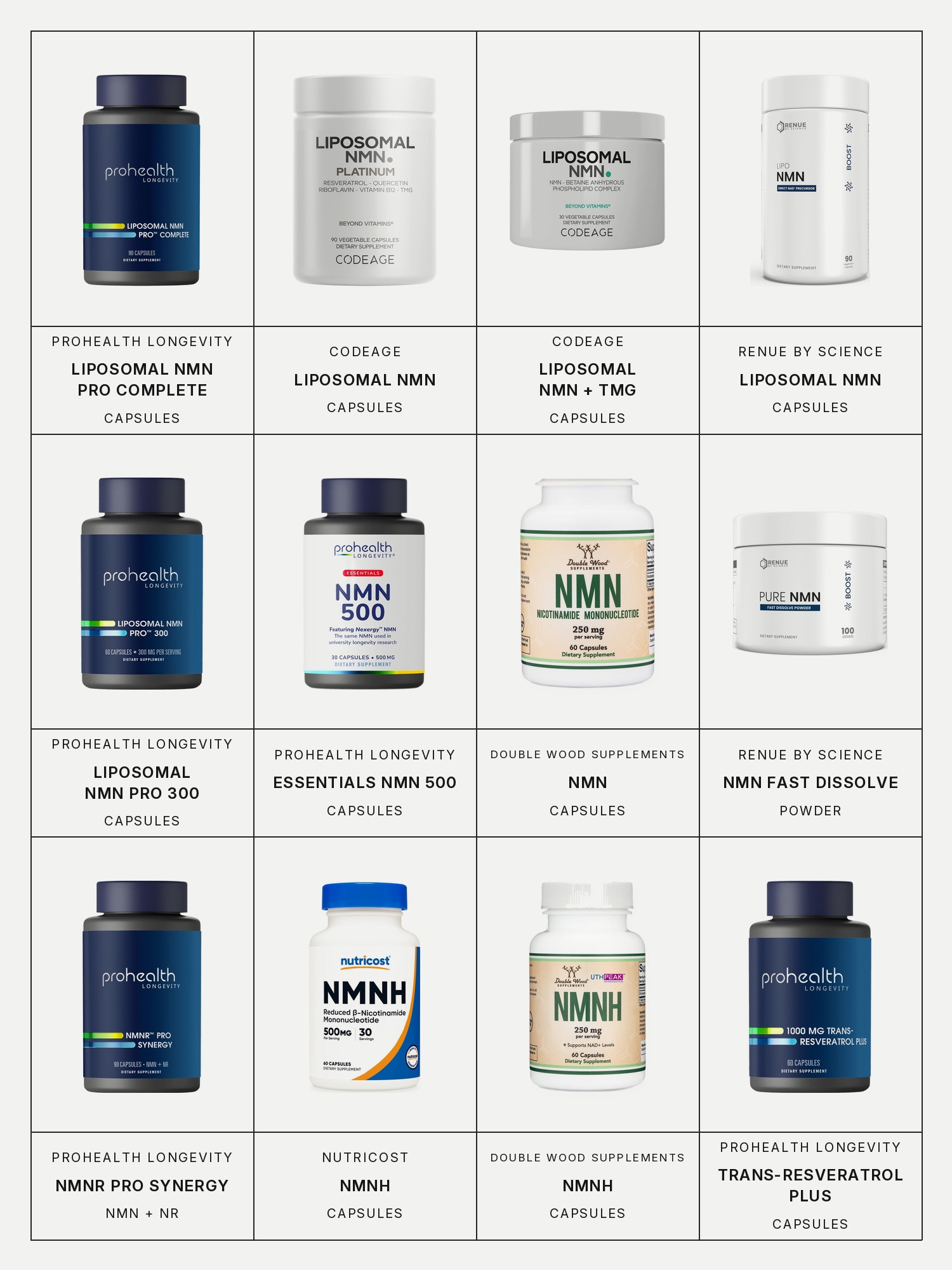
Grid two has one liposomal capsule and three plain formats, which makes it a useful control group. ProHealth's Pro 300 is the liposomal one, and Essentials 500 is the plain 500 mg capsule from the same house. Double Wood Supplements, started in 2013 by twin brothers Reese and Evan Wood, keeps things minimal with 250 mg per serving, meant for the morning. Renue's fast-dissolve NMN powder is crystalline NMN meant to dissolve under the tongue, which is a different bet from a capsule. Here is why I like plain formats in the same edit. A published randomized trial by Yi and colleagues gave 80 adults 300, 600 or 900 mg of ordinary oral NMN for 60 days and measured higher blood NAD+ in every group. By contrast, the review site The NAD Review says no peer-reviewed human trial shows any liposomal product beating ordinary oral NMN, and calls Renue's own pilot of about 15 people company-run and unpublished. I treat plain NMN capsules and powder as the baseline the liposomal bottles have to beat.


The supporting cast
Grid three is the supporting cast. NMNR Pro Synergy from ProHealth pairs NMN and NR with TMG in a three capsule serving, on the brand's argument that the two precursors work through complementary pathways. Nutricost, a Utah company founded in 2013, sells NMNH at 500 mg per serving and calls it a reduced form of NMN. Double Wood's NMNH is 250 mg per serving, labeled for an empty stomach earlier in the day, and the brand describes it as the hydrochloride salt of NMN. Two brands, two definitions, which tells you how young this corner is. The ingredient maker EffePharm calls one Phase I trial the first and largest completed on NMNH, a sponsor's own account that I hold loosely. The last product is ProHealth's Trans-Resveratrol Plus, which the brand pitches as the most researched trans-resveratrol, citing 13 published human studies. What I would skip is stacking all four because they share a shelf. Each one adds another unknown, and you lose track of which bottle you are reacting to.


The question I would ask every bottle
What I keep from all this is a single question: compared with plain NMN, what does the wrapper add. Brands can answer with founder stories and phospholipid chemistry, but the sources I read say no published human trial has settled it. Until one does, I would choose on clarity: a stated dose, a batch test you can open, a maker who tells you what is actually in the capsule. Everything else on the front of the bottle is packaging.