A buying guide to designer winter coats sorted by what they are made of, from wool and cashmere to down, shearling and the classic peacoat, with the fit test I use for each.
Designer Winter Coats Worth the Investment

How I shop for a winter coat
Buying designer winter coats is mostly a fit decision dressed up as a style decision. Before I look at the price, I check three things: whether the shoulder seam sits where my shoulder ends, whether there is room for a real sweater underneath, and where the hem lands against the shoes I wear most. Get those right and almost any coat looks expensive. Get them wrong and even the best label looks borrowed.
The material decides the rest. Down is the warmest for its weight. Wool and cashmere hold their shape and look right over tailoring. Shearling is the warmest of all, and also the heaviest. So this guide is organised by what the coat is made of rather than by price: wool and cashmere first, then down, then shearling, leather and faux fur, then peacoats, and a last group of coats that earn the space on their own.
Every piece below comes from a house that takes outerwear seriously, from Max Mara and Moncler to Toteme and Burberry, and the spread runs from under $400 to well past $10,000. Each section ends with the test I run in the fitting room and the one situation where I would pass. Read those, then buy the coat you will want on the worst morning of the winter.
Wool and cashmere coats
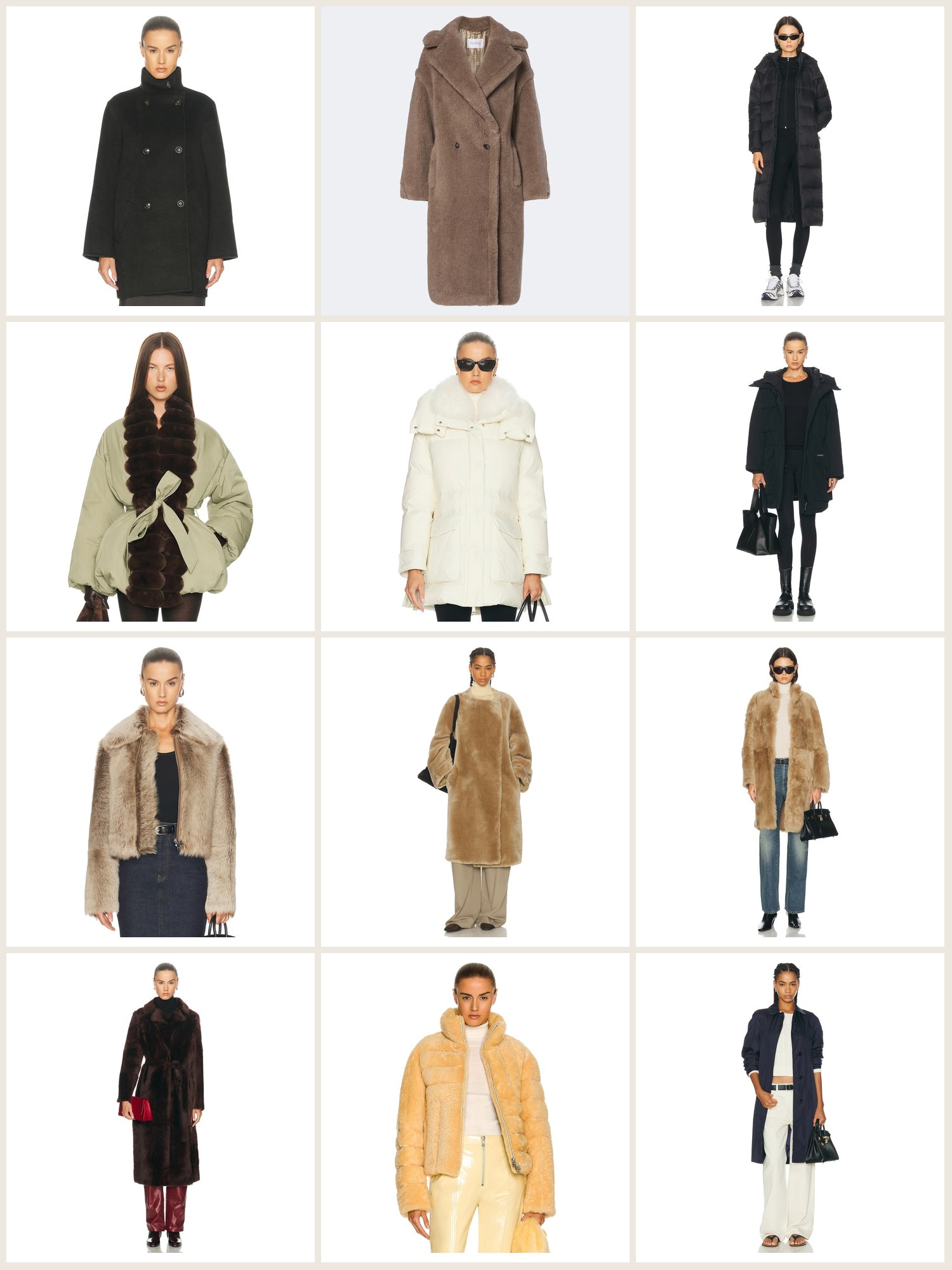
Max Mara's Teddy Bear coat was designed in 2013, when creative director Ian Griffiths went back to a deep-pile coat from the house's 1980s archive, and it has been the shorthand for a serious winter coat ever since. That is the benchmark I hold every wool coat in this group to. The Teddy Bear Icon here is cashmere and silk, oversized and double-breasted, and warm enough that you stop needing a scarf. Khaite's Levitt in oatmeal cashmere is the quieter version of the same idea, cut long and clean.
If those are more than you want to spend, the middle of this group is where I would actually shop. Toteme's hooded wool coat is the most practical of these designer winter coats, because the hood means you can skip the hat. Isabel Marant's Clesa in wool and cashmere and the Acne Studios single-breasted wool coat are both simple enough to wear over a suit or a hoodie. The Row's Ciara wraps rather than buttons, which makes it the best choice if you layer chunky knits. Loulou de Saison's Olmo is double-breasted and closes right up to the chin, and Bessette's Lily is the gentlest way in.
My test for every one of them: lift both arms in the mirror. If the coat rides up past your hips, the shoulder is wrong, and no amount of tailoring later will fix it.
What I would skip: a long wrap coat if you live somewhere windy and walk a lot, because it opens with every step.
Wool and cashmere coats

Lily Wool Coat Sterling
Bessette
$509

Olmo High-Neck Double-Breasted Coat
Loulou de Saison
$1,100

Hooded wool coat
Toteme
$1,390

Clesa wool and cashmere coat
Isabel Marant
$1,990

Single-breasted wool coat
Acne Studios
$2,050

Ciara wool and cashmere-blend wrap coat
The Row
$3,500

Levitt Cashmere Coat
Khaite
$8,800

Teddy Bear Icon cashmere and silk coat
Max Mara
$9,150
Down and puffers
Moncler started in 1952 in Monestier-de-Clermont, a mountain village near Grenoble, and its first down jackets were made in 1954 to keep the company's own factory workers warm. I think about that every time a puffer is sold as pure fashion, because the best designer winter coats in this category still behave like workwear. Moncler's Courcelles hooded down coat is the one I would point to first: long, hooded and plain enough to wear with anything.
Canada Goose has been at this since 1957, when Sam Tick opened Metro Sportswear in a Toronto warehouse, and the Erie parka is its city coat rather than an expedition one. Yves Salomon's down coat in meringue is lighter in colour and in mood. The Bottega Veneta parka in grey seal is the splurge for someone who wants a puffer that reads as tailoring. Rudsak gives you two very different answers: the Shali is a short hooded puffer with a cinched waist, and the Bethany is a double-breasted wool, silk and yak coat with a removable down vest, so it is really three coats.
At the friendlier end, The North Face Hydrenalite long parka and Helsa's bubble puffer with faux fur are the two I would buy without overthinking it.
The test: zip it all the way up and sit down. A good down coat should not pull across the hips or press flat at the shoulders.
What I would skip: a short puffer as your only coat if you commute on foot, because cold thighs ruin the whole outfit.
Down and puffers

Hydrenalite City Long Down Hooded Parka
The North Face
$400

Bubble Puffer with Faux Fur
Helsa
$449

Bethany 3-in-1 Wool Coat with Down Vest
Rudsak
$795

Shali Hooded Short Down Puffer
Rudsak
$995

Down Coat
Yves Salomon
$1,640

Erie Parka
Canada Goose
$1,695

Courcelles hooded down coat
Moncler
$2,525

Parka
Bottega Veneta
$4,400
Shearling, leather and faux fur
Yves Salomon's story starts in 1920, when Gregory Salomon set up as a furrier in Paris, and four generations on the house still knows how to make shearling feel light. Its long belted reversible shearling coat is the piece in this group I would save for, because reversible means two coats in one very good one.
Toteme, founded in Stockholm in 2014 by Elin Kling and Karl Lindman, has two here: a collarless shearling coat in rye, and a raglan leather coat that works as well with jeans as with a slip skirt. Arma's Lucie is the short shearling jacket, and Joseph's Manu is leather on the outside and shearling inside, so it looks sleek and still keeps you warm. Nour Hammour's Blaise is a plush shearling coat that does the most for a plain outfit, and the Bottega Veneta short teddy shearling jacket in butter is the statement of the whole guide. For a lower spend, Zimmermann's Valiant faux fur jacket in brown gives you the same texture without the weight.
The test I use: shearling should feel soft when you bend your elbow, not stiff like cardboard, and the collar should sit flat when it is open.
What I would skip: a long, heavy shearling if you ride a hot subway every day, because you will spend more time carrying it than wearing it.
Shearling, leather and faux fur

Valiant Faux Fur Jacket
Zimmermann
$1,575

Lucie Shearling Jacket
Arma
$2,345

Collarless Shearling Coat
Toteme
$2,395

Blaise Coat
Nour Hammour
$2,825

Raglan leather coat
Toteme
$2,880

Manu shearling-lined leather coat
Joseph
$4,045

Long Belted Reversible Shearling Coat
Yves Salomon
$5,505

Short Teddy Shearling Jacket
Bottega Veneta
$8,100
Peacoats and tailored coats
Thomas Burberry invented gabardine in 1879, a tightly woven cloth meant to keep rain out without the stiffness of the rubberised coats of the time, and the house has been making serious outerwear ever since. The Burberry Tickhill coat in navy is the most traditional piece in this guide, and I mean that kindly: it is the coat that looks right at a funeral, a job interview and a Saturday market.
Lemaire's double-breasted coat in alpaca and wool is softer and a little slouchy, and it is the one I would wear with sneakers. Chloé's double-breasted wool-blend peacoat in black is the sharpest of the four, and Joseph's Isaia peacoat is the easiest buy. A peacoat is the most forgiving of all designer winter coats: hip length, double-breasted, with a collar you can turn up when the wind changes.
The test is simple. Button it over your thickest sweater. If the buttons strain or the front gapes, size up, because a peacoat should close flat.
What I would skip: a peacoat as your only coat if your winters sit well below freezing, since it stops at the hip and your legs take the cold.


More coats worth the closet space
This last group is where I put the coats that do not fit a neat category but earn the space anyway. Moncler's Avocette down coat in white is the bright one, and Brunello Cucinelli's shearling-trimmed wool-blend down coat is the most expensive thing on this page, which shows you where wool and down meet at the very top.
Arma's Rien reversible shearling wrap coat and Nour Hammour's Dakota shearling-trimmed leather coat both come in warm browns that sit happily with black and with camel. Alfie's Dani coat is the one I would buy for someone who wants a single coat that does everything. Destree's Eden Garden coat in black and rust is the conversation piece, and Favorite Daughter's Petite Simon coat in charcoal mini houndstooth is cut for shorter frames, so the hem lands where it should. L'Academie by Marianna's Kye wool coat in ivory is the gentlest spend in the guide and still looks considered.
The test: hold the coat's length against your most-worn shoes. A coat that ends just above the boot shaft looks deliberate, and one that ends at the widest part of the calf rarely does.
What I would skip: an ivory coat if you ride a crowded train twice a day.
More coats worth the closet space

Kye Wool Coat
L'Academie by Marianna
$399

The Petite Simon Coat
Favorite Daughter
$675

Eden Garden Coat in Black and Rust
Destree
$780

The Dani Coat
Alfie
$1,630

Dakota shearling-trimmed leather coat
Nour Hammour
$1,970

Avocette down coat
Moncler
$2,730

Rien reversible shearling wrap coat
Arma
$3,270

Shearling-trimmed wool-blend down coat
Brunello Cucinelli
$12,500
The coat I would buy first
If I could only buy one designer winter coat this year, it would be a long wool coat in a neutral colour with room in the shoulder for a real sweater, and I would add a down coat second for the days that make wool feel like a costume. Shearling is the third coat, not the first, however good it looks in photographs.
Spend the most on the coat you will wear on the coldest commute and the least on the one you wear for an hour at dinner. A coat that fits through the shoulders and closes over your heaviest knit is the one that will still feel right five winters from now. If you want to keep browsing, I also put together Best Designer Coats and Coats for the Long Season Ahead.






