A fringe scarf is the finished end of woven cloth, and this edit covers cashmere, wool, tartan, silk and chunky knit versions. I would reach for one over a coat as soon as the mornings turn cold.
Fringe Scarf: From Loom Ends to the Blanket Scarf Boom
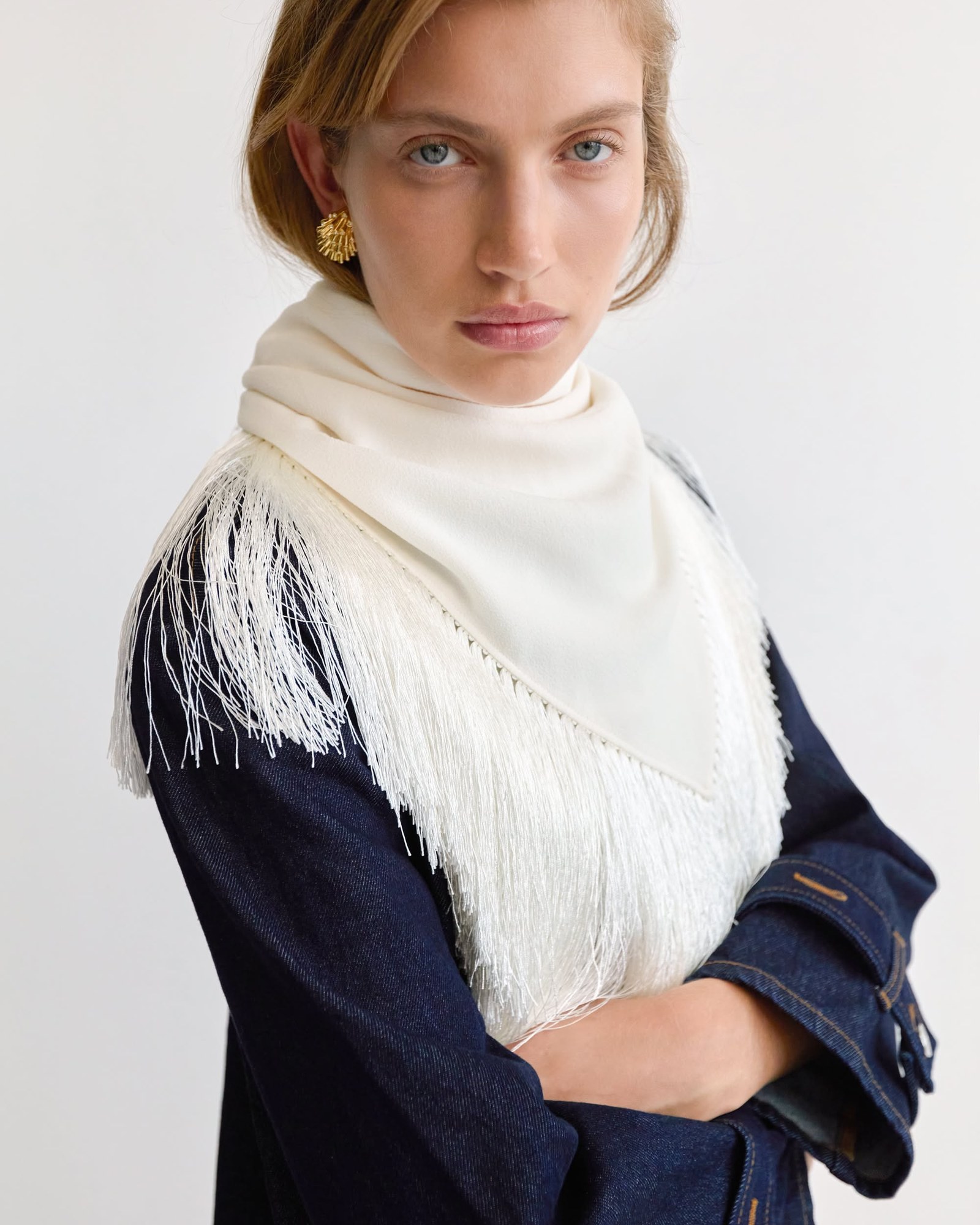
Where the fringe comes from
A fringe scarf starts at the loom. When a weaver did not hem a cut edge, several strands of weft were removed and the remaining warp threads were twisted or braided together so the cloth would not unravel. That is the oldest fringe there is: finished warp threads on handwoven cloth. A scarf that keeps its fringe is showing you how it was made.
I like that a fringe scarf turns a working edge into a detail. Most fringe today is made separately and sewn on, but the scarves in this edit still end the cloth in loose threads, knotted or left plain. In October, with the first cold mornings, it is the scarf I would grab to throw over a coat or a knit.
Start with cashmere, because the ends show it best. Johnstons of Elgin started working with cashmere in 1851, so I trust its black cashmere one to be a serious one, and I would pair it with Vince's cream wrap for a light coat and a dark coat. Monticelli's gray woven scarf has knotted fringe at both ends and a 280-gram weight. Gobi has two in black, the plain Fringed Scarf and a wide one with a deeper fringe. Zadig & Voltaire's Nuage in gray is a bandana, so fold it into a triangle with the paisley showing.
Before you buy any of them, pinch a few fringe threads and tug gently: knots should stay put. Then drape it the way you would wear it and look at the fringe against your height. Long fringe on a short scarf reads messy.
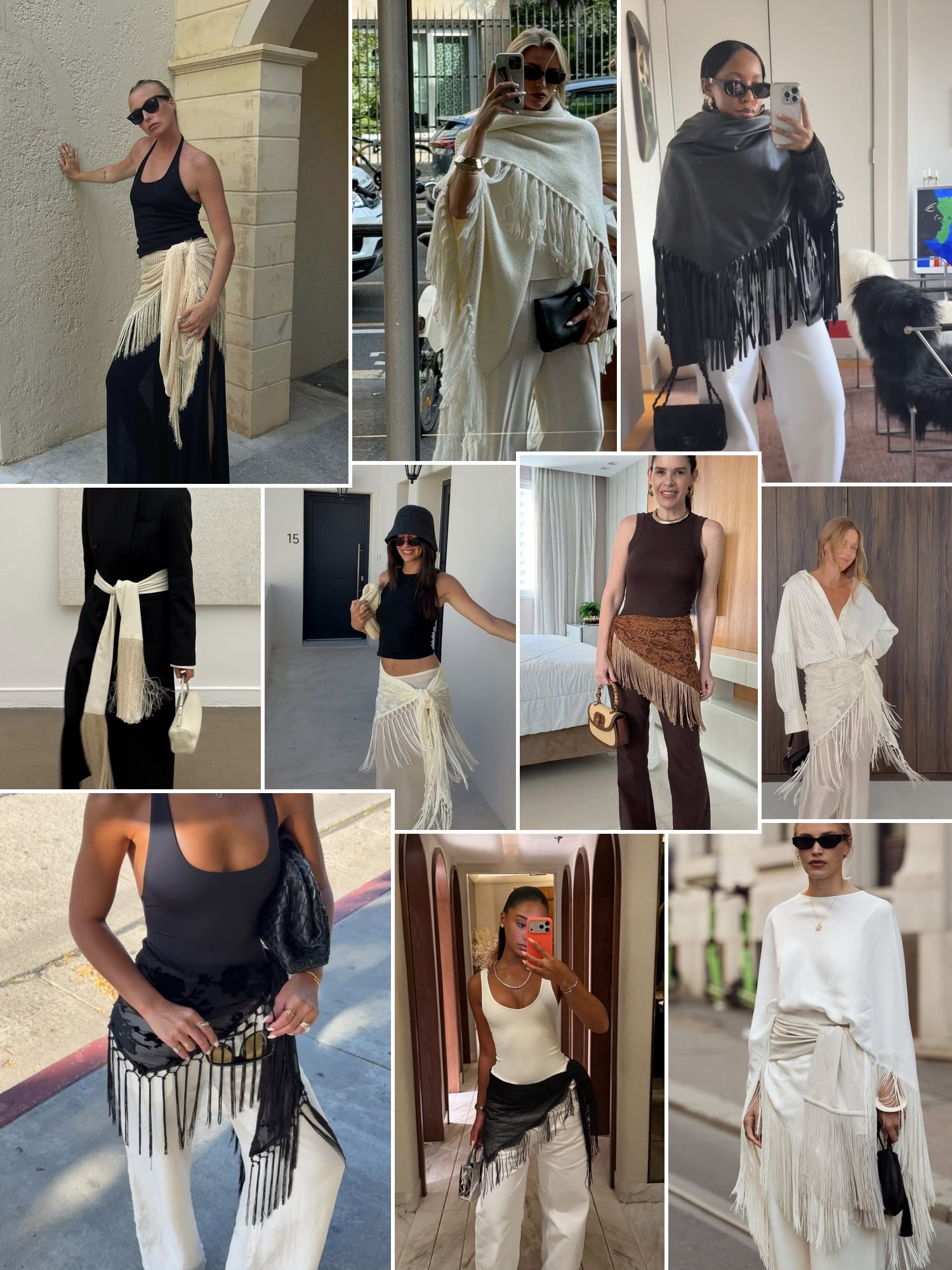
Cashmere fringe scarves

Cashmere Fringed Scarf
Gobi Cashmere
$119

Nuage Cashmere Bandana Scarf
Zadig & Voltaire
$228

Essential Pure Cashmere Woven Scarf With Fringes
Monticelli Cashmere
$499

Cashmere Scarf With Fringes
Portolano
$450

Cashmere Fringe Scarf
Johnstons of Elgin
$295

Cashmere Fringe Scarf
Vince
$248

Wide Fringe Scarf
Gobi Cashmere
$199

Wool & Cashmere Fringe Bandana
Nordstrom
$79
Wool and blanket scarves with long fringe
The blanket scarf had a rough start. In 2012 Lenny Kravitz was photographed in a very large one, the internet laughed, and Jimmy Fallon called it a blanket on his talk show. By 2018 multiple catwalk models were wearing them, which tells you how fast a joke becomes a trend. The wool pieces below are the grown-up version, with fringe doing the work.
Johnstons of Elgin's Mull scarf in light gray is the quiet one, long fringe at each end, and I would wear it with a navy coat. Anine Bing's Augustina in black is about 27.4 inches wide and 71.8 inches long, so it is a real wrap with fringed hems. Herskind's Daniella is wool with 10 percent alpaca in brown, about 20 by 80 inches, and its deep fringe suits a tan trench. COS makes a navy scarf in 52 percent mohair and 46 percent wool, a nice change from a plain gray.
For something sharper, rag & bone's Brooke in brown has faux leather trim and sits well under a puffer jacket. Reiss's Picton in black is 95 percent wool and 5 percent cashmere. Barbour's Ellison in soft pink is brushed with a logo patch, and I would let it be the only color in a black outfit. Prince of Scots' black merino keeps it simple.
Fitting-room test: wrap it twice and look at the ends. The fringe should hang straight, not curl or tangle. What I would skip: a scarf with fringe longer than your hand if your bag has a crossbody strap, because the two will fight all day.


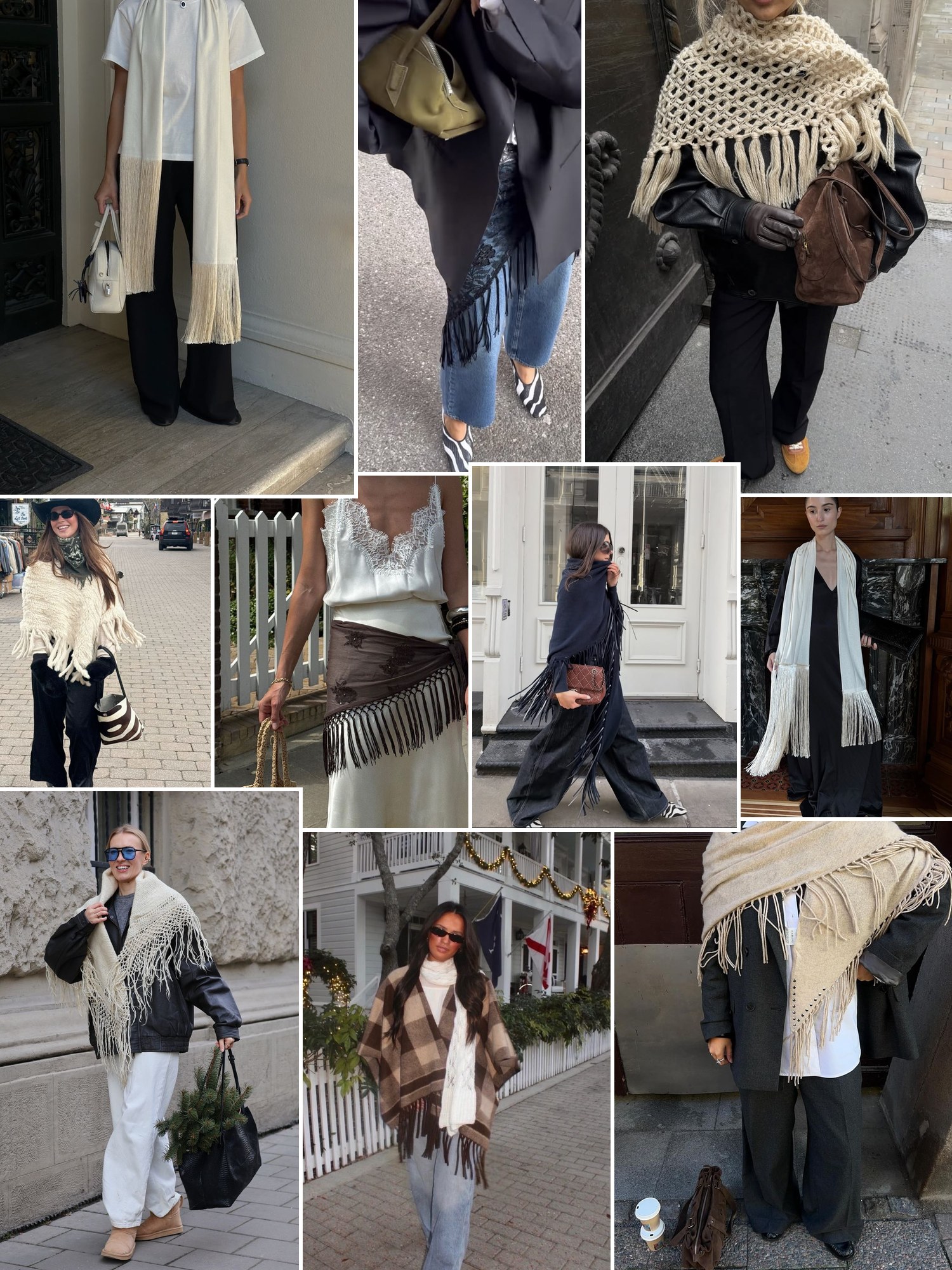
Tartan and check with fringed ends
The 1822 visit of George IV to Scotland, in Highland garb, did a lot for tartan. It set off a boom in tartan weaving, and most clan-named patterns from before 1850 trace back to William Wilson & Son of Bannockburn, near Stirling. So when I see a fringed tartan scarf, I think of a pattern that was partly invented and wholly loved.
Barbour's Deanna in red, navy and cream is the traditional one, and TBCo's lambswool tartan in brown and red has fringed ends that finish it well. For a quieter check, Arctic Fox & Co's Reykjavik in brown and cream is easy over a camel coat, and Acne Studios makes a pale gray and blue checked scarf with a logo label. Goldbergh's Akiko is long, about 100 inches, in brown and rust brushed wool, so wind it twice. Hat Attack's Foundry check in ivory and tan is polyester, about 41.5 by 26 inches, with fringe trim.
Varley's Lindsey in charcoal and white is a check knit, and it is the one I would wear with a plain sweater and jeans. Yumi's oversize checked scarf in blue, green and pink is 100 percent polyester and loud on purpose, so give it a neutral outfit and nothing else.
Test the pattern at the ends: the check should line up square to the fringe, not slant. Look at whether the fringe color matches a thread in the check. What I would skip: a busy check over a patterned coat, because both lose.


Silk and lightweight scarves with fringed trim
The word cashmere comes from Kashmir. When General Napoleon Bonaparte sent a Kashmir shawl to Paris from Egypt, it was said to have caused a sensation, and French makers started copying it. Light scarves with fringe are the descendants, thin enough to fold in a bag and still warm enough for a cool evening.
OLAH's Frida With Love is a skinny black silk scarf with long fringe, and I would tie it at the neck over a white shirt. Echo's Half and Half is an oversized silk scarf with a fringed trim in red, mustard and black stripes. Burberry's lightweight check is 51 percent wool and 49 percent silk with fringe edges, and Reiss's Heidi in ivory is wool and cashmere. Weekend Max Mara's Wkarauche stole in navy is 55 percent cashmere and 45 percent silk, and it is sheer on purpose.
The leopard cashmere and silk wrap with an eyelash fringe edge is gauzy, and I would drape it over a black coat. Echo's Cabana Stripe is cotton in cream and gray. Fable England's Eve is a large square paisley in brown tones.
Hold it up to a window. If you can see through the whole thing, it is a layer, not a scarf. Run the fringe through your fingers and check that no threads are pulled. What I would skip: the sheer stole as your only warmth on a windy walk, and any fringe that already looks frayed.

Frida With Love Silk Skinny Fringe Scarf
OLAH
$65

Half and Half Silk Scarf
Echo
$199

Eyelash Trim Print Cashmere & Silk Wrap
Nordstrom
$99

Lightweight Check Wool Silk Scarf
Burberry
$475

Heidi Plain Wool & Cashmere Lightweight Scarf
Reiss
$119

Wkarauche Cashmere & Silk Stole
Weekend Max Mara
$235

Cabana Stripe Wrap
Echo
$59.25

Eve Paisley Large Square Pashmina Scarf
Fable England
$58
Chunky and brushed knit fringe scarves
By 1830, weaving cashmere shawls with French-produced yarn had become an important Scottish industry, and Scotland has been tied to scarves ever since. The knit scarves below are a different animal: brushed, fuzzy and thick, with fringe that moves when you do. They are the ones I would reach for from now until the first snow.
THE GREAT.'s Big Fringed Sweater Scarf is a camel knit triangle with a deep fringed edge, and it works like a poncho collar. Jacquemus's Carro is red, a mohair, alpaca and virgin wool blend at 28, 28 and 24 percent, with a long fringe, so wear it with a black coat. TOTEME's monogram jacquard scarf is cream and blush in alpaca blend. Free People's Winter Days Blanket Scarf is an ombre from cream to brown with long twisted fringe, which is the 2010s blanket scarf, done right.
Rag & bone's Mila is 100 percent cashmere, about 78.4 inches long, in ivory with fringe trim. WellBeing + BeingWell's Highland is 90 percent alpaca, about 88 by 10 inches, in ice blue and white plaid. Lovers and Friends' Louisa in red is 80 percent acrylic and 20 percent wool, about 12 by 78 inches. Treasure & Bond's brushed scarf in bright pink is the happy one.
Test the weight: lift it with one hand and see if it hangs or sags. Wear a bulky one with a slim coat, not a puffy one. What I would skip: a thick fuzzy scarf tucked under a tight collar, because it will crowd your neck.

The Big Fringed Sweater Scarf
THE GREAT.
$395

L'Écharpe Carro Mohair, Alpaca & Wool Blend Fringe Scarf
Jacquemus
$320

Monogram Jacquard Alpaca Blend Fringe Scarf
TOTEME
$460

Brushed Fringe Scarf
Treasure & Bond
$45

Louisa Scarf
Lovers and Friends
$88

Highland Scarf
WellBeing + BeingWell
$98

Mila Textured Scarf
Rag & Bone
$155

Winter Days Blanket Scarf
Free People
$48
How I would pick one this month
I would choose in order. First, pick the fiber for the weather you really have: cashmere for dry cold days, wool or alpaca for rain and wind, silk for in between. Second, check the fringe in your hand, with the knots tight and the ends even. Third, decide if you want pattern or color, and let one coat decide for you.
If I had to take one home, it would be a plain black cashmere scarf with fringe, because the fringe is the detail and the cloth does the rest. It is the loom, still showing at the edge of a scarf. Wear it long, and let the ends go where they want.






