How to mix antique and new furniture: one old anchor, a new soft layer, and a modern object that bridges the two.
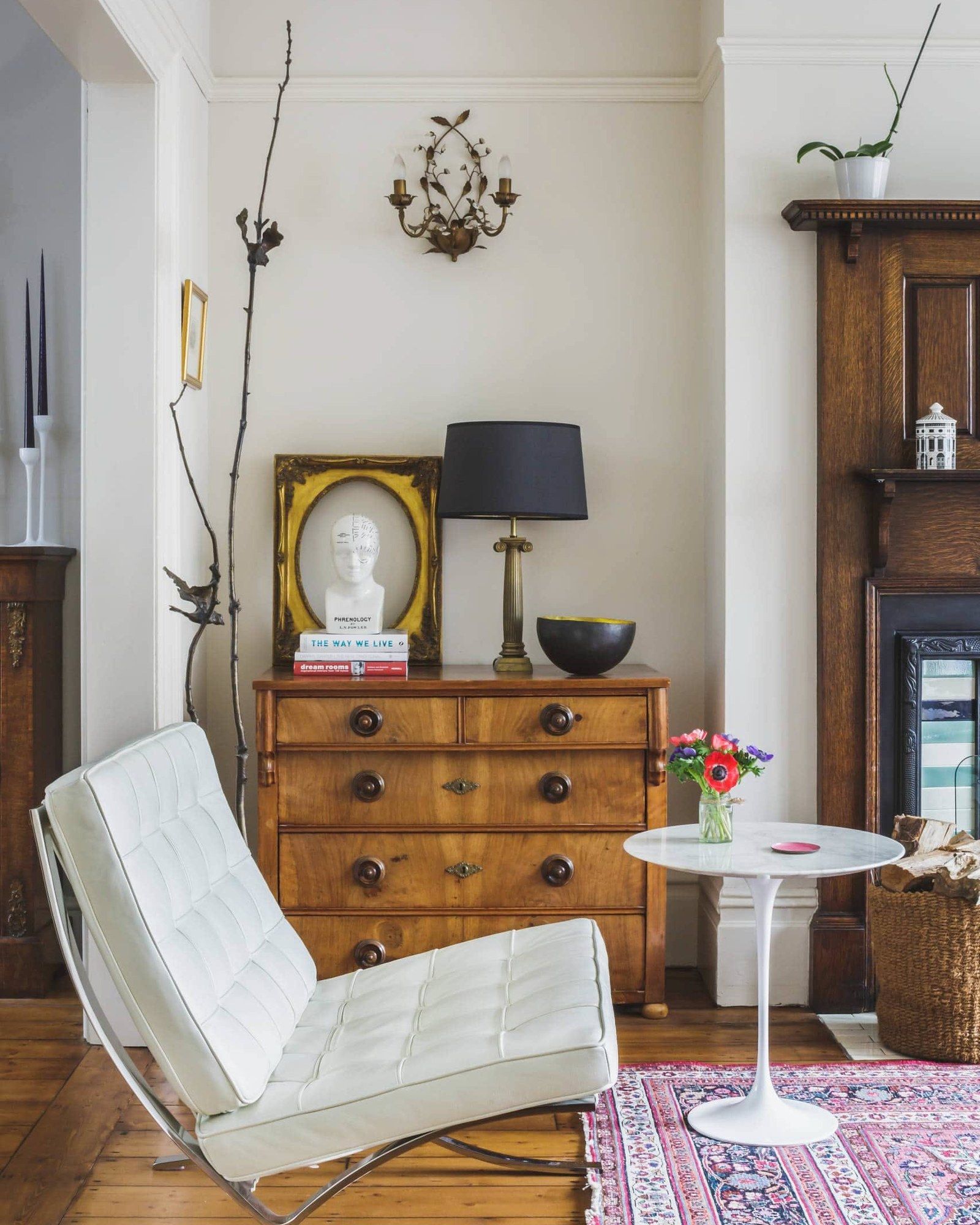
How To Mix Antique And New Furniture
One old piece per room, chosen for scale
Mixing antique and new furniture works when the old pieces are outnumbered and load-bearing. One antique per room, sized to be the largest or most emphatic thing in it, and everything else new and quiet. That single ratio solves most of the problem, because a room with one nineteenth-century cabinet and modern seating reads as a home, while a room split evenly between periods reads as a shop. Choose the anchor for scale before style. A credenza, a coffee table, an armchair with real presence. Ignore whether the wood tone matches anything, since matching wood tones across periods is neither achievable nor desirable and the attempt is what makes a room look like a suite. Do check height against your existing furniture, because antique seat heights are commonly lower than modern ones and a period chair beside a contemporary sofa can sit a surprising distance below it. Function is worth being honest about too. Antique case pieces were built for linen and china rather than for a television and a router, so measure the internal depth and check whether the back panel can take a cable hole before you commit.
The Antique Anchor, $600 To $7,800

Bauhaus SS33 chair by Anton Lorenz for Thonet, 20th century
Anton Lorenz, Thonet
$600

Set of 4 folding chairs made of wood and Vienna straw Italia70s Mid-Century
1stDibs
$1,218.34

'Cordilheira' Mid-Century Modern Cabinet in Brazilian Hardwood by Knót Artesanal
Knót Artesanal
$1,950

Cabinet Black and Gold Napoleon III 1860 France marble Top André-Charles Boulle
André-Charles Boulle
$2,724.66

Bouclè Wink Lounge Chair by Toshiyuki Kita for Cassina, 1980s
Cassina, Toshiyuki Kita
$4,494.85

Early Noguchi Coffee Table by Herman Miller, First Production, 1950s
Herman Miller, Isamu Noguchi
$5,748.67

Oak Slatted Credenza / Sideboard With Record Player Hatch
1stDibs
$7,800
New textiles are how you tie it together
The soft layer is where the new money should go, and it is what stops an antique looking marooned. Rugs, cushions and throws in current production are the connective tissue: they carry a colour from the old piece into the rest of the room, and they are far cheaper to change than furniture. Pull one colour out of the antique, usually from the timber or a detail rather than the obvious one, and repeat it twice in the textiles. That repetition is what makes the mix look intentional. Practically, buy the rug bigger than feels necessary, since a rug that stops short of the seating is the single most common error and it makes an expensive room look temporary. Natural fibres sit better beside old timber than synthetics do, and a flatweave jute or wool rug is a more forgiving neighbour to an antique than a high-pile modern one. Underlay is the unglamorous part that makes the difference. A good felt and rubber underlay stops a flatweave creeping across a hard floor, and it adds the softness underfoot that a thin rug beside old timber otherwise lacks.
The New Soft Layer, $115 To $1,670

Exclusive Studio Linen Pillow Cover
Nordic Knots
$115

Helena Cotton Velvet Cushion
Christina Lundsteen
$140

Moccacino Floral Embroidered Cotton Cushion
Los Encajeros
$160

+ Beto Val tasseled satin-jacquard cushion
La Doublej
$350

5' X 8' Square Flatweave Area Rug i
Nordic Knots
$495

Ribbed cashmere down cushion
Brunello Cucinelli
$725

Nobilis Cluny velvet-jacquard and wood pouf
Six The Residence
$1,005

Cashmere-jacquard cushion
Dolce&Gabbana
$1,670
Then a modern object to break the spell
The last element is small and it matters more than its price suggests: one clearly contemporary object placed on or near the antique. A current ceramic vase on the nineteenth-century cabinet, a new glass tray on the vintage coffee table, a modern lamp beside a period chair. It stops the antique reading as a museum piece and tells anyone in the room that the arrangement was a decision. Keep it simple in form, because a plain modern shape sets off a decorated old one and two decorated things fight. Scale down rather than up here, since a large contemporary object competes with the anchor instead of framing it. And place it off centre. An object centred on an antique surface looks like a display. Placed to one side, with room around it, it looks like something someone put down and liked where it landed. Lighting counts as a modern object here. A current table lamp on a period cabinet does the same work as a vase and has the advantage of changing how the old timber reads after dark, which is when most people actually see the room.
The Modern Object That Bridges Them, $80 To $990

x Leanne Ford Bevagna Utensil Crock
il Buco Vita
$80

Medium Love Rattan Basket
UNDERWATER WEAVING STUDIO
$176

Keepsake gold-plated porcelain trinket box
La DoubleJ
$250

Casper high ceramic vase
Astier De Villatte
$330

Wicker-Resin Placemat
Moda Domus
$395

Bounty Basket
UNDERWATER WEAVING STUDIO
$504

Wisteria Porcelain Serving Bowl
Tiffany & Co.
$685

PH 5 Mini Pendant Lamp
Louis Poulsen
$990
Our honest take
We would resist buying a second antique for at least a year. The room almost never needs it, and the pull to add another old thing is really a wish for the room to feel more finished, which the textiles will do faster and for less. We would also stop trying to match periods or timbers. It cannot be done and the effort shows. What we would take seriously is height and rug size, because those are the two measurable errors that make a well-bought room look wrong. And if the antique needs restoration to work, budget for that before you buy rather than after. If you take one thing away, buy one old piece, make it the biggest thing in the room, and spend the rest on a rug that is larger than you think you need. If you want to keep browsing, I also put together Cane And Rattan Furniture and Does Vintage Furniture Hold Its Value.