How to stack rings so the result looks intentional, covering proportion, spacing, finger placement and sizing.
How to Stack Rings Without It Looking Cluttered

A stack needs a hierarchy
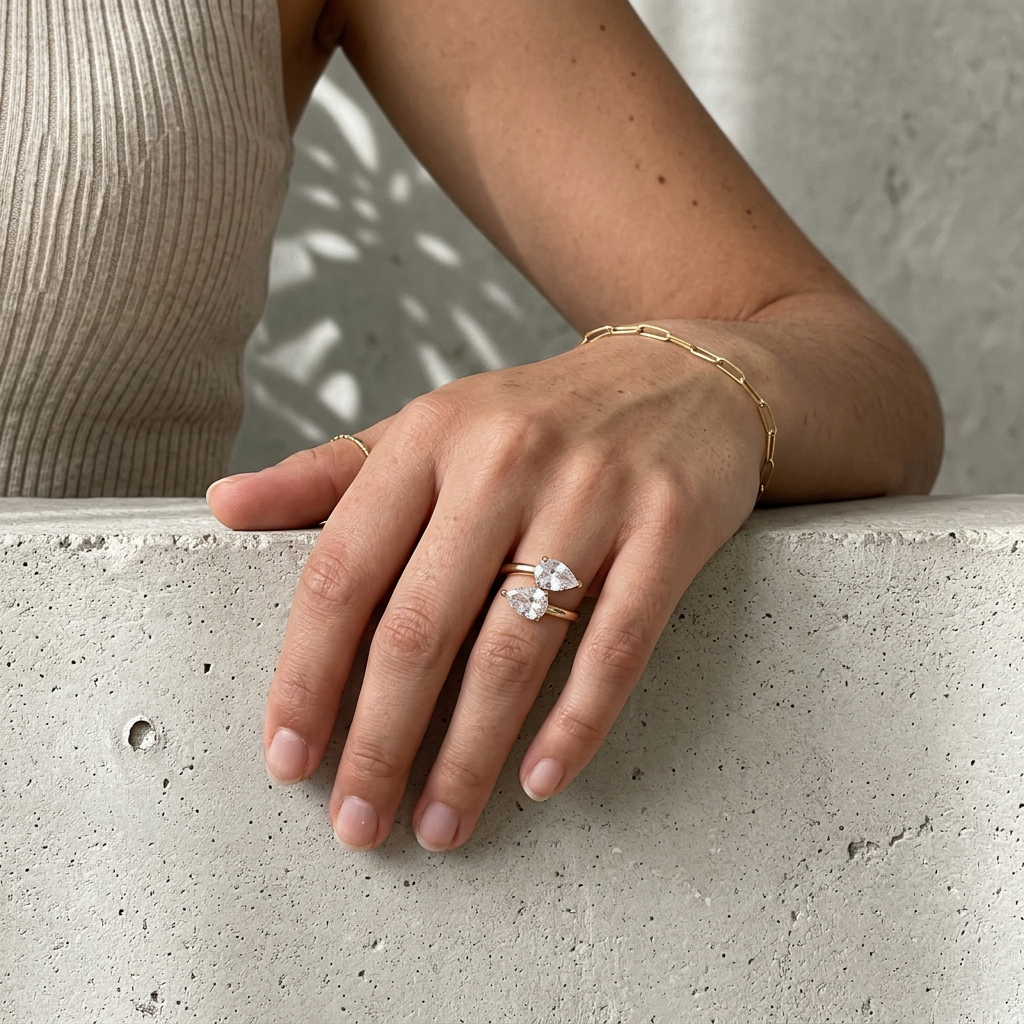
The difference between a ring stack that looks considered and one that looks like you emptied a dish onto your hand is hierarchy. One ring leads. Everything else supports it.
That lead ring does not have to be the most expensive. It has to be the one with the most visual weight, whether that comes from a stone, a wider band, or a distinctive shape. Once it exists, the other rings have a job, which is to frame it.
The most common mistake is stacking four rings of similar width and similar finish. Individually they are fine. Together they read as one thick, undifferentiated band and none of them gets to be interesting.
The second most common mistake is symmetry. Matching both hands, or evenly distributing rings across every finger, drains the look of any energy. Weight one hand more than the other and leave gaps deliberately.
Start with three rings. Three is enough to create a relationship between pieces and few enough that you can see what each one is doing. Add from there once you know which finger you actually keep them on, which is usually not the one you expected.


Proportion, spacing and where things sit
A few structural rules do most of the work.
Vary the width. A wide band next to two thin ones creates rhythm. Three medium bands do not. If everything you own is the same width, the cheapest fix is one deliberately thin band, not another medium one.
Use the space between knuckles. Stacking two or three rings on the same finger segment gets crowded fast. Moving one ring to the finger above the knuckle, or onto an adjacent finger, gives the eye somewhere to rest and makes the whole hand read as composed rather than loaded.
Leave a finger empty. Usually the middle finger, because it is the widest and the most visually dominant. An empty finger acts as punctuation.
Mind the sizing. Rings worn above the knuckle need a different size from rings worn at the base, and a wide band fits more tightly than a thin one at the same nominal size, because there is more metal in contact. If you are buying a wide band, size up half a size. This single detail causes more unworn rings than any other.
And consider your hands over a day. Fingers swell in heat and after salt. A stack that fits perfectly in the morning can be uncomfortable by evening.
Signets and wider bands

Gold Etched Bezel Custom Birthstone Ring
BaubleBar
$68

Dôme Figure Diamond Dipped Ring
Mejuri
$1,300

Retro 14K Gold Custom Ring
BaubleBar
$178

Toronto Mosaic Dôme Ring
Mejuri
$1,100

Isabella Sterling Silver Cigar Band
BaubleBar
$98

Dôme Ring
Mejuri
$188

Bold Chain Ring
Mejuri
$448

Bold Dot Ring
Mejuri
$128

Courage Signet Ring
Mejuri
$198

Bold Open Dôme Ring
Mejuri
$198
Mixing metals and finishes
Mixing gold and silver in one stack works, and it looks more modern than matching everything. The trick is repetition. If a metal appears once it reads as a mistake. If it appears twice it reads as a decision.
So with five rings, do not wear one silver and four gold. Wear two silver and three gold, and separate them rather than grouping each metal at one end. A two-tone ring anywhere in the stack does this work for you automatically, because it gives both metals a reason to be there.
Finish is a separate lever from colour. A brushed or hammered band next to a high polish one adds texture without adding another colour, which is useful when you want depth but the stack is already busy.
Stones need more restraint than metal. One stone ring per hand is usually the ceiling. Two can work if they are clearly different scales, a solitaire and a row of very small stones, for example. Three competing stones is where a stack tips into cluttered regardless of how good each ring is.
Signets sit slightly apart from all of this. A signet is heavy enough to lead on its own, and often looks best with just one thin band beside it.
One ring that does the talking

Silver Etched Bezel Custom Birthstone Ring
BaubleBar
$68

Interconnected Loop Pavé Diamond Ring
Mejuri
$1,300

Nikki Shell Statement Ring
BaubleBar
$24

Charlotte Bold Ring
Mejuri
$248

Gold Cubic Zirconia Custom Birthstone Ring
BaubleBar
$68

Solo Diamond Ring
Mejuri
$368

18K Gold Evil Eye Pavé Ring
BaubleBar
$32

Heirloom Ring
Mejuri
$1,300

Pavé Diamond Signet Pinky Ring
Mejuri
$748

Diamonds Line Ring
Mejuri
$448
Common questions
How many rings is too many? There is no fixed number, but if you cannot say which ring is the focal point, you have one too many. Three to five across both hands suits most people.
Can I mix gold and silver rings? Yes. Make sure each metal appears at least twice so it reads as intentional, and spread them rather than clustering.
Do wide bands fit differently? Yes. Wide bands feel tighter than thin ones in the same size. Go up half a size for anything notably wide.
Which finger should I stack on? Whichever you will tolerate. Index and ring fingers take stacks well. The middle finger is often better left empty because it dominates the hand.
Will stacked rings scratch each other? Softly, yes, especially with softer high-karat gold. Rings worn touching will develop marks where they meet. Most people come to like it, but if you do not, separate them by a finger.