Oakley sunglasses move from everyday frames to broad sport shields and sharper performance shapes, with Prizm tints across the mix. I sort them by use and explain what I would check at the bridge, temples and sightline.
Oakley Sunglasses: From a 1984 Prototype to Everyday Frames and Sport Shields
On a 1984 drive along the Pacific Coast Highway, Jim Jannard noticed that his sunglasses let light in at the sides. Oakley says he improvised a first prototype from a coat hanger, a Lexan goggle lens and electrical tape, then called it Eyeshade. I love the bluntness of that fix. The first sport-performance sunglasses story starts with someone annoyed by a very specific problem.
The brand had started building its own point of view years earlier. Oakley’s history says Jannard began building his own brand in 1975. Oakley sunglasses still have that mix I like: a clear silhouette, a bit of engineering, and enough personality that they do not disappear into an outfit. I would choose by how I spend the day, not by a gender label or a team uniform.
For daily wear, the matte black Holbrook is the easy anchor, with its square frame and front rivets; it looks right with a plain tee or a long coat. Sylas in polished clear feels lighter with a dark jacket, while Frogskins in gray ink and gray Prizm keep the color quiet. HSTN SQ in matte rootbeer and tungsten warms up an oatmeal sweater. Holbrook XXL takes that dark, familiar outline in a roomier direction; Feedback in rose gold and brown gradient brings a softer glint. Gascan in matte gray ink reads cooler with denim, and Eye Jacket Redux gives black frames a more sculptural line. Before I decide, I check that the bridge sits evenly and the temples stay comfortable with my hair tucked back.
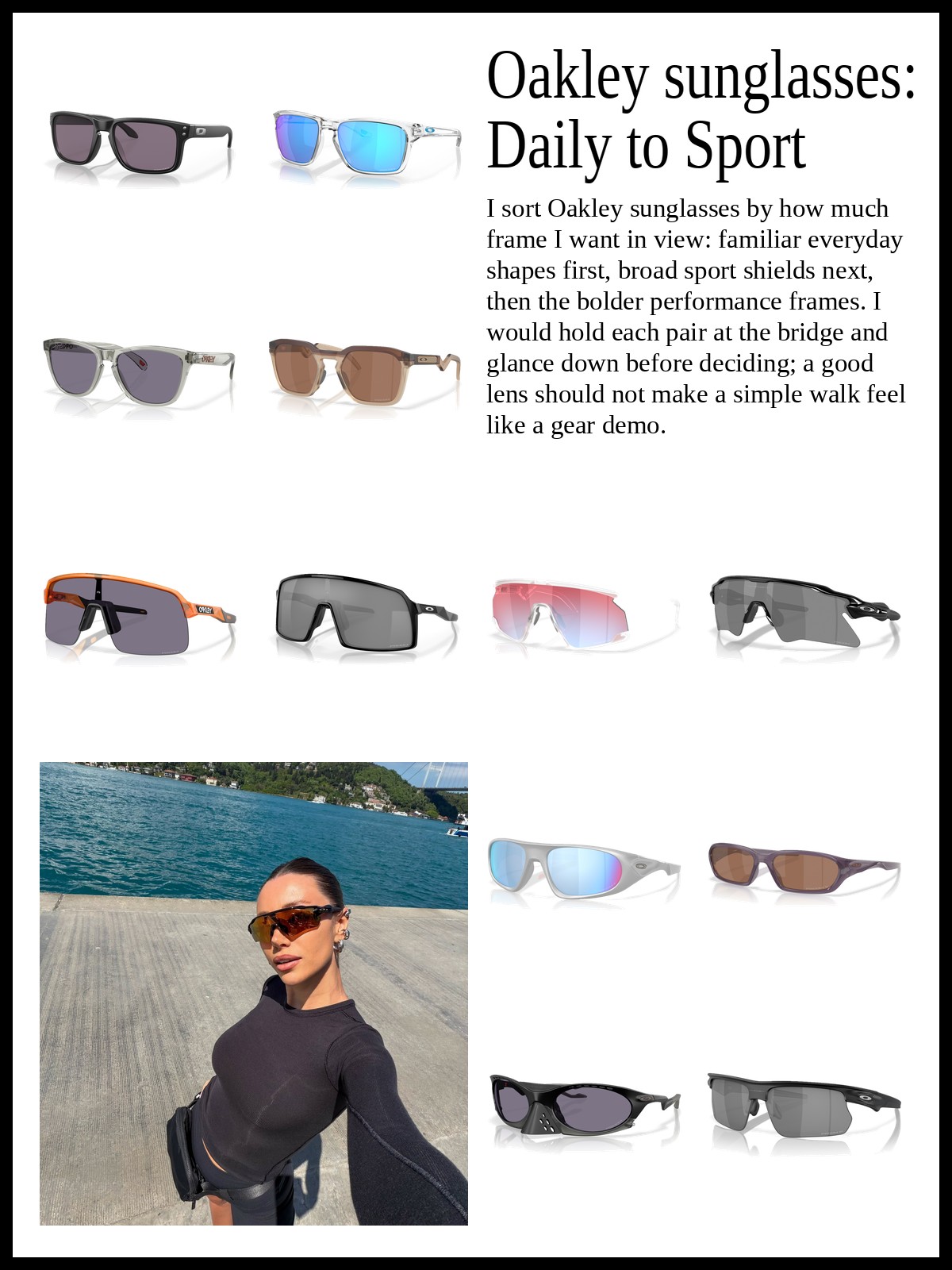


A wider shield for motion
A shield earns a place in my rotation only if it stays settled when my eyes move from the horizon to the pavement. Cyclingnews notes Oakley launched Sutro in 2019 for urban cyclists, and that origin makes sense to me: the broad shield is not reserved for a training kit. Sutro Lite in matte transparent ginger keeps its shield shape but softens the frame color; the full Sutro in polished black with a black Prizm lens is the more graphic choice.
BXTR in matte clear with Snow Sapphire reads cool and crisp, while Radar EV Heater in polished black and Radar EV Path in matte black feel like the focused pair when I want a sportier wrap. Radar EV Path’s taller lens extends the upper field of view, a detail I would notice more on a ride than on a cafe walk. Flak 2.0 XL in matte carbon and brown gradient looks calmer than the Encoder Strike Team USA in matte navy and Prizm Road. Half Jacket 2.0 XL keeps the black frame but adds Deep Water polarized lenses.
I would pair the transparent ginger or clear frames with navy, charcoal or a white tee and let the shield be the whole point. Try them with the cap or helmet you actually wear, then glance down and sideways; the frame should not creep into your sightline. What I would skip: wearing a shield with every detail fighting for attention. If the lenses already lead, I keep the outfit quiet.


Color, frame, contrast
Lens color is not decoration alone in this group, though I still want the frame to make sense with my clothes. Oakley describes Prizm as manipulating incoming light to enhance color and contrast, which is why I pay attention to the tint rather than choosing purely from the front view. The X-silver Neoforma with Deep Water polarized lenses looks almost liquid; I would let it sit against navy or charcoal instead of adding another shiny accent.
Terraforma Obscura Collection in transparent aubergine with Tungsten polarized feels like the evening-minded option, especially with a brown coat or a dark blue sweatshirt. Plantaris in matte black and gray Prizm is the spare, dark choice, while BiSphaera in matte black with Black polarized lenses makes a more graphic line. Instagator keeps the frame black and the lens gray, so it reads calmer than its name. Actuator in brown tortoise with Sapphire polarized adds a warm frame against a cooler lens. Bushwick in satin black is the pared-back one; CYBR Lightning in black with Black lenses is the most direct.
I would keep these around one strong contrast at a time: the frame, the lens, or the clothes. On a bright day I want my usual commute or walk to decide the tint, then I try the pair for pressure at the nose and temples. A small head turn should not make the frame slide or bump.


The pair I will actually wear
My first decision is where these will live: in a coat pocket for daily errands, or in a kit bag for a ride. Then I choose the silhouette. I like Holbrook or Sylas for a familiar everyday outline, Sutro for a broad shield, and Radar EV for its taller lens.
After that I decide on the tint and check the bridge, temple pressure and sightline while moving my head. I would pick only the pair I can wear without fidgeting, then test it with the hat or helmet already in rotation. The 1984 Eyeshade began as a homemade answer to light sneaking in at the side. My own test is simpler: walk outside, turn toward the sun, and see if I forget the frame. If you want to keep browsing, I also put together Chanel Sunglasses Women Hunt For, Plus Frames In The Same Spirit and Best Sunglasses for Small Faces.






