Phia vs Indyx comes down to what you want standing next to your closet. Indyx pairs a free digital wardrobe with human stylists and a resale marketplace, while Phia pairs a self-filling closet with a shopping assistant. Here is the honest comparison.

Phia vs Indyx: A Closet With a Stylist, or a Closet With a Price Check
The short version
Indyx and Phia both want to be the place your wardrobe lives, but they come at it from opposite directions. Indyx, the "one-stop digital wardrobe app" founded by Yidi Campbell and Devon Rule, leans on people: human stylists, a resale marketplace, even in-home cataloguing in some cities. Phia leans on automation: a closet that fills itself, outfits that suggest themselves, and a shopping assistant wrapped around all of it.
Full disclosure: I write for Phia, so weigh that. I have described Indyx using its own listing and site as of October 2026, so check them yourself before you commit.
In Phia vs Indyx, Indyx is for people who want to curate and maybe sell, with stylists on call. Phia is for people who want the closet to stay current on its own, get dressed faster and buy smarter. Here it is, task by task.
Phia vs Indyx, feature by feature
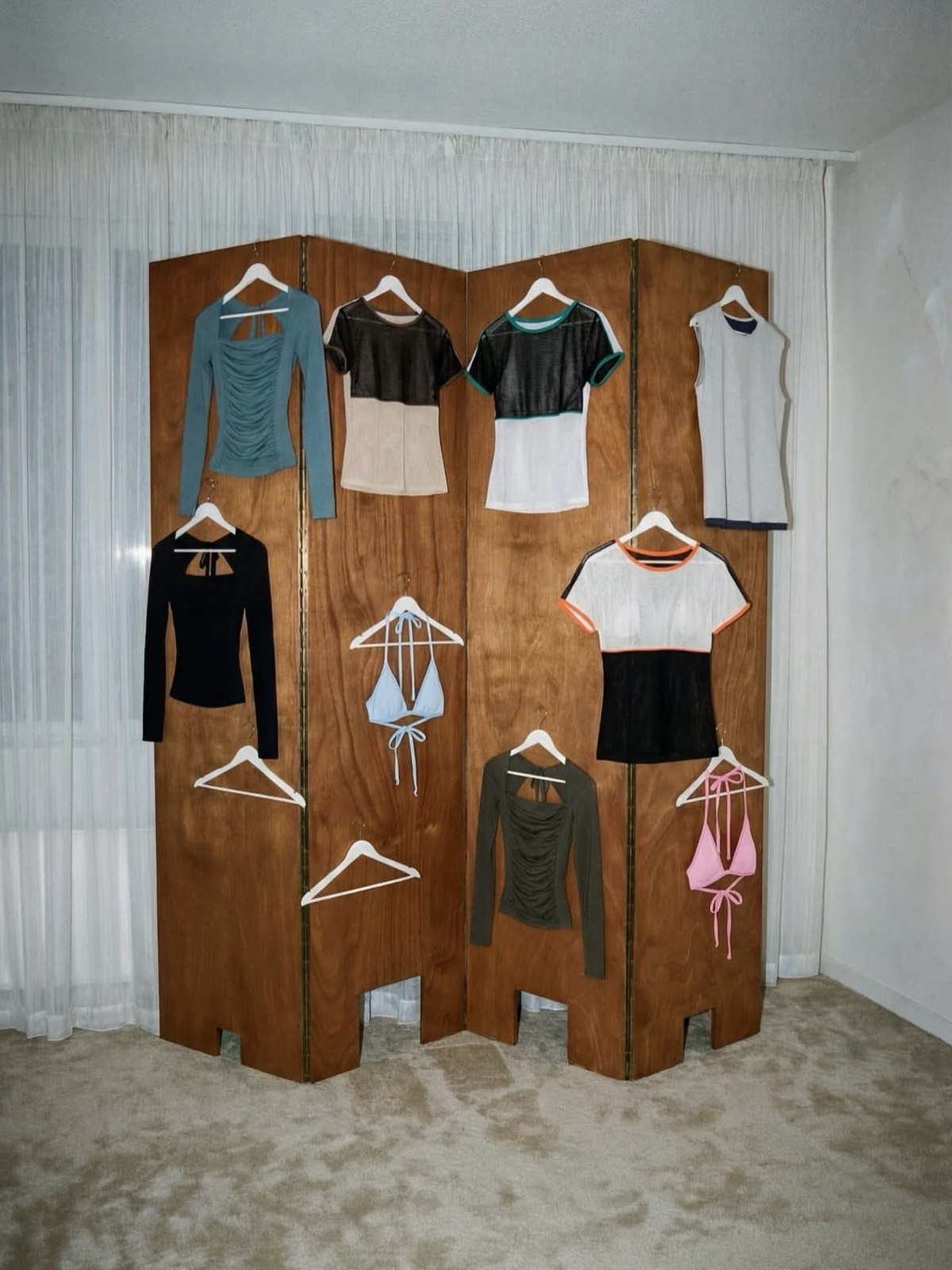
Indyx is built around people, so a feature list was never going to flatter it, and I want to say that before the scorecard. On the fifteen closet features I care about, Phia has all fifteen and Indyx has two in its core app: automatic background removal and a free download. Its human stylists, Archivist cataloguing service and resale marketplace are real strengths that a feature grid cannot capture.
The scorecard does show where your time goes. Every way of getting clothes into Phia is automatic: Gmail sync, instant camera roll sync, checkout capture and outfit photos that turn into closet pieces. Indyx asks you to photograph, paste links or forward receipts, or to book someone to do it for you.
Then there is everything that happens once the closet is full. Phia suggests outfits, builds one around any single piece, thinks about the weather, lets you try things on, writes your Style analysis, finds “More like this” for anything you own and checks prices across more than 220,000 sites. Indyx deliberately leaves styling to people. That is a real choice, and it also means waiting for a person when Phia has an answer in a second.
Indyx and Phia, screen by screen
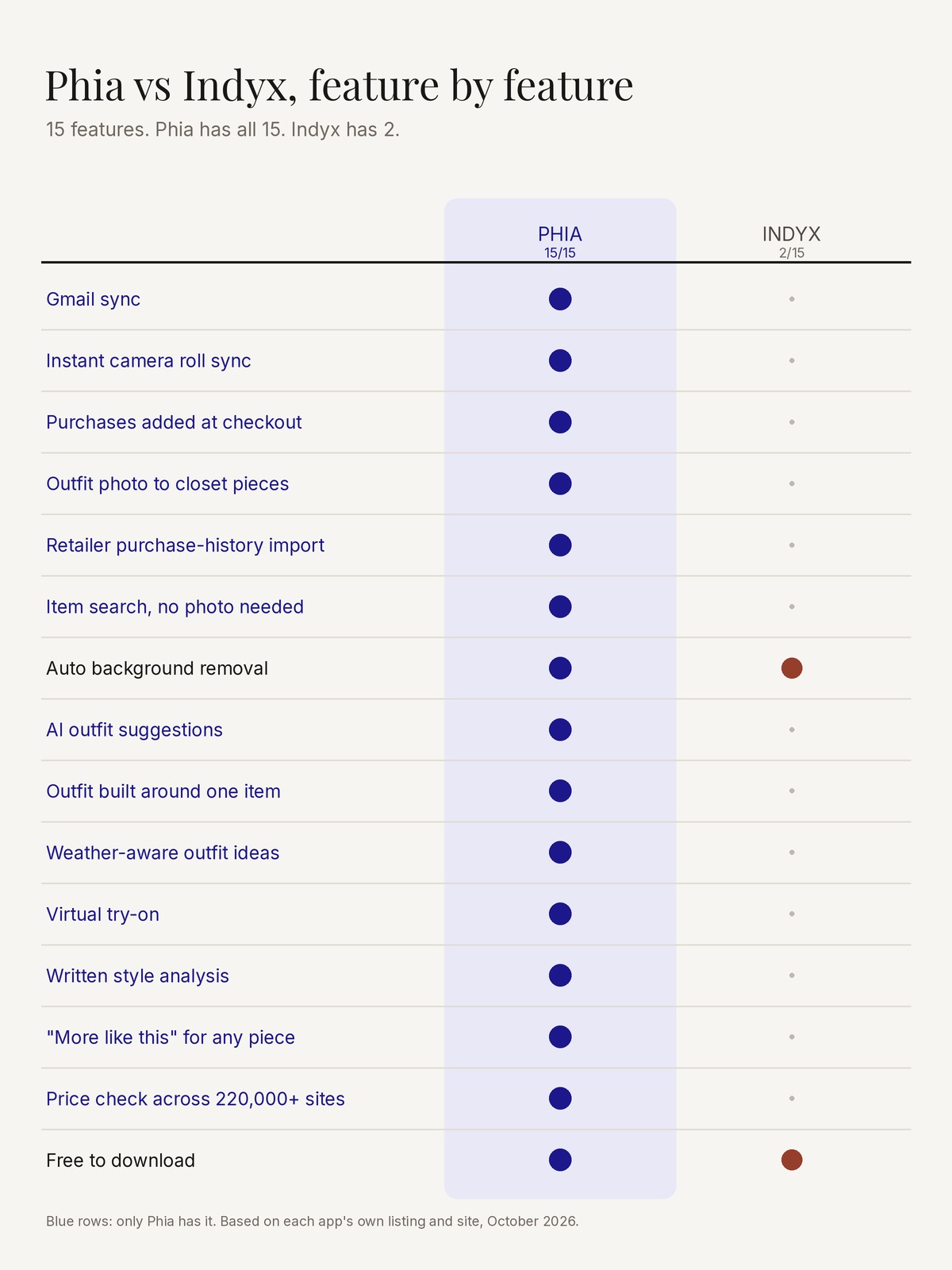
Indyx's closet is beautifully catalogued. You index items yourself with automatic background removal, or hire one of its Archivists to come to your home and do it. Phia skips the cataloguing step. Lana's closet, butter yellows, a pink quilted bag and ballet flats, is clean retailer photos, the kind Gmail sync brings in.
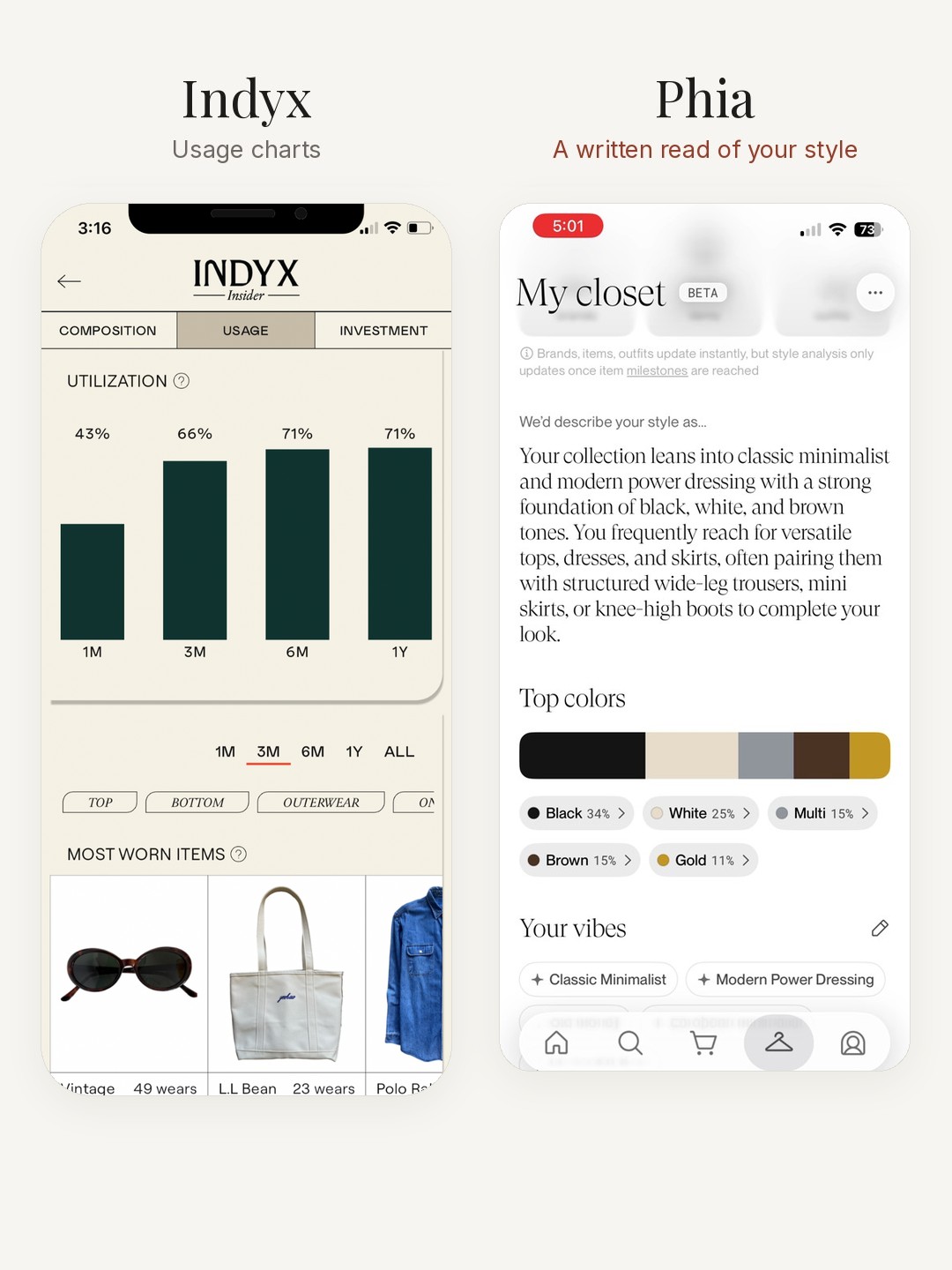
The insight screens tell the same story. Indyx shows usage charts: the share of your closet you have actually worn over time. Phia's Style analysis writes about you instead, with a paragraph describing your style, your top colors by percentage, editable vibes, top brands and up to ten styling rules.
Both are useful. One tells you what you wore. The other tells you who you are when you get dressed, and that is the one that changes what you buy next.
Task: Uploading your closet
My pick: Phia.
Indyx's core wardrobe is free with unlimited items and outfits, and background removal included. You add clothes by photo, by pasting a product link, or by forwarding receipts to the app. For people who would rather not do any of it, Indyx sells an Archivist service that catalogs your closet in person in select US cities.
Phia's version of that service is software. Connect Gmail and Phia finds retailer order confirmations, receipts and shipping emails and turns each one into a closet item with a photo, brand, size and color. Instant camera roll sync adds what you have already photographed, and checkouts with the Phia extension add themselves. Confession #1: I have never once remembered to forward a receipt, which is exactly why automatic sync matters to me.

Task: Understanding your closet
My pick: Phia, for most people.
Indyx has a reputation as a gold mine for closet data, with breakdowns by category and color, wear tracking and more, and App Diaries noted that its analytics sit in the paid Indyx Insider tier.
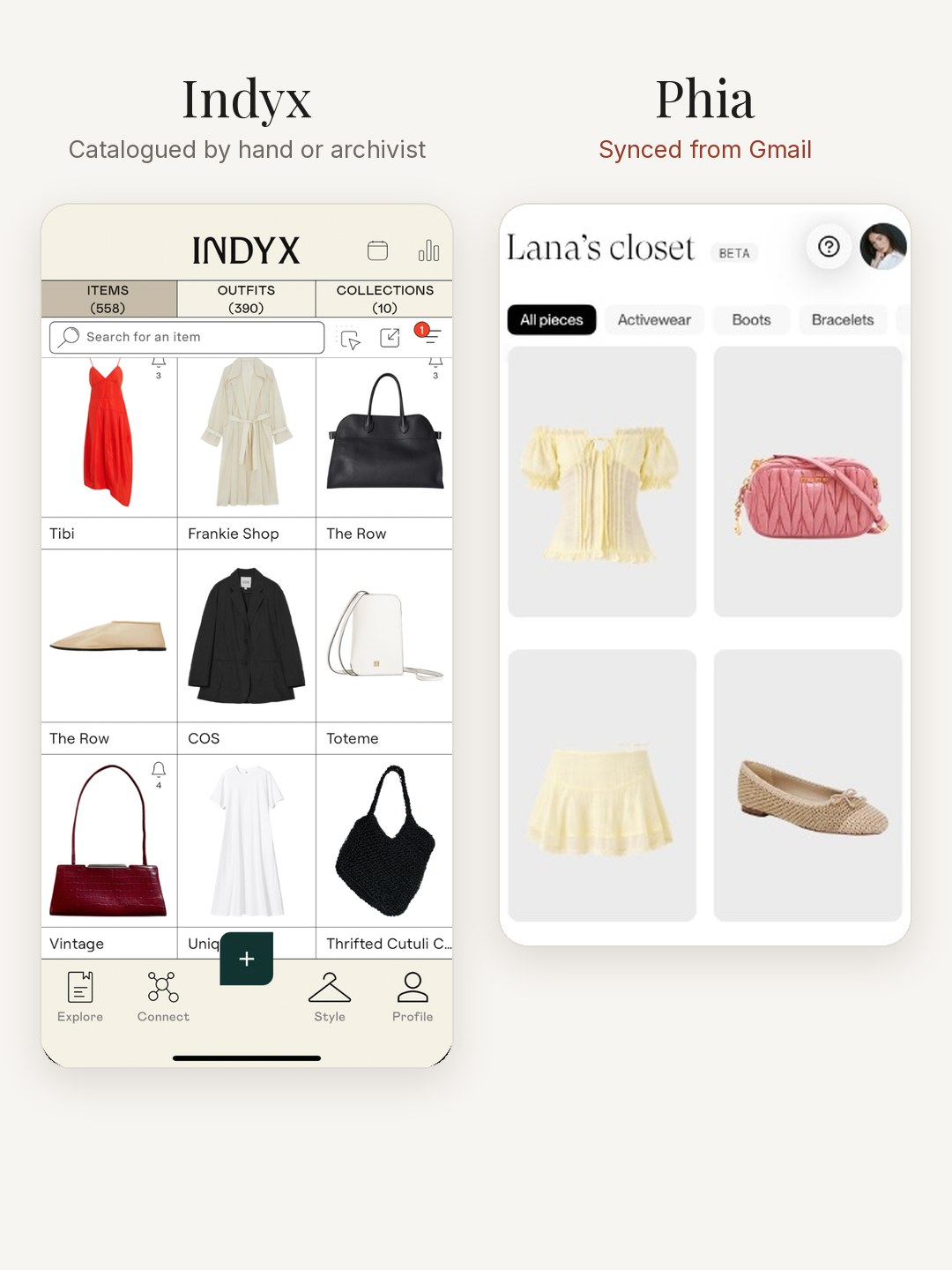
Phia's new Style analysis takes a different approach. Instead of charts, it reads your closet and tells you about yourself in plain words, something like "your collection leans into modern power dressing and classic minimalist styles, anchored by a palette of gold, white and black." Underneath, it shows your top colors by percentage, your vibes, your top brands, and a count of brands, items and outfits that updates instantly. You can add up to ten styling rules you swear by, and the written analysis refreshes as your closet reaches item milestones. For most people, that is the insight they actually wanted from closet data.
Task: Planning your outfits
My pick: Phia.
Indyx gives you drag-and-drop outfit boards and a wear calendar, and it deliberately leans on human stylists rather than AI suggestions. If you like to build each look yourself, it is a satisfying canvas.
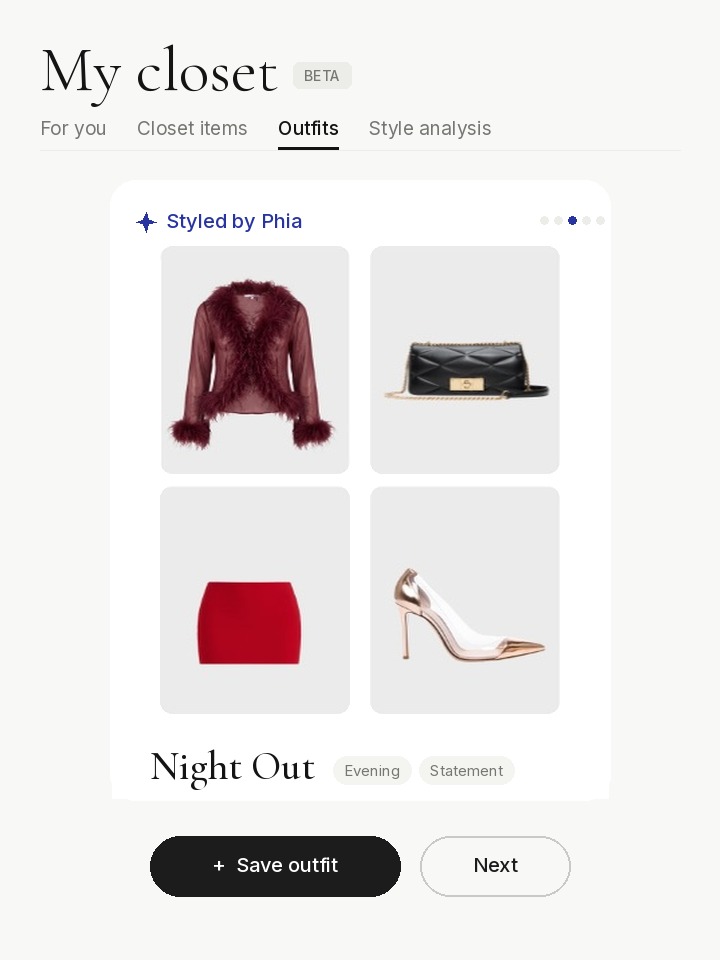
Phia lets you plan outfits yourself too, but its algorithm also instantly suggests how to pair what you own. Suggested outfits for you appear in the Outfits tab, Style from one item builds a full look around a single piece, and Styled by Phia sends a new outfit idea every day once you have five tops and five bottoms.
A week without a stylist
I wanted to know whether instant styling could stand in for a person, so I gave Phia a week.
Monday, I asked for an outfit around a striped shirt I loved and never wore. Style from one item built a full look around it in seconds, and it went to work with me.
Wednesday, Styled by Phia sent the outfit of the day with the weather factored in, which saved my suede loafers from a rainy morning.
Friday, I read my Style analysis properly for the first time. It described my closet as modern power dressing on a classic minimalist base and named my top colors and brands. A stylist would have said it more warmly, but not more accurately.
An Indyx stylist brings taste and conversation, and some people will always want that. For the everyday question of what to wear, an answer in a second is hard to argue with.
What Indyx reviewers keep asking for
Indyx's App Store reviews are warm, and they are honest about the same few things.
Cataloguing takes time, and people ask for bulk uploads and bulk tagging. Phia's version of a bulk upload is not uploading at all. One Gmail connection pulls in retailer order confirmations, receipts and shipping emails, and camera roll sync turns the clothes already on your phone into closet pieces. Items from receipts arrive with photo, brand, size and color filled in.
Some recent reviews describe a receipt import that closed before items could be added. Receipts are the engine of a Phia closet rather than a side door, and you never have to forward one.
And some people object to features sitting behind the paid Insider tier. Phia's closet, outfit suggestions and Style analysis come with the free app. Confession #2: I am cheap about apps in a way I am not about shoes, so free is not a small thing to me.
Task: Getting styled by people, and shopping
For human styling, Indyx has no real equivalent at Phia. It sells styling from lookbooks to ongoing help, its community can style you on the Insider plan, and its peer-to-peer resale marketplace lets you sell straight from your closet. If you want a person's eye on your wardrobe, that is what Indyx is built around.
For shopping, Phia has no real equivalent at Indyx. Phia is a shopping assistant first: it compares prices across more than 220,000 sites, new and secondhand, applies coupons at checkout and watches for price drops, with your closet right there so you can see whether you already own something similar.
My read: if you love fashion as a hobby and want people in the loop, Indyx is a thoughtful app. If you want your closet built, styled and explained for you, and you want help at the moment you buy, Phia is the one I would download first. Both are free to start.
Phia vs Indyx: quick answers
Is Phia free like Indyx? Yes. Phia is free to download, and its closet, outfit suggestions and Style analysis come with it. Indyx's core closet is free, with paid Insider features and paid styling services.
Does Phia sell clothes like Indyx's marketplace? No. Phia is a shopping assistant, so its strength runs the other way: comparing prices across more than 220,000 sites, new and secondhand, before you buy.
Does Phia have human stylists? No. Phia's styling is instant and automatic: Suggested outfits for you, Style from one item, Generate outfit and a daily idea from Styled by Phia.
Does Phia show closet data like Indyx? Phia's Style analysis shows your top colors by percentage, your vibes, your top brands and counts of brands, items and outfits, with a written description of your style on top.
Where does Phia work? On iPhone with a Safari extension, in Chrome and on phia.com.