The women's OG Detroit jacket here comes from Carhartt WIP, in black, tan and off-white, with camo-pattern and logo-patch versions too. I also sort the hooded, chore, canvas, denim, bomber and quilted jackets so you can pick the shape that fits how you dress.
The Carhartt Jacket for Women: Detroit, Chore and Bomber Shapes Worth Knowing
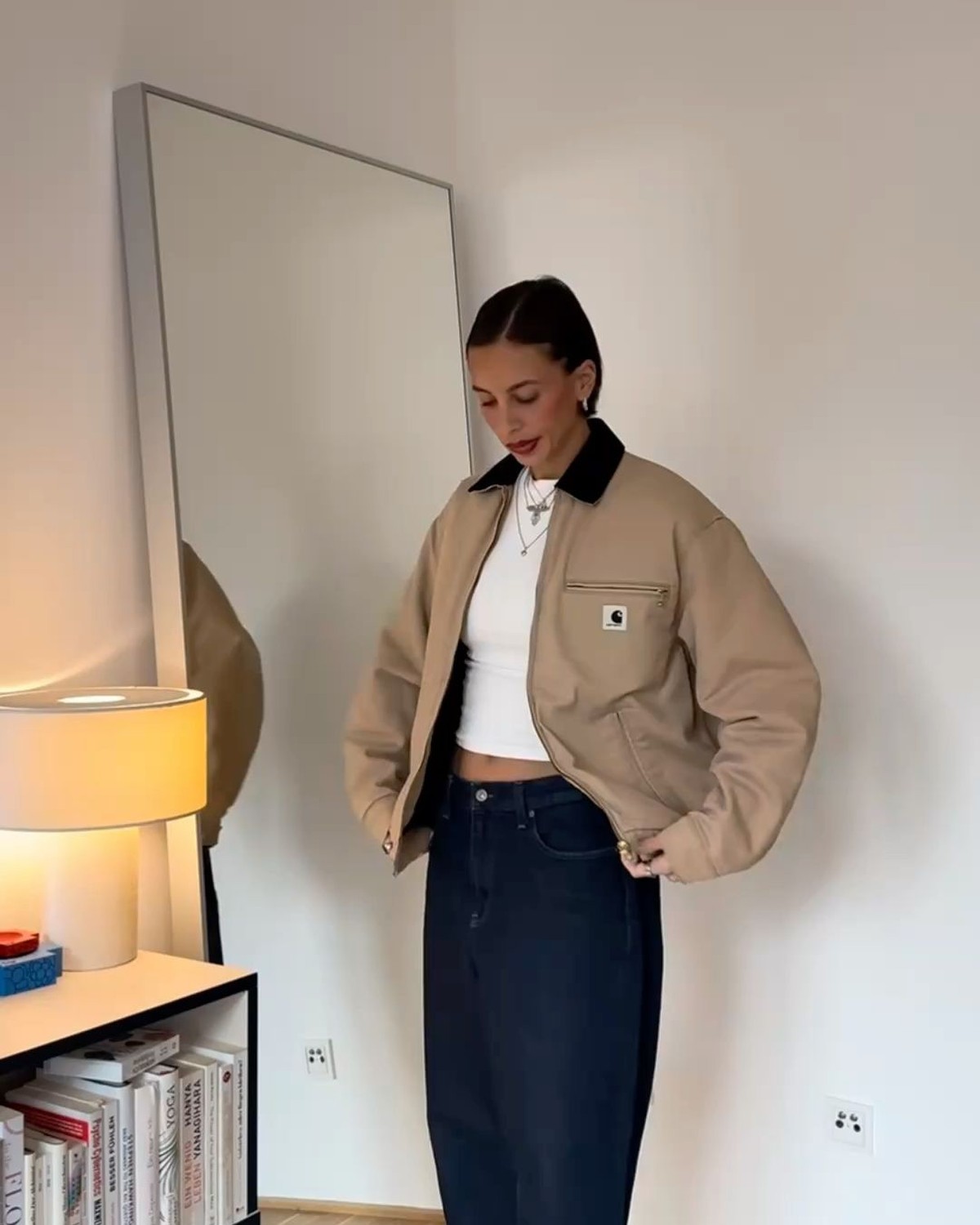
Hamilton Carhartt founded his company in 1889 in a small Detroit loft, and it began by making overalls. The story I love is that he designed his first bib overall after talking directly with railroad workers. That habit of asking the person who will wear the thing is still the best way to shop for a Carhartt jacket, and it is why women have been pulling these shapes out of the work world for decades. During World War II the company made workwear for women entering factories on the home front, so this is not a borrowed look.
Everything in this edit comes from Carhartt WIP, the streetwear line. Edwin Faeh established it in 1994 to be Carhartt's exclusive European distributor, and the brand presented its first women's collection in 2000. So when you search for a Carhartt women's jacket, the designer-shop version you land on is usually this one: the same workwear codes, cut for the street.
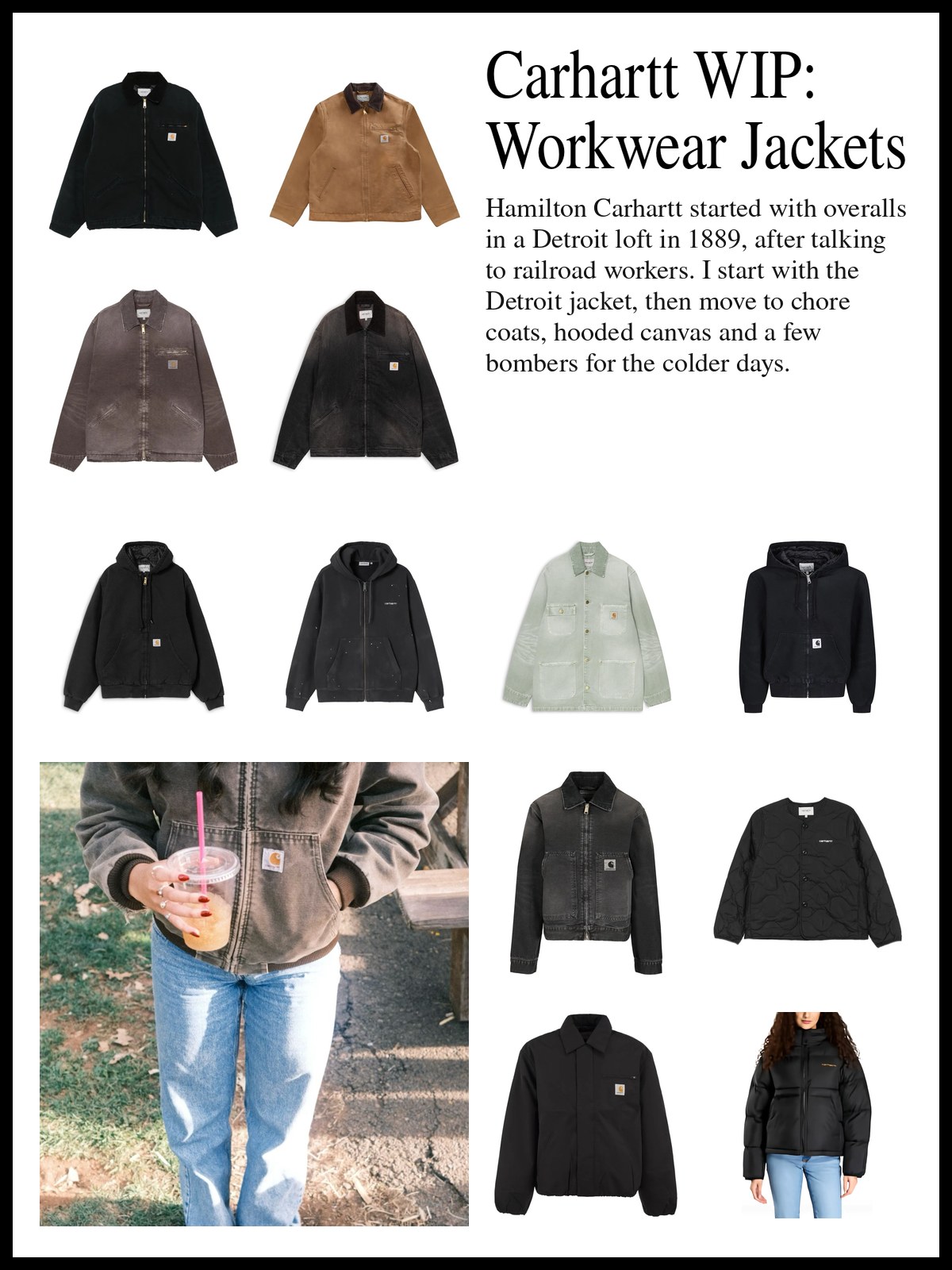
The first grid is all Detroit, and I would start here. Carhartt says the Detroit Jacket originally launched in 1954, and the shape is short, boxy and quick to wear with high-waisted jeans or a slip dress. The plain OG Detroit jacket appears several times, and the Black OG Detroit Jacket, the Tan OG Detroit Jacket and the Off-white OG Detroit Jacket give you the three easiest colors. The Detroit Cotton Black Tobacco Logo Jacket is the one with a little more personality, the OG Detroit camo-pattern jacket is the loud one, and the OG Detroit logo-patch jacket keeps the branding up front.
The Black OG Detroit Denim Jacket is the one I would try if canvas feels stiff to you. Carhartt introduced Detroit versions made specifically for women in its Icons Re-Engineered line, in Rugged Flex canvas and 100% cotton denim. The Detroit oversized jacket and the Detroit jacket (winter) are for layering over a knit, and the OG Detroit zip-up jacket swaps the buttons for a zipper.
Detroit and OG Detroit jackets

OG Detroit jacket
Carhartt WIP
$255

Detroit Jacket
Carhartt WIP
$248

OG Detroit jacket
Carhartt WIP
$250

Detroit Cotton Black Tobacco Logo Jacket
Carhartt WIP
$368

OG Detroit jacket
Carhartt WIP
$307

Og Detroit jacket
Carhartt WIP
$274

OG Detroit jacket
Carhartt WIP
$368

OG Detroit zip-up jacket
Carhartt WIP
$305

Black OG Detroit Jacket
Carhartt Work In Progress
$211

Tan OG Detroit Jacket
Carhartt Work In Progress
$192

Off-white OG Detroit Jacket
Carhartt Work In Progress
$174
&link=https%3A%2F%2Fwww.farfetch.com%2Fshopping%2Fwomen%2Fcarhartt-wip-detroit-jacket-winter-item-32172607.aspx)
Detroit jacket (winter)
Carhartt WIP
$200

OG Detroit camo-pattern jacket
Carhartt WIP
$319

OG Detroit logo-patch jacket
Carhartt WIP
$294

Black OG Detroit Denim Jacket
Carhartt Work In Progress
$308

Detroit oversized jacket
Carhartt WIP
$229
Hooded, chore and denim, the easy layers
The second grid is where the jackets get more varied: hooded, chore, canvas and denim. If the Detroit is the sharp one, these are the easy ones. I reach for them on days when I just want to put something on and leave.
Carhartt says the Active Jac was introduced in 1975 and is still its top-selling jacket, which tells you something about how many people want a hood and a simple shape. Here it shows up as the OG Active Jacket, the OG Active jacket (winter) and the OG Active hooded jacket. The Active Cotton Stone Canvas Drawstring Hooded Jacket is the canvas one with a drawstring hood, and the Hooded Painter jacket and Hooded Nelson jacket are the other hooded options.
Now the Chore Coat, which is my favorite shape in this group. Carhartt's archive holds ads for the Chore Coat dating back to 1917, and the company says the coat is largely unchanged today. That is a long run for a pocketed, boxy coat. Try the Pocket Chore Coat and the OG Chore corduroy-collar coat as the Carhartt coat women reach for over a dress, or open over a tee and trousers. The OG Michigan logo-patch coat and the Tan OG Michigan Jacket sit in the same family. The Clark jacket and Brown Clark Jacket are the plainer ones, and I would try them over tailoring.
For denim, the Off-white Mercer Stripe Denim Chore Jacket is the one I keep thinking about, because it puts a stripe on the chore shape. The Black Belmar Denim Jacket and Navy Belmar Denim Jacket are the plainer options, and the OG hooded zip-up denim jacket is the casual one. Tuck the sleeves up once and see if the cuff hits your wrist bone.
Hooded, chore, canvas and denim jackets

Active Cotton Stone Canvas Drawstring Hooded Jacket
Carhartt WIP
$298

Hooded Painter jacket
Carhartt WIP
$191

Pocket Chore Coat
Carhartt WIP
$308

OG Active hooded jacket
Carhartt WIP
$355

OG Michigan logo-patch coat
Carhartt WIP
$273

Clark jacket
Carhartt WIP
$209

Hooded Nelson jacket
Carhartt WIP
$167
&link=https%3A%2F%2Fwww.farfetch.com%2Fshopping%2Fwomen%2Fcarhartt-wip-og-active-jacket-winter-item-25505283.aspx)
OG Active jacket (winter)
Carhartt WIP
$220

OG Active Jacket
Carhartt WIP
$278

Brown Clark Jacket
Carhartt Work In Progress
$222

Off-white Mercer Stripe Denim Chore Jacket
Carhartt Work In Progress
$85

Tan OG Michigan Jacket
Carhartt Work In Progress
$166

OG hooded zip-up denim jacket
Carhartt WIP
$265

OG Chore corduroy-collar coat
Carhartt WIP
$441

Black Belmar Denim Jacket
Carhartt Work In Progress
$140

Navy Belmar Denim Jacket
Carhartt Work In Progress
$158
Bombers, quilted and fleece for colder days
The third grid is for colder days: a fleece, two bombers, quilted pieces and a few padded jackets. I will be plain about this group. These are the shapes I would add after I already own a Detroit or a chore coat, not before.
The Arcan bomber jacket and the logo-patch bomber jacket are the classic bomber shape, and they sit shorter than a coat, so they look good with a long skirt or wide-leg trousers. The Elliot fleece pouch-pocket jacket is the soft one, and I would wear it where a sweatshirt feels too thin and a coat feels too much. The two quilted ripstop jackets have a quilted line that looks tidy over a knit.
For padding, look at the Stanwood padded logo-patch jacket, the Stanwood insulated jacket and the Toronto puffer jacket. The names tell you these are padded or insulated, but I would not read a number into that, since nothing on the page gives one. Try them on with the sweater you actually wear in winter, and check that you can lift your arms over your head without the hem riding up.
Carhartt describes duck as a tightly woven cotton fabric known for durability and resistance to wear. It says firm duck has a structured feel that breaks in naturally over time, so the fabric fits the wearer, while washed duck is pre-washed for a softer feel and does not need the break-in. Duck is usually the stiffest fabric at first. That is worth knowing before you decide how stiff you want it.
What I would skip: buying a padded jacket in a size that only works over a thin shirt. Try it over the heaviest thing you will wear under it, and skip anything that pulls across your back when you reach forward.
Bombers, quilted, padded and fleece jackets

Elliot fleece pouch-pocket jacket
Carhartt WIP
$212

Arcan bomber jacket
Carhartt WIP
$341

Quilted ripstop jacket
Carhartt WIP
$273

Stanwood padded logo-patch jacket
Carhartt WIP
$236

Toronto puffer jacket
Carhartt WIP
$446

Stanwood insulated jacket
Carhartt WIP
$221

Logo-patch bomber jacket
Carhartt WIP
$362

Quilted ripstop jacket
Carhartt WIP
$212
&link=https%3A%2F%2Fwww.farfetch.com%2Fcm%2Fshopping%2Fwomen%2Fcarhartt-wip-og-detroit-jacket-winter-item-24981309.aspx)
OG Detroit Jacket (Winter)
Carhartt WIP
$223

Quentin Corduroy-Collar Jacket
Carhartt WIP
$271

Madison Ripstop Jacket
Carhartt WIP
$167

Postal Jacket
Carhartt WIP
$160

Corduroy-Collar Shirt Jacket
Carhartt WIP
$177

Arizona Jacket
Carhartt WIP
$280

Manderson Jacket
Carhartt WIP
$201

Whitsome Pocket-Detail Cotton Shirt Jacket
Carhartt WIP
$151

Georgia Shirt Jacket
Carhartt WIP
$178

Tapestry Chore Jacquard Jacket
Carhartt WIP
$392

Duck Orell Jacket
Carhartt WIP
$223

OG Arcan Jacket
Carhartt WIP
$229

Kori Sweater Jacket
Carhartt WIP
$96

Maine Active Faux Fur Jacket
Carhartt WIP
$202

Janet Liner
Carhartt WIP
$139

Prentis Liner
Carhartt WIP
$148

Kylan Liner Jacket
Carhartt WIP
$207

W' Alumni Jacket
Carhartt WIP
$348

Benson Quilted Jacket
Carhartt WIP
$369

Winter Vest
Carhartt WIP
$173
How I would choose one
Here is how I would choose. Start with the shape you will wear most. If you live in jeans and boots, the Detroit jacket is the easiest. If you want something roomier for layering, go with the chore coat. If you want a hood, the Active shape is the one, and if it is properly cold, move to the bombers and padded styles.
Then do a fitting-room test. Raise your arms, cross them, and reach forward. Check where the hem lands: a Detroit should sit near your waistband, a chore coat a little lower. Look at the sleeve, and see whether it covers your wrist bone when your arm is bent.
Finally, decide how much break-in you want. Firm duck starts stiff and softens as you wear it, and washed duck starts soft. Either way, a workwear jacket looks best when it looks lived in, and I would take one that fits me well on day one over one I have to grow into. If you want to keep browsing, I also put together Bomber Jackets and Designer Bomber Jackets.






