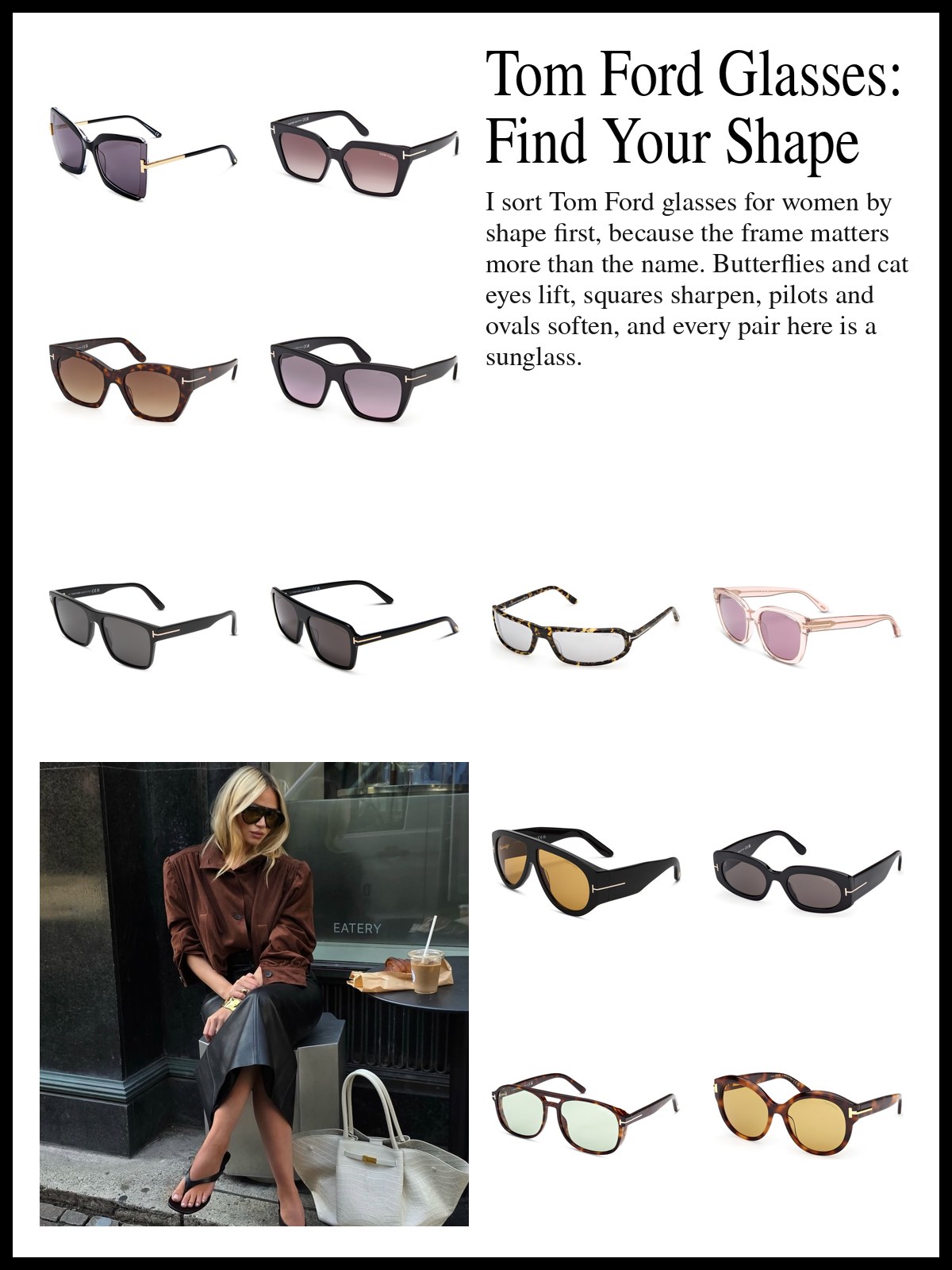
Tom Ford glasses for women, sorted by shape: cat eye and butterfly, square and rectangular, then round, oval, pilot and navigator. Every pair here is a sunglass, and the notes cover how each shape sits on the face and what to check before you commit.
Tom Ford Glasses for Women: Cat Eyes, Squares and Pilots Worth Trying On
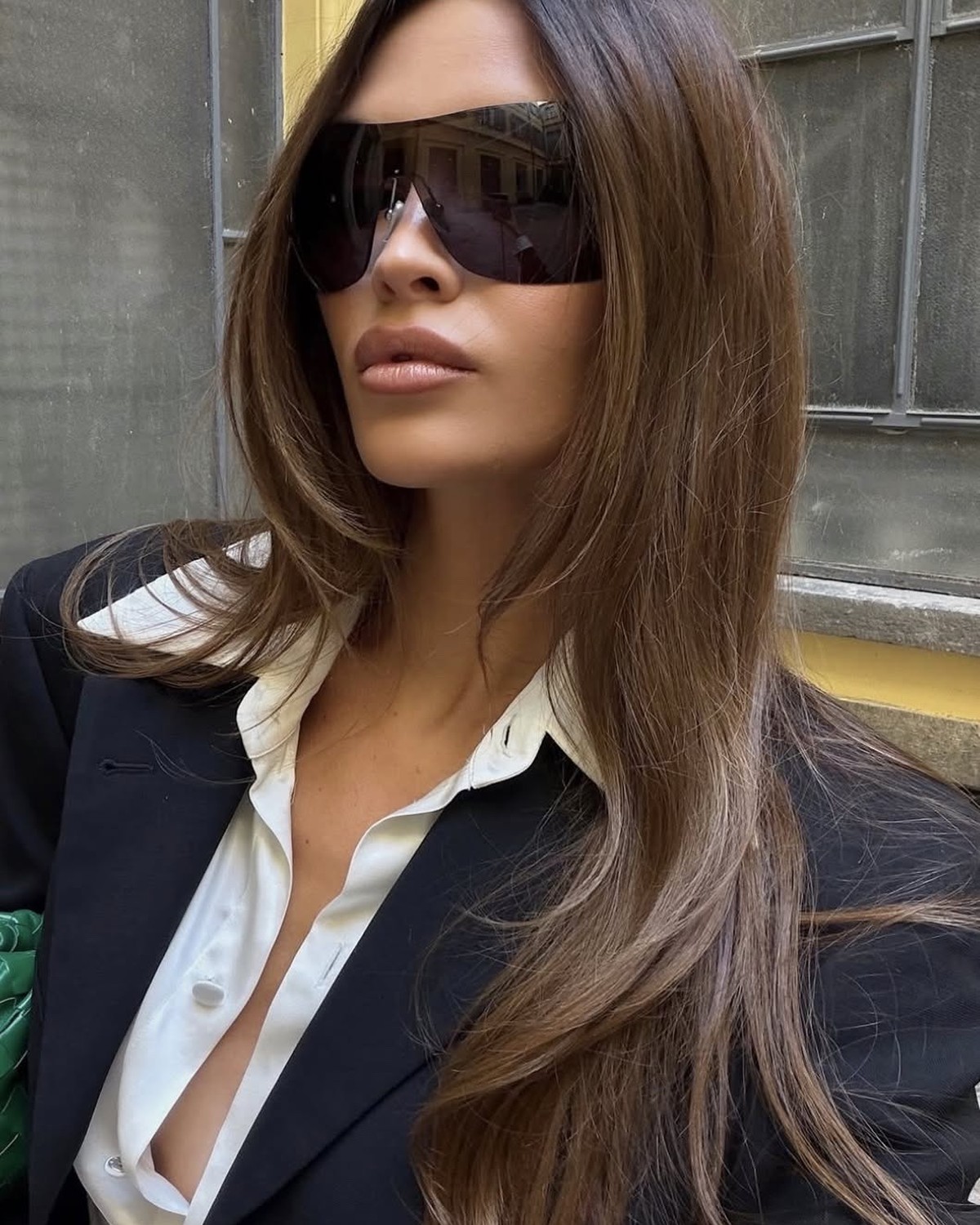
The first Tom Ford Eyewear collection was due to be presented in October 2005, after Marcolin signed a license in April of that year to design, make and distribute frames and sunglasses under the Tom Ford label. That is the quiet fact behind the whole category. These are not an afterthought to the clothes, they have had their own maker for a long time. So when I look at Tom Ford glasses for women, I start with a plain reminder: every pair in this edit is a pair of sunglasses, not optical frames.
I like to sort by shape before anything else, because the shape decides how a pair sits on your face, and the name on the temple does not. The first group is the cat eye and the butterfly, the two shapes with an upswept outer corner. They lift the face rather than frame it neatly, which is why they look good with a slicked-back ponytail and a plain white shirt.
Start with size, since the millimeter number in each name tells you a lot. The Gia Butterfly at 63mm is the big one, close to a face-covering shade, so it suits a coat collar turned up. The Joanna Butterfly at 59mm and the Elvira Butterfly at 55mm are a little more moderate. The Winona Cat Eye at 53mm and the two Stacy Cat Eye pairs at 53mm are the smaller, sharper end, and the Icon Collection Cat Eye at 52mm is the smallest of the group. The Penelope is named as a Polarized Cat Eye at 59mm, which is the only pair here whose name says so. Several more butterfly and cat eye pairs have no name, only a size between 53mm and 59mm.
My fitting-room test is simple. Smile wide in the mirror. If the bottom of the frame lifts off your cheek, good. If it rests hard on the cheekbone, go down a size.
Cat eye and butterfly sunglasses

Gia Butterfly Sunglasses, 63mm
Tom Ford
$585

Winona Cat Eye Sunglasses, 53mm
Tom Ford
$480

Butterfly Sunglasses, 54mm
Tom Ford
$490

Butterfly Sunglasses, 55mm
Tom Ford
$490

Joanna Butterfly Sunglasses, 59mm
Tom Ford
$560

Elvira Butterfly Sunglasses, 55mm
Tom Ford
$490

Penelope Polarized Cat Eye Sunglasses, 59mm
Tom Ford
$490

Butterfly Sunglasses, 54mm
Tom Ford
$615

Butterfly Sunglasses, 53mm
Tom Ford
$615

Stacy Cat Eye Sunglasses, 53mm
Tom Ford
$530

Cat Eye Sunglasses, 55mm
Tom Ford
$440

Butterfly Sunglasses, 59mm
Tom Ford
$560

Icon Collection Cat Eye Sunglasses, 52mm
Tom Ford
$615

Butterfly Sunglasses, 55mm
Tom Ford
$615

Stacy Cat Eye Sunglasses, 53mm
Tom Ford
$530

Cat Eye Sunglasses, 54mm
Tom Ford
$490
Square and rectangular, the sharper shapes
Square and rectangular frames do the opposite job. Where the butterfly lifts, a square steadies. This second group is the one I reach for with a trench, a tailored blazer or a gray knit set, because the straight top line reads as precise rather than playful.
Look at the temples. Marcolin describes the elegant metal T on its Tom Ford frames as an unmistakable hallmark of the brand, and Tom Ford's own site describes an icon rectangular style as having a shiny metal T logo on the temples. It is a small, neat detail, and it is the reason a plain black square can still look like it came from somewhere in particular. Turn the pair sideways in your hand and check that it sits clean and even.
For the squares, the Vincent Square at 56mm, the Morgan Square at 55mm and the Emma Square at 51mm are the named pairs, and the Emma is the smallest and the most delicate on a narrower face. The unnamed Square pairs, at 53mm, 54mm and 55mm, are the plain ones, and I would call them the easiest first pair for anyone who has never owned a designer sunglass. The Jake Rectangular at 54mm shows up twice, and the Penn Rectangular at 53mm is a close cousin. The two other Rectangular pairs, at 53mm and 64mm, are the extremes: the 64mm is the widest pair in this group, and I would wear it with a very simple outfit and nothing else going on.
The practical test here is the width. Hold the frame against your face with the arms open: the outer edge should sit about level with the widest part of your face, not poke out past it. If it does, go smaller.
Square and rectangular sunglasses

Square Sunglasses, 55mm
Tom Ford
$370

Vincent Square Sunglasses, 56mm
Tom Ford
$370

Rectangular Sunglasses, 64mm
Tom Ford
$530

Square Sunglasses, 53mm
Tom Ford
$370

Square Sunglasses, 53mm
Tom Ford
$505

Morgan Square Sunglasses, 55mm
Tom Ford
$480

Square Sunglasses, 54mm
Tom Ford
$490

Emma Square Sunglasses, 51mm
Tom Ford
$490

Rectangular Sunglasses, 53mm
Tom Ford
$615

Jake Rectangular Sunglasses, 54mm
Tom Ford
$585

Jake Rectangular Sunglasses, 54mm
Tom Ford
$585

Penn Rectangular Sunglasses, 53mm
Tom Ford
$490
Round, oval, pilot and navigator, the softer lines
This last group is the softer one: round, oval, pilot and navigator. Rounded lines are friendlier on a face that already has strong angles, and I like them with denim, a slip dress, a camel coat and not much jewelry.
The pilots and the aviators are the classic travel pairs. The Clark Aviator comes in at 59mm, and the Reggie Brow Bar Aviator at 61mm carries, as its name says, a bar across the top, which gives it a straighter, sterner line. The Bronson Pilot at 60mm and the plain Pilot at 55mm are the closest in feel. For the navigators, the Rosco at 58mm, the Eliott at 59mm and the Stavros at 63mm sit between a square and a pilot, and the Stavros is the biggest of the three.
The ovals are the gentler end. The Iggy Oval at 49mm is the smallest pair in the whole edit, a neat little frame, and the plain Oval at 52mm and the two Chloe Oval pairs at 52mm sit just above it. The Icon Collection Round at 57mm is the one true circle here, and I would wear it with a messy bun and a big knit.
What I would skip: a very large frame, like the 63mm Stavros, if you plan to wear it all day on a small face. It is a lovely pair for a beach or a drive, but it will slide down your nose in a long afternoon. I would also skip buying on shade alone. The American Academy of Ophthalmology says darker lenses do not block more UV, and that the color and darkness of a lens say nothing about its protection.
Round, oval, pilot and navigator sunglasses

Bronson Pilot Sunglasses, 60mm
Tom Ford
$595

Oval Sunglasses, 52mm
Tom Ford
$343

Rosco Navigator Sunglasses, 58mm
Tom Ford
$490

Icon Collection Round Sunglasses, 57mm
Tom Ford
$430.5

Iggy Oval Sunglasses, 49mm
Tom Ford
$370

Chloe Oval Sunglasses, 52mm
Tom Ford
$325

Chloe Oval Sunglasses, 52mm
Tom Ford
$325

Clark Aviator Sunglasses, 59mm
Tom Ford
$480

Eliott Navigator Sunglasses, 59mm
Tom Ford
$550

Stavros Navigator Sunglasses, 63mm
Tom Ford
$550

Reggie Brow Bar Aviator Sunglasses, 61mm
Tom Ford
$525

Pilot Sunglasses, 55mm
Tom Ford
$620
How I would choose one pair
Here is how I would choose one pair. Decide the shape first, then the size, then the color. If you wear a lot of tailoring, start with the squares. If your outfits are soft and slouchy, the butterfly or the oval will give them a lift or a finish.
Then check the protection, not the look. The American Academy of Ophthalmology says to choose sunglasses that block 99 to 100 percent of both UVA and UVB radiation, and that a label of 100 percent UV400 means the same thing. I would read the label on any pair before I decided, and I would not assume anything from the lens color.
A last word on screens. The same group says it does not recommend blue light-blocking glasses for computer use, because there is no scientific evidence that blue light from screens damages the eyes. So these are for the sun, and that is where I would wear them. Try them on in daylight, at a window if you can, and keep the pair that feels like you. If you want to keep browsing, I also put together Versace Glasses for Women and Glasses That Do the Talking.






