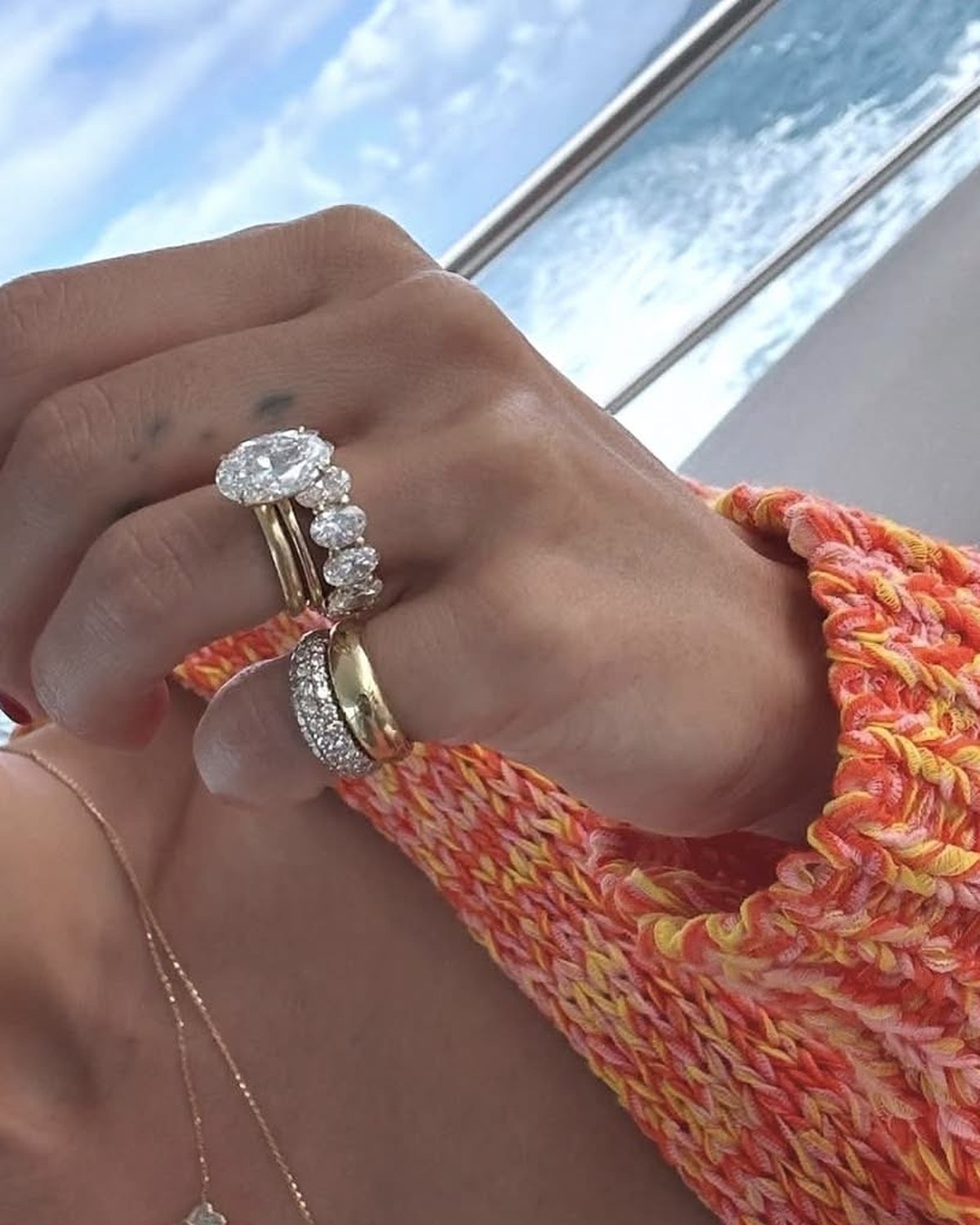
This wedding ring stack edit moves from diamond eternity bands and plain gold wedding rings to contours, pavé, gemstones and coordinated enhancers. I would begin with the engagement ring already in your jewelry box, then build around its shape, color and daily comfort.
Wedding ring stack: The Bridal Band, Rewritten in Layers
A ring stack with a past
In London, March 1961, Nathan Cousins bought his wife Doris a double eternity ring from Kutchinsky: two rows of baguette diamonds set in platinum in a chevron pattern. It is not a bridal stack in the way we picture one now, but it already holds the idea that a wedding ring can grow beyond a matched pair. That is what I like about a wedding ring stack. The story need not end at the ceremony.
A plain gold wedding band has its own long history. One jewelry history traces Roman betrothal rings from iron to gold, and says a plain gold band had become the standard British wedding ring by the eighteenth century. The gem-set eternity band grew from the keeper ring, worn beside a wedding ring, with matching stones appearing on some keepers by the mid-eighteenth century. By 1934, Princess Marina chose three eternity rings, in diamonds, rubies and sapphires, as her wedding bands. WWD's 2026 bridal coverage describes a newer version of that collecting instinct: building a stack over time and choosing designs that feel personal.
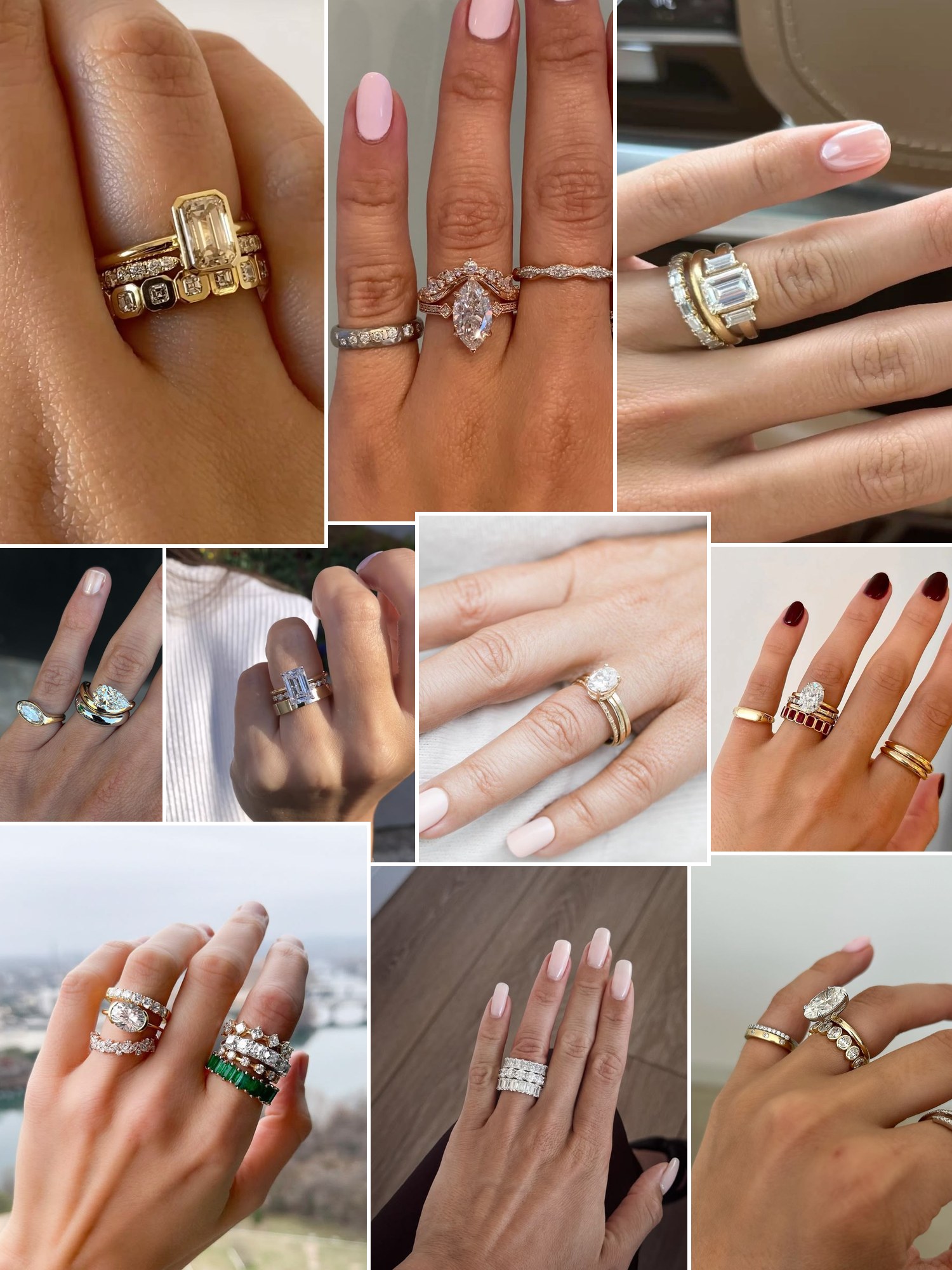
For the first layer, I would compare the Riviera Eternity Lab Diamond Ring, with round stones circling the slim band, against the Evening Star Eternity Diamond Ring, where ten round diamonds sit in starburst settings. The Baguette Diamond Eternity Band makes the line sharper; the Lab Grown Diamond Eternity Band returns to round stones. The Flowing 0.75 TCW Lab-Grown Diamond Eternity Band bends the silhouette, while the double-row eternity band changes the proportion altogether. My fitting-room test is simple: look at the rings from above and from the side, then open and close your hand. If the stones crowd the engagement setting, leave some air.
Diamond eternity bands
&link=https%3A%2F%2Fwww.brilliantearth.com%2FRiviera-Eternity-Lab-Diamond-Ring-(1-ct.-tw.)-14K-Gold-BE2DR100ELC%2F)
Riviera Eternity Lab Diamond Ring (1 ct. tw.)
Brilliant Earth
$1,490

Evening Star Eternity Diamond Ring
Brilliant Earth
$1,150

Baguette Diamond Eternity Band
Mejuri
$1,600

Lab Grown Diamond Eternity Band
Mejuri
$838

14K Yellow Gold Round Lab-Grown Diamond Shared-Prong Eternity Band
Saks Fifth Avenue Collection
$1,470

Flowing 14K Yellow Gold & 0.75 TCW Lab-Grown Diamond Eternity Band
näas
$790

1Ct Princess Cut Diamond Eternity Stackable Wedding Ring 14K Gold Lab Grown
Bliss
$811

Lab Grown Diamond Double Row Eternity Band 14k
Julianna B.
$1,540
Plain gold, with a point of view
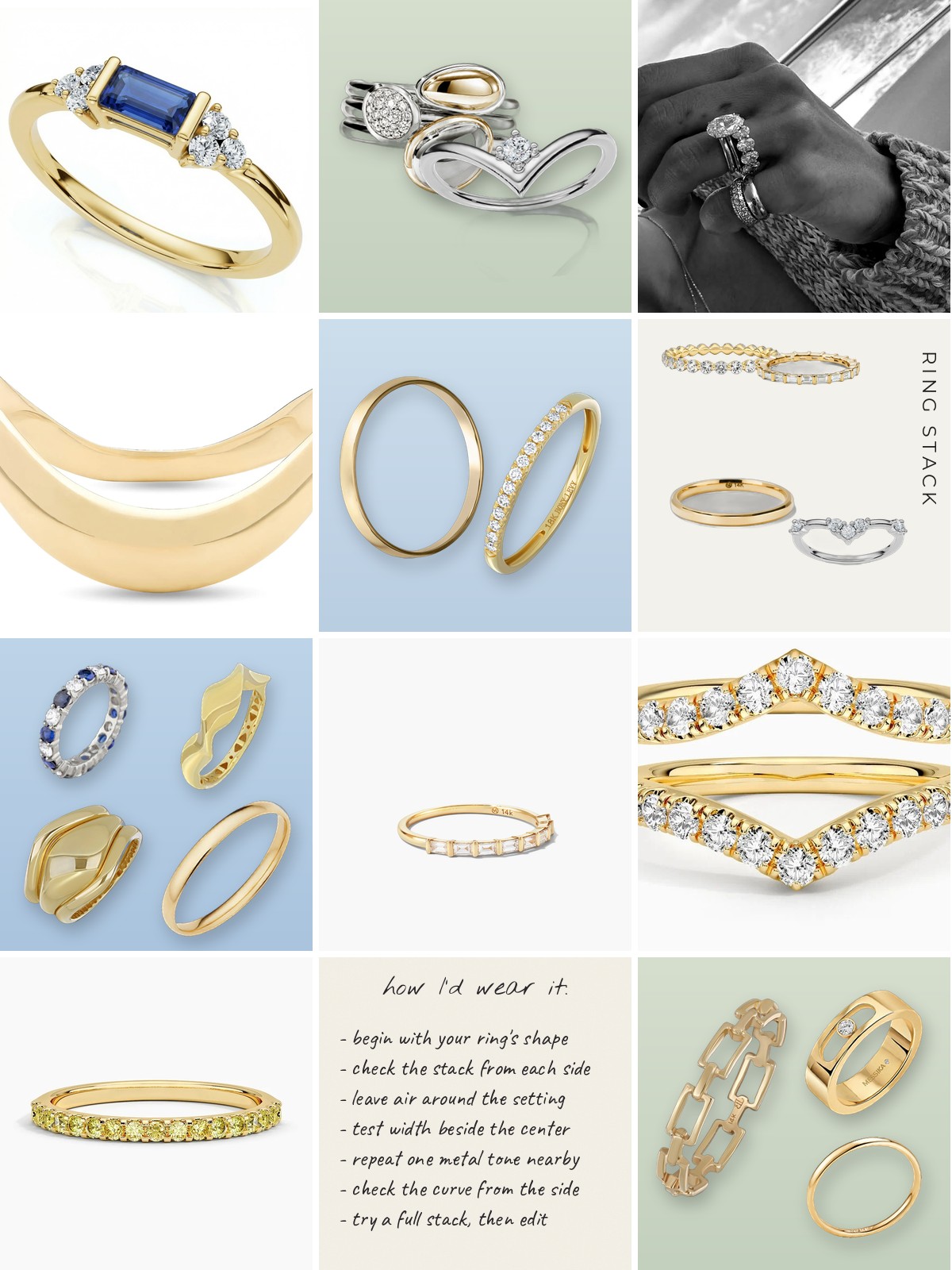
By the eighteenth century, a plain gold band had become standard in Britain, and I still understand the argument for letting one quiet circle hold the line. The widths here make the choice visible: The 2mm Smooth Band is a pencil stroke, while the 3.5mm Comfort Fit Wedding Ring has a more substantial, softly domed face. Between them sit the 2mm Comfort Fit Wedding Ring and Bliss Diamond's 2mm 14K Gold Comfort Fit Plain Wedding Band, each with a smooth interior detail.
DEVATA's 2mm Classic Dome Band Ring keeps a rounded highlight, Bony Levy's 14K Gold Everyday Smooth Band Ring looks restrained beside a pavé row, and David Yurman's DY Eden Band Ring adds softly textured edges without stones. I would wear a narrow band beside an engagement ring with a busy gallery, or let the broader band be the only wedding ring on a simpler setting. If you are mixing metals, repeating one tone elsewhere on the hand can make the contrast feel deliberate.
Try the width beside the setting instead of judging a band alone: the center stone needs room to read, and the ring should pass your knuckle without a fight. What I would skip: a broad plain band beside a low, detailed setting if the band hides its profile. I'd rather let the metal be the calm note and reserve sparkle for one clear place.

2mm Smooth Band
Mejuri
$538

2mm Comfort Fit Wedding Ring
Brilliant Earth
$390

3.5mm Comfort Fit Wedding Ring
Brilliant Earth
$690

2mm 14K Gold Comfort Fit Plain Wedding Band
Bliss Diamond
$309

2mm Classic Dome Band Ring in 14K Gold
DEVATA
$187.5

14K Gold Everyday Smooth Band Ring
Bony Levy
$350

Classic Gold Band
The Lovery
$316

DY Eden Band Ring in 18K Yellow Gold, 2MM
David Yurman
$1,300
Curves that follow the setting
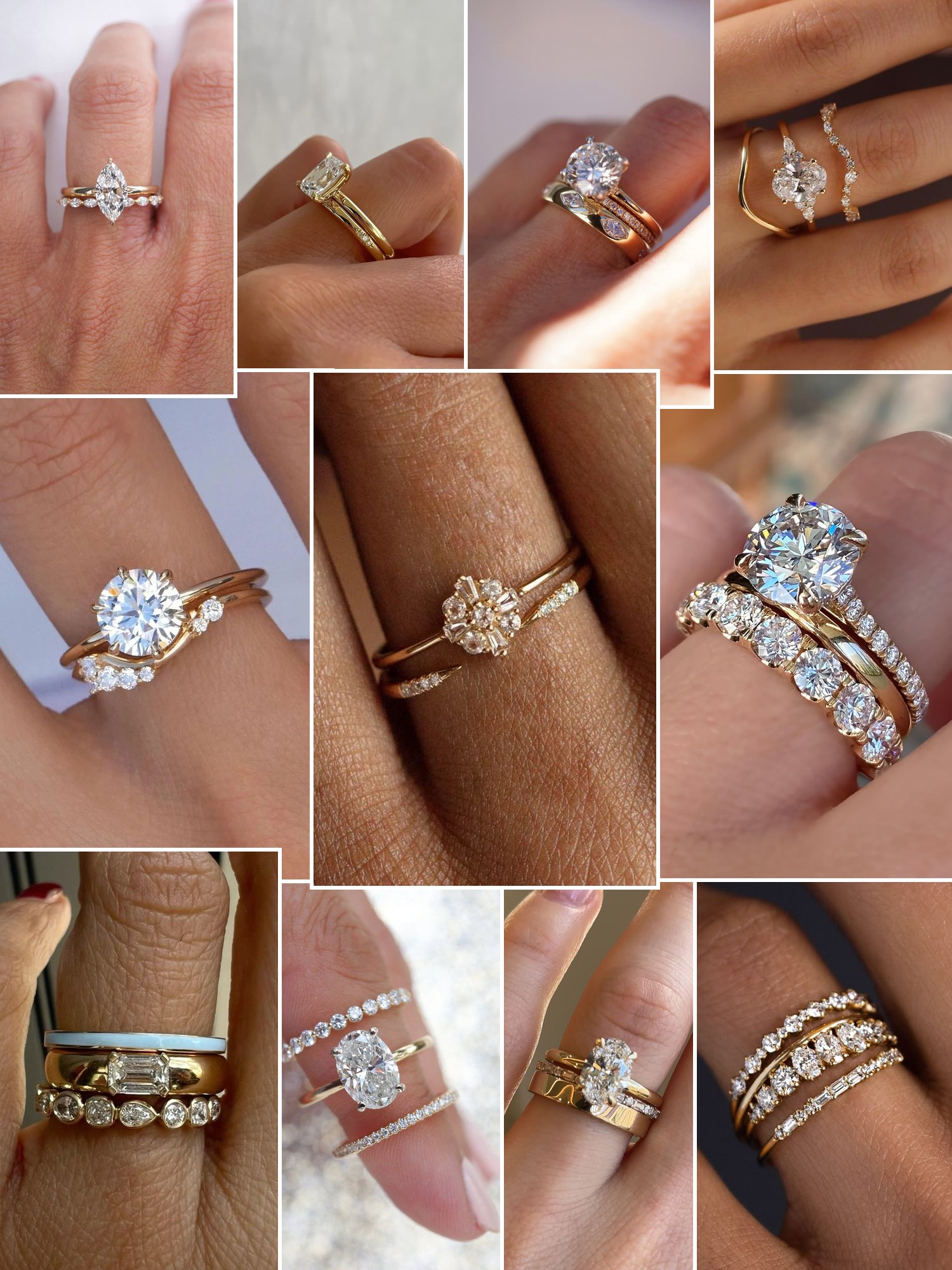
A straight band can leave a wedge-shaped gap when the center setting drops into its path. That is when a contour or curved band earns its curve: it is shaped to nest around the engagement ring and close the space a straight band can leave. I would start by looking at the ring from the side, not by guessing from the center stone's outline.
The 2mm Curve Band is a quiet sweep; its 4mm Curve Band makes the curve part of the look. The 1.5mm Curved Wedding Ring stays narrow and polished. For a pointed profile, Bliss Diamond's Diamond Stackable Chevron Wedding Ring gives a white-gold V with a small diamond accent, while DEVATA's Chevron Lab Grown Diamond Ring uses a pear-cut tip and round stones. Its Chevron Round Lab Grown Diamond Ring centers a round stone at the point instead.
Bony Levy's 14K Gold Wavy Band Ring has a ridged, undulating line, and LANA's Skinny 14K Gold Curved Bubble Ring gives the crescent a smooth, sculptural profile. I would bring the actual engagement ring to a fitting, check the pair from top and side, and move my hand naturally. What I would skip: choosing a deep V just because the product photo looks dramatic, before checking that it clears the setting and still makes sense worn alone.

2mm Curve Band
Mejuri
$538

4mm Curve Band
Mejuri
$898

1.5mm Curved Wedding Ring
Brilliant Earth
$490

Diamond Stackable Chevron Wedding Ring 14k Gold Lab Grown
Bliss Diamond
$448

Chevron Lab Grown Diamond Ring in 14K Gold
DEVATA
$337.5

Chevron Round Lab Grown Diamond Ring in 14K Gold
DEVATA
$300

14K Gold Wavy Band Ring
Bony Levy
$625

Skinny 14K Gold Curved Bubble Ring
LANA
$1,160
Pavé, baguettes and a blue note
A line of pavé can echo an engagement ring's sparkle or introduce a second texture, and WWD's June 2026 bridal coverage makes the case for personal choices over one dominant setting. I would decide first whether this layer should blend in or be the one small surprise.
The Baguette Diamond Half Eternity Band gives a straight, half-circle rhythm; its Aurora Lab Grown Sapphire Eternity Ring surrounds a gold-vermeil band with white sapphires. The Bliss Lab Diamond Ring uses scalloped pavé arcs, while the Yellow Lab Diamond Ring adds a warm line of yellow stones. For a blue focal point, Bliss Diamond's 1/3Ct Thin Sapphire Diamond Stackable Wedding Ring pairs an emerald-cut sapphire with diamond clusters. Fantasia by DeSerio's 14K White Gold band circles blue sapphires and cubic zirconia, and Bony Levy's Pavé Diamond Stacking Ring gives the stack a full row of sparkle.
I would repeat one detail, perhaps the metal color or a stone shape, then let the rest vary. Check the band against the engagement setting for height and width, and see whether the half-eternity line or full circle feels more natural on your hand. What I would skip: pairing two full rows of stones at the same scale beside a large center setting, unless uninterrupted sparkle is the point.

Baguette Diamond Half Eternity Band
Mejuri
$998

Aurora Lab Grown Sapphire Eternity Ring
Mejuri
$258
&link=https%3A%2F%2Fwww.brilliantearth.com%2FBliss-Lab-Diamond-Ring-(1%2F5-ct.-tw.)-14K-Gold-BE2FPD14LC%2F)
Bliss Lab Diamond Ring (1/5 ct. tw.)
Brilliant Earth
$950
&link=https%3A%2F%2Fwww.brilliantearth.com%2FYellow-Lab-Diamond-Ring-(1%2F4-ct.-tw.)-14K-Gold-BE2D318LC%2F)
Yellow Lab Diamond Ring (1/4 ct. tw.)
Brilliant Earth
$990

1/3Ct Thin Sapphire Diamond Stackable Wedding Ring 14k Gold Lab Grown
Bliss Diamond
$488
&link=https%3A%2F%2Fwww.nordstrom.com%2Fs%2Fpave-diamond-stacking-ring-nordstrom-exclusive%2F7948274%3Fphia%3D1)
Pavé Diamond Stacking Ring (Nordstrom Exclusive)
Bony Levy
$945

18K Yellow Gold & Diamond Wedding Band
Messika
$3,650

14K White Gold
Fantasia by DeSerio
$1,395
Sets that leave room to grow
When Princess Marina married Prince George in 1934, she chose three eternity rings as wedding bands, in diamonds, rubies and sapphires. A stack can be a composition from the start, or a record that gathers a new layer with time. WWD's 2026 coverage quotes a jeweler describing just that shift, away from a one-time decision and toward building a stack over time.
The Wishbone Ring Stacker Set pairs a pavé wishbone with a plain gold companion; the Slim Charlotte Stacker Set sets white sapphires against smooth gold vermeil. The Flair Nested Lab Diamond Ring Stack follows an engagement ring's shoulders with scalloped pavé, while Bony Levy's Set of 3 14K Gold Stacking Rings gives you three coordinated gold profiles. John Hardy's Surf Pebble Set of 3 Stacking Rings mixes silver, 14K gold and diamonds. Bliss Diamond's 1/4Ct Diamond Guard Wedding Stack Ring adds a slightly contoured frame; Oradina's 14K Yellow Gold Forever Band Stack Ring keeps the outside layer low and polished.
I would choose the engagement ring first, then one band that echoes its finish and another that changes the rhythm. Try the complete set together, then see whether each piece still has a role on its own. If the combination presses, rocks or crowds the setting, simplify it before adding another ring.

Wishbone Ring Stacker Set
Mejuri
$696

Slim Charlotte Stacker Set
Mejuri
$218
&link=https%3A%2F%2Fwww.brilliantearth.com%2FFlair-Nested-Lab-Diamond-Ring-Stack-(7%252F8-ct.-tw.)-14K-Gold-BE629%2F)
Flair Nested Lab Diamond Ring Stack (7/8 ct. tw.)
Brilliant Earth
$2,480

Set of 3 14K Gold Stacking Rings
Bony Levy
$1,595

Surf Pebble Set of 3 Stacking Rings
John Hardy
$1,595

1/4Ct Diamond Guard Wedding Stack Ring 14K Gold Lab Grown
Bliss Diamond
$608

14K Gold Link Stacking Ring
Bony Levy
$495

14K Yellow Gold Forever Band Stack Ring
Oradina
$230
Let the first band lead
I would choose in this order: the engagement ring's shape, a wedding band that sits comfortably beside it, then a stone or texture that feels personal. A plain gold ring can be the anchor; an eternity band, a contour or a nested set can build outward without requiring every piece to match.
There is room in the history for both the unadorned band and the jeweled keeper, from Britain's gold circles to that double eternity ring Nathan Cousins chose in London in 1961. I would keep the stack flexible, add one ring at a time and let the combination reflect the life around it. A ring box can be a small archive, not a final answer. If you want to keep browsing, I also put together How to Stack Rings Without It Looking Cluttered and Bridal Shoes.






