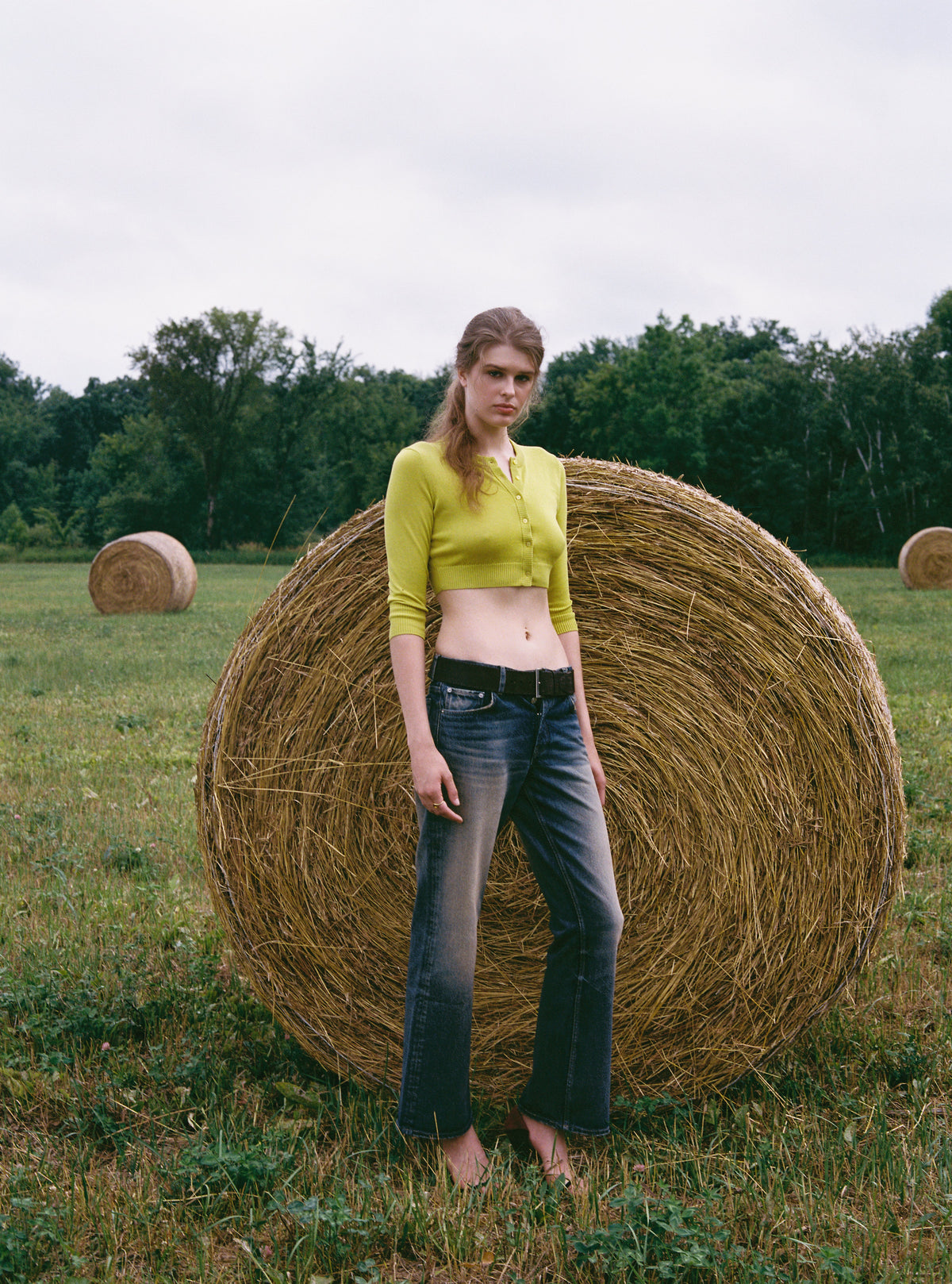
Auralee grew out of a Tokyo textile wholesaler in 2015, when designer Ryota Iwai began developing his own fabric rather than buying stock cloth, sourcing wool as far as Mongolia. I went through knitwear, bottoms and outerwear to see where fabric alone can carry a wardrobe.
Auralee

Fabric Before Anything Else
Ryota Iwai started Auralee in Tokyo in 2015 out of a textile wholesaler, and he still develops much of the brand's own cloth rather than buying it off a shelf, sourcing wool as far as Mongolia and tweed woven in Iwate in northern Japan. Iwai grew up around vintage shops in Kobe and later trained at Bunka Fashion College, and that early interest in old workwear still shows in how plain his shapes stay. The cashmere cardigan is the clearest example, a simple shape that depends entirely on the hand of the yarn to feel special. The ribbed cashmere turtleneck sweater makes the same case in a closer fit, where the rib itself becomes the only detail.
I would judge every piece here by how it feels against the hand before deciding whether the shape works for you. A logo would only get in the way of that decision.

Cashmere cardigan
Auralee
$720

Cashmere cardigan
Auralee
$720

Wool half-zip sweater
Auralee
$750

Striped wool-jersey T-shirt
Auralee
$310

Ribbed cashmere beanie
Auralee
$270

Ribbed cashmere beanie
Auralee
$270

Striped wool-jersey T-shirt
Auralee
$395

Checked cotton and silk-blend shirt
Auralee
$735

Wool sweater
Auralee
$610

Fringed checked cashmere scarf
Auralee
$475

Wool cardigan
Auralee
$670

Striped cotton and silk-blend shirt
Auralee
$565

Cashmere scarf
Auralee
$310

Cashmere scarf
Auralee
$310

Ribbed cashmere turtleneck sweater
Auralee
$710

Wool shirt
Auralee
$525

Cotton-twill shirt
Auralee
$485

Garment-dyed alpaca cardigan
Auralee
$975

Cotton and cashmere-blend T-shirt
Auralee
$270

Ribbed cotton-jersey T-shirt
Auralee
$160

Suri alpaca-blend sweater
Auralee
$525

Knitted striped cotton T-shirt
Auralee
$545

Ribbed-knit cotton T-shirt
Auralee
$285

Giza fine knit cotton shirt
Auralee
$605
Where The Proportion Shows Up
Bottoms are where the proportion argument at Auralee gets tested against your own body, not just admired on a hanger. The silk wide-leg pants have enough drape to move rather than stand away from the leg, so the rise and length matter more than usual. The pleated wool straight-leg pants take a more structured route, where a crisp pleat can look sharp or simply heavy depending on how it lands on the shoe. I would check both against shoes you actually own before deciding, since quiet tailoring only reads as easy when the proportions are already right.

Asymmetric fringed checked cashmere wrap midi skirt
Auralee
$2,740

Silk wide-leg pants
Auralee
$690

Silk mid-rise wide-leg pants
Auralee
$690

Wool and cotton-blend straight-leg pants
Auralee
$735

Pleated wool straight-leg pants
Auralee
$525

Herringbone wool wide-leg cargo pants
Auralee
$825

Distressed mid-rise wide-leg jeans
Auralee
$635

Pleated cotton-poplin midi skirt
Auralee
$970
The Layer That Finishes It
Auralee began showing on the Paris menswear runway in 2019, and the outerwear is where that step shows up most, one finished layer without a conspicuous badge doing the convincing. The wool, cotton and linen-blend jacket has enough weight to work as a real outer layer, while the cotton jacket is lighter and closer to a shirt-jacket you could wear indoors. Both rely on the same idea as the knitwear: texture and cut carrying the interest instead of a name on the chest. I would choose whichever jacket solves an actual gap in your closet rather than the one that looks most unusual on its own.


Judge It By Hand
Auralee rewards a more exacting eye than a logo-led label does, and that is really the whole argument for it. With the knitwear, the hand and weight decide whether a piece disappears under a coat or actually anchors the outfit. With the bottoms, the rise and hem only work when they are checked against shoes already in a closet, not judged in isolation. The outerwear is the simplest place to see the logic at work, one finished layer with no badge doing the convincing. I would start with knitwear if a wardrobe is mostly relaxed basics, and with the jacket if something is needed to wear out the door. Either way, the fabric should be doing the convincing, not the name on the label.