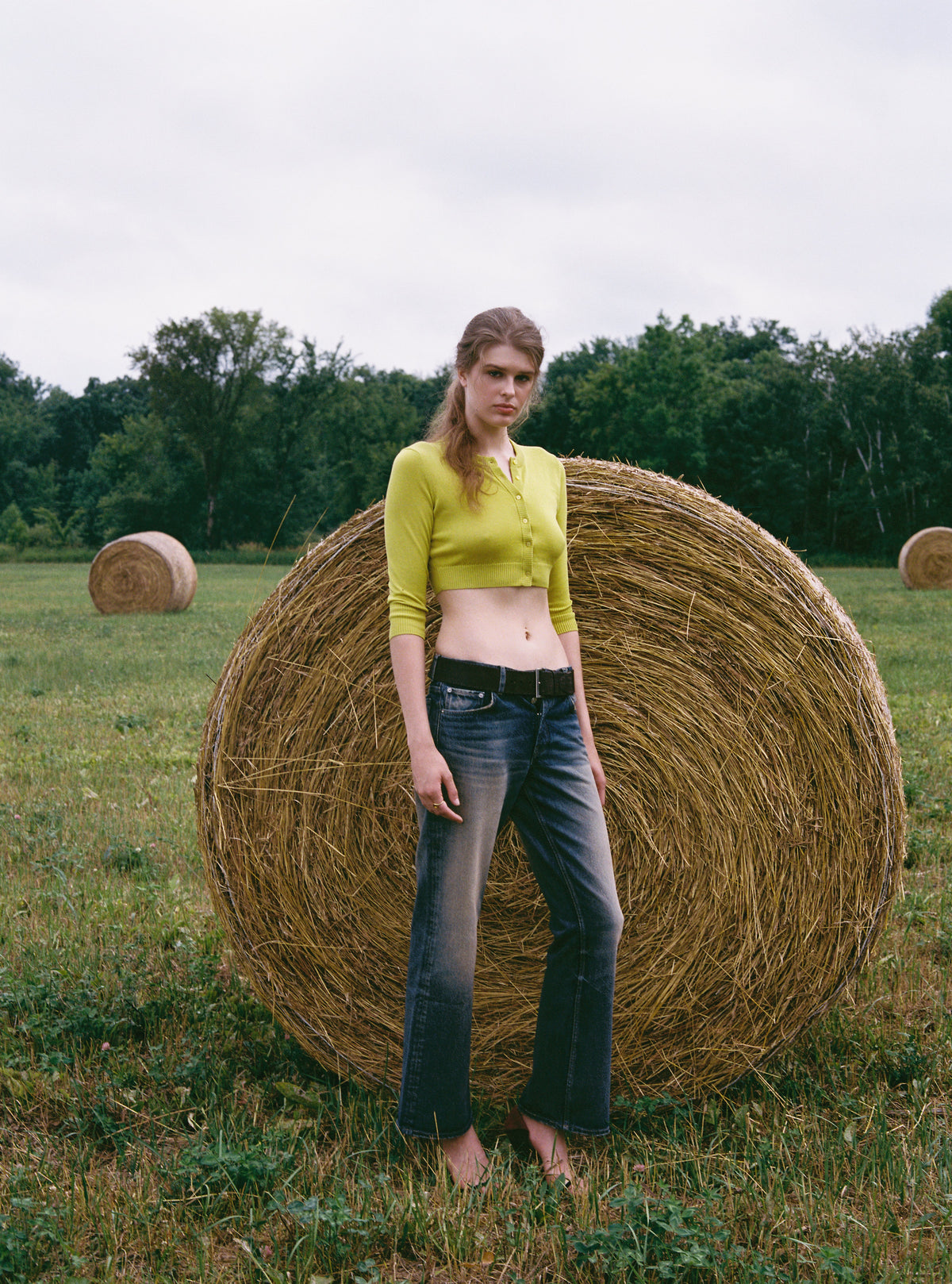
Blaze Milano started in 2013 when three former Elle editors, Corrada Rodriguez d'Acri, Delfina Pinardi and Maria Sole Torlonia, decided no brand had ever built its entire range around one garment: the blazer. Every piece is still made in Italy, and the idea carries into dresses, skirts and knitwear built around the same sharp shoulder line.
Blazé Milano

A Blazer For Actual Life
Corrada Rodriguez d'Acri, Delfina Pinardi and Maria Sole Torlonia met working as editors at Elle, and in 2013 they built a brand around the one garment they all reached for anyway: the blazer, made entirely in Italy. The Nightbreak checked wool blazer is the most legible example of that focus, a shape sharp enough to wear alone over a plain top. The Coiba wool and cashmere-blend jacket softens that same structure slightly, useful for a day that moves between a desk and something more relaxed after. The Everynight double-breasted blazer, one of the label's original styles, still holds up as the oversize option in the group.
I would start with one of these before looking at the dresses or skirts, since the jacket is where the tailoring reads most clearly. What interests me here is how a jacket can sharpen ordinary pieces rather than demand a special occasion.

Clelia corduroy-trimmed checked wool jacket
Blazé Milano
$2,370

Nightbreak checked wool blazer
Blazé Milano
$2,050

Coiba wool and cashmere-blend jacket
Blazé Milano
$2,370

Chausie wool-blend jacket
Blazé Milano
$2,150

Coiba Leather-Trimmed Velvet Jacket
Blazé Milano
$2,370

Everynight double-breasted blazer
Blazé Milano
$1,825

Everynight checked double-breasted wool blazer
Blazé Milano
$1,885

Shamo velvet-trimmed sequined jacket
Blazé Milano
$1,620

Tatoosh leather-trimmed shearling jacket
Blazé Milano
$2,990

Tatoosh shearling jacket
Blazé Milano
$3,830

Cotton-velvet jacket
Blazé Milano
$1,505

Clelia matellassé cotton-corduroy jacket
Blazé Milano
$1,940

Clelia corduroy-trimmed herringbone jacket
Blazé Milano
$2,150

Shamo Bolero cropped Prince of Wales wool jacket
Blazé Milano
$1,620

Chausie checked wool trench jacket
Blazé Milano
$2,095

Altai checked wool and cashmere-blend jacket
Blazé Milano
$1,995

Checked wool blazer
Blazé Milano
$1,735

Everynight cotton-velvet blazer
Blazé Milano
$1,395

Dales crepe jacket
Blazé Milano
$1,675

Everyday checked wool and cashmere-blend jacket
Blazé Milano
$1,735

Charmer pinstriped wool blazer
Blazé Milano
$1,995

Everyday double-breasted herringbone wool-blend blazer
Blazé Milano
$1,825

Coiba herringbone jacket
Blazé Milano
$2,050

Saona Charmer double-breasted checked virgin wool blazer
Blazé Milano
$1,560
One Decision, Not A Stack
The dresses make sense for the days when getting dressed needs to be a single decision rather than an outfit built from separate pieces. The Friesian crepe maxi dress carries the same clean shoulder line as the blazers, just built into one garment instead of layered on top of a top. The Novalis crepe midi dress is the more versatile length, easier to dress down with flat shoes than a full maxi. I would treat the embellished Anyway mini dress as the outlier here, a piece for a specific night rather than a regular rotation. Either way, the tailoring logic holds even without a jacket in the mix.


Structure With Room To Move
The skirts and trousers keep the label's polish but leave room for a softer knit or a plain shirt on top, which matters because head-to-toe tailoring can turn into costume very quickly. The Darryl leather straight-leg pants repeat the sharp line of the blazers in a completely different fabric, useful for a day that calls for less formality but the same silhouette. The Coci checked wool mini skirt does similar work at a shorter length, pairing easily with the same knitwear as the rest of this edit. I would resist buying every category at once and instead pick the piece whose silhouette gets reached for on an ordinary day. The rest can be added slowly, once that is clear.

Ara velvet-trimmed crepe midi skirt
Blazé Milano
$750

Coci plush mini skirt
Blazé Milano
$560

Coci checked wool mini skirt
Blazé Milano
$600

All About You Malaya sequin-embellished maxi skirt
Blazé Milano
$850

Darryl leather straight-leg pants
Blazé Milano
$1,190

Coci cotton-velvet mini skirt
Blazé Milano
$545

Fox straight-leg cotton-velvet pants
Blazé Milano
$975

Coci cotton-corduroy mini skirt
Blazé Milano
$490

Popeye leather midi skirt
Blazé Milano
$1,030

Fox checked wool straight-leg pants
Blazé Milano
$655

Fox checked wool pants
Blazé Milano
$645

Popeye pinstriped wool knee-length skirt
Blazé Milano
$645

Lundy crepe straight-leg pants
Blazé Milano
$610

Coci herringbone wool-blend mini skirt
Blazé Milano
$530

Leather mini skirt
Blazé Milano
$405

Jealousy cotton-velvet mini skirt
Blazé Milano
$490

Nightbreak linen, wool and silk-blend mini skirt
Blazé Milano
$470

Vezon pleated tapered woven pants
Blazé Milano
$700

Ourway cotton‑blend woven mini skirt
Blazé Milano
$490

Denim midi skirt
Blazé Milano
$490
The Knitwear Makes It Wearable
The knitwear here is the counterpoint that makes the sharper tailored shapes feel lived in rather than formal. The Racka ribbed wool and cashmere-blend sweater works as the plain layer under any of the jackets, while the Highland Uda ribbed wool and cashmere-blend cardigan gives the same softness with more room to adjust for temperature. The Clapotis Maline mid-rise wide-leg jeans bring the wardrobe down to a completely ordinary register, proof that Corrada Rodriguez d'Acri and her partners are not only building occasion pieces. I would use the knitwear to answer whether a jacket or skirt still works on a day that calls for less formality. That is the real test of whether a tailored wardrobe is actually livable.

Woolly velvet coat
Blazé Milano
$2,690

Racka ribbed wool and cashmere-blend sweater
Blazé Milano
$710

Highland Uda ribbed wool and cashmere-blend cardigan
Blazé Milano
$1,190

Highland wool and cashmere-blend polo sweater
Blazé Milano
$750

Elfe Joni cable-knit wool-blend cardigan
Blazé Milano
$1,355

Clapotis Maline mid-rise wide-leg jeans
Blazé Milano
$445

Highland wool and cashmere-blend vest
Blazé Milano
$685

Gliss cotton-velvet vest
Blazé Milano
$1,285

Ribbed wool and cashmere-blend cardigan
Blazé Milano
$645

Novalis Manipur crepon tank
Blazé Milano
$475

Teke checked wool and cashmere-blend shorts
Blazé Milano
$570

Tinker cotton-velvet shorts
Blazé Milano
$490

Tatoosh shearling coat
Blazé Milano
$3,445

Highland wool and cashmere-blend polo sweater
Blazé Milano
$725

Highland wool and cashmere-blend polo sweater
Blazé Milano
$725

Highland embroidered wool and cashmere-blend sweater
Blazé Milano
$645

Berber embroidered denim shirt
Blazé Milano
$670

Highland embroidered wool and cashmere-blend sweater
Blazé Milano
$645

Highland wool and cashmere-blend vest
Blazé Milano
$685

Clapotis Maline mid-rise wide-leg jeans
Blazé Milano
$490

Highland Dorset ribbed-knit wool and cashmere-blend sweater
Blazé Milano
$925

Racka ribbed-knit wool and cashmere-blend sweater
Blazé Milano
$710

Berber leather shirt
Blazé Milano
$605

Nitak Curly virgin wool coat
Blazé Milano
$2,260
The Weekday Test
My test for a designer wardrobe is whether I can imagine wearing the pieces on a completely unremarkable weekday. Blaze Milano blazers pass that test when they are treated as workhorses rather than a uniform: put one over a simple top, then decide whether the outfit needs the structure of a skirt or the ease of knitwear. The dresses make sense for the days when getting dressed needs to be a single decision, while a good blazer gives a familiar pair of trousers a reason to come back into rotation. I would resist buying every category at once. Pick the silhouette that actually gets reached for, then use the other pieces to build around it slowly. That is the difference between a label with a recognizable signature and a closet full of clothes that only make sense in a showroom.