Cashmere is warmer and softer per gram. Merino lasts longer and costs far less. Here is which one your money should go to.
Cashmere vs Merino: Which Sweater Is Worth the Money

Why cashmere costs what it costs
The price gap is a supply story, not a marketing one. A cashmere goat produces roughly 150 to 300 grams of usable undercoat per year once the coarse guard hairs are separated out. A merino sheep produces three to five kilograms of fleece. That is something like a fifteen to twenty-five times difference in yield per animal per year, and it flows through every stage after it.
The fiber itself is genuinely different. Cashmere measures around 14 to 19 microns in diameter, merino around 17 to 24. Finer fiber with more crimp traps more air, which is why cashmere delivers roughly three times the warmth of wool at the same weight and feels soft rather than prickly against the neck.
So the premium buys two real things: lightness for a given warmth, and softness next to skin. What it does not buy is durability. That is the trade-off, and any honest version of this comparison leads with it. A Skye Cashmere Crewneck at $445 is buying fineness, not longevity.
Cashmere worth the cost


Where merino wins, and it wins often
Merino is more elastic, which is the property that decides how a sweater ages. It springs back rather than drapes, so cuffs and hems recover their shape, elbows do not bag out and the garment survives being worn twice a week. Cashmere has lower elasticity and pills more readily, particularly where the arm rubs the body.
Price is the other half. A good merino crewneck lands well under half what comparable cashmere costs, which changes what you can do with it. You can own three, wear them in rotation, and not think about it. A Cobel Regenerative Wool Cardigan at $248 is that kind of purchase.
The honest split is by role rather than by budget. Merino for daily knitwear, travel, anything worn over a shirt, anything you will wash often. Cashmere for the lightweight layer you want against skin, the thing you pack because it weighs nothing, the sweater you wear to be comfortable rather than to work. Most wardrobes want both, doing different jobs.
If you can only buy one, buy merino.
Everyday knits at a lower price

Eugenie Top
Reformation
$168

Nikki Cashmere Crew
Reformation
$124.6

Elliot Boucle Crew
Reformation
$218

Lowen Regenerative Wool Embroidered Cardigan
Reformation
$198

Starling Cotton Sweater Tank
Reformation
$128

Amy Regenerative Wool Sweater Set
Reformation
$298

Roxana Cashmere Sweater Tank
Reformation
$178

March Regenerative Wool Cropped Turtleneck
Reformation
$198
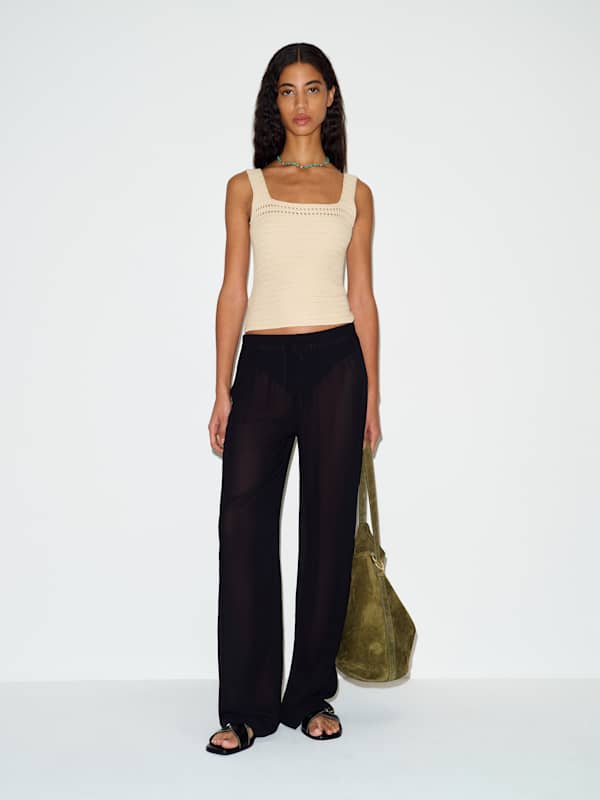
Azara Cotton Sweater Tank
Reformation
$128
How to judge a sweater in thirty seconds
The fiber name on the label is the least useful information on it. A 100% cashmere label discloses composition and nothing about fiber length, yarn twist, ply or knit density, which is where quality actually lives. Cheap cashmere exists in volume and it is made from short, coarse fibers that pill within a month.
Four checks, none of which need expertise. Weight: pick it up. Good knitwear has heft for its size, because density comes from more yarn. Stretch the hem gently and let go: it should snap back, not stay stretched. Hold it to the light: you should not see through the body of a well-knitted sweater. Rub the surface briskly with your palm for a few seconds: if fibers ball up immediately, they will keep doing that.
Also look at ply. Two-ply and above wears far better than single-ply at the same fiber grade. Where a brand states the yarn origin and the mill, as with knitwear spun and made in Scotland, that is usually a sign someone is paying attention to the parts the label does not cover.




The questions people actually ask
Is cashmere warmer than merino? Yes, roughly three times warmer per gram, because the fiber is finer with more crimp and traps more air. A thin cashmere sweater can match a much heavier wool one.
Is cashmere worth the money? For a lightweight next-to-skin layer, yes. For a sweater you will wear hard twice a week, merino is the better value because it resists pilling and holds its shape.
Does cashmere pill? All cashmere pills to some degree, most heavily in the first few wears and worst under the arms. Better cashmere pills less and stops sooner. De-pill with a comb rather than a razor.
Is merino itchy? Fine merino at the low end of its micron range is not. Coarser wool is. Micron count, not the word wool, decides itch.
How do you wash either? Hand wash cool with a wool-specific detergent, press the water out without wringing, dry flat. Never hang a wet sweater.
Which lasts longer? Merino, clearly, because of its elasticity and resistance to pilling.