A Mytheresa fine jewelry edit organized by budget, from a first diamond-and-gold piece around $1,000 to statement pieces over $10,000.
Fine Jewelry By Price Point: Diamonds, Yellow Gold And White Gold
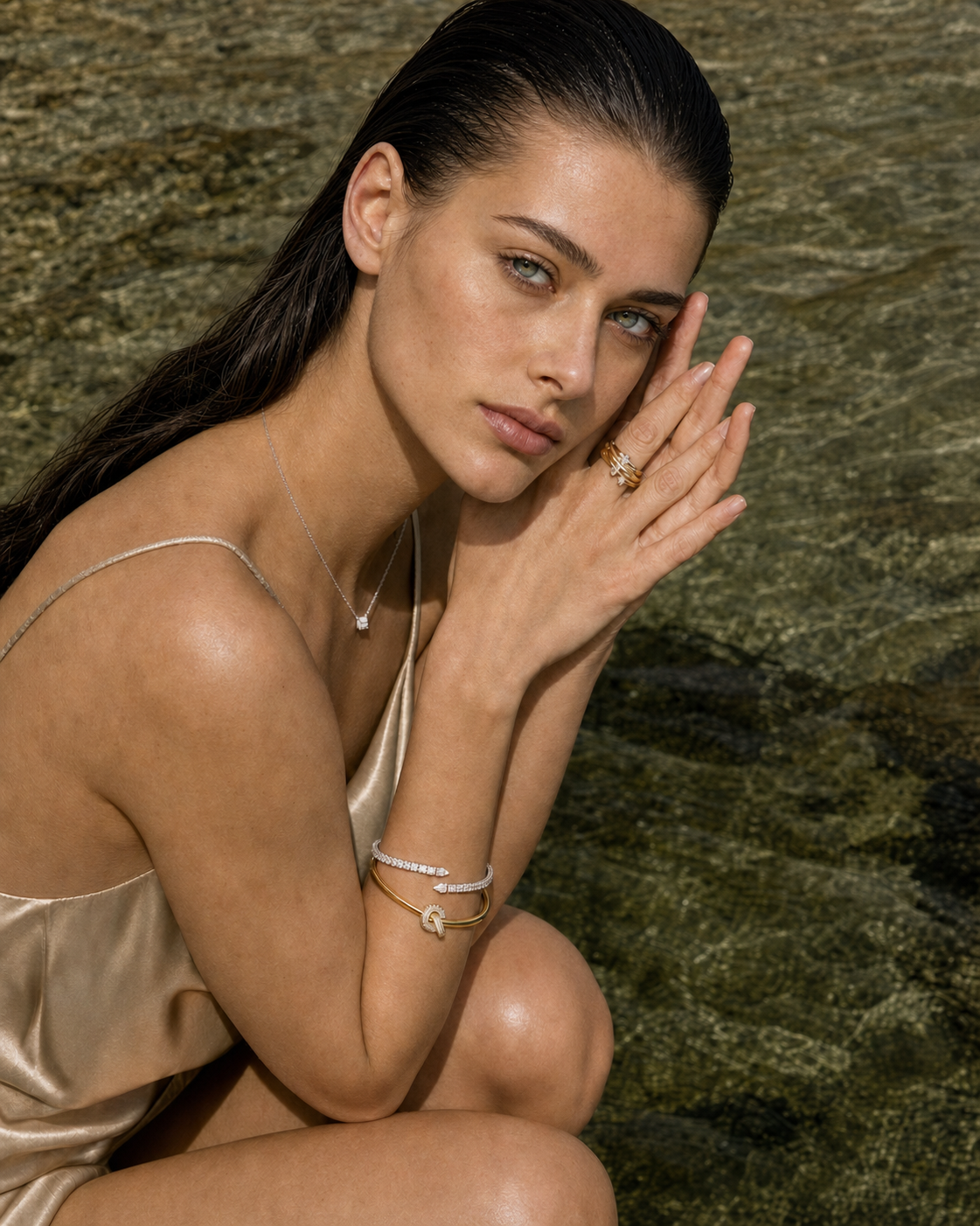
Fine Jewelry By Price Point
Fine jewelry shopping gets easier once you stop browsing by brand and start browsing by budget. Mytheresa's jewelry floor runs from a few hundred dollars in vermeil up to six-figure diamond chokers, and that spread can make it hard to know where your money actually lands or what you're paying extra for. Think of this as a map of what diamonds and gold actually cost at each rung of the ladder, not one retailer's idea of what you should want.
$1,000 to $2,000
$1,000 to $2,000 is where fine jewelry starts to feel real: solid 14kt and 18kt gold, genuine diamonds, and construction meant to last decades rather than a season. What you're paying for at this level is mostly metal purity and the size and clarity of a small, well-cut stone, not brand markup or design complexity. It's the smartest place to buy your first serious piece, or to add a small collection without committing to a five-figure decision. Nothing here needs a special occasion to justify it.
$1,000 to $2,000

Tigris MX Gris sterling silver ring with diamonds and yellow and rose gold connectors
Spinelli Kilcollin
$2,000

À La Folie 9kt gold ring with diamonds
Yvonne Leon
$1,890

Pavé 18kt gold earrings with diamonds
David Yurman
$1,750

Petite Venus 14kt gold stud earrings with diamonds
Mateo
$1,550

Rêve Simple 14kt gold necklace with diamonds and pearls
Sophie Bille Brahe
$1,420

Antifer 18kt white gold earring with diamonds
Repossi
$1,350

14kt gold ring with diamonds
Stone and Strand
$1,270

Mini Moroccan 14kt gold necklace with enamel and diamond
Sydney Evan
$1,070

Petit Boucle de Perle 14kt gold hoop earring with freshwater pearls
Sophie Bille Brahe
$1,000
$2,000 to $5,000
$2,000 to $5,000 is where the stones get bigger and the design gets more ambitious.The jump in price mostly buys more carats, a more intricate setting, or a signature design element rather than a different tier of craftsmanship altogether. This is where houses like Gucci and Bucherer Fine Jewellery start to show up: more structural, sculptural pieces alongside the classic diamond stud are seen. This is where you build out a piece meant to be worn on rotation for years, not saved for special occasions. Expect to notice the difference in hand, even if a photo can't always show it.
$2,000 to $5,000

Orangerie de Coeur 18kt gold necklace with diamonds
Sophie Bille Brahe
$5,000

Melrose 18kt gold huggie earrings with diamonds
Anita Ko
$4,800

18kt gold necklace with emeralds and diamonds
Shay Jewelry
$4,490

Courant 18kt gold single earring with diamonds
Sophie Bille Brahe
$4,200

Stretchy 18kt white gold ring with diamond and sapphires
Bucherer Fine Jewellery
$4,000

Cable Link 18kt gold ring with diamonds
Shay Jewelry
$3,790

Huggie 18kt gold earrings with diamonds
Anita Ko
$3,450

Petite Pavé 18kt gold pinky ring with diamonds
David Yurman
$3,250

18kt white gold and enamel pinky ring with diamonds
Kamyen
$3,100

Interlocking G 18kt gold necklace with onyx and diamond
Gucci
$2,750

Cable Flex® Buckle sterling silver and 14kt gold bracelet with diamonds
David Yurman
$2,500

14kt gold bracelet with diamonds
Sydney Evan
$2,005
$5,000 to $10,000
$5,000 to $10,000 is where fine jewelry starts to function as an heirloom conversation rather than a wardrobe add-on. Pieces in this range carry noticeably larger or more numerous diamonds, more elaborate gold work, and in some cases enamel or gemstone detailing that takes real hours to craft. This tier rewards trying pieces on in person if you can manage it, since at this price, proportion and how a piece actually sits on your hand or ear matters as much as anything on the spec sheet.
$5,000 to $10,000

Golden Strada 18kt yellow and white gold ring with diamonds
Yeprem
$10,000

Water Droplet 14kt gold bangle with diamond
Mateo
$9,500

Midi 18kt white gold tech ring jackets with diamonds
Suzanne Kalan
$9,000

Legacy Knot 18kt gold bangle with diamonds
Engelbert
$8,550

18kt white gold earrings with diamonds
Suzanne Kalan
$8,000

Pavé 18kt white gold pinky ring with diamonds
Shay Jewelry
$7,470

Love Smash 18kt gold and leather pendant necklace with diamond
Marie Lichtenberg
$7,040

Heart 18kt white gold ring with emeralds and diamonds
Kamyen
$6,750

Croissant De Lune 18kt gold single earring with diamonds
Sophie Bille Brahe
$6,400

Nudo Solitaire 18kt rose and white gold necklace with diamonds
Pomellato
$5,950

18kt gold necklace with diamonds
Anita Ko
$5,700

18kt white gold earrings with pearls and diamonds
Mikimoto
$5,020
Over $10,000

Large 18kt gold choker with diamonds
Anita Ko
$147,175

Flora Small 18kt gold choker with emeralds and diamonds
Anita Ko
$54,400

Legacy Knot Big 18kt white gold ring with diamonds
Engelbert
$38,150

18kt gold earrings with turquoise, sapphire, and diamonds
Marina B
$28,800

Classics Twist 18kt white gold bangle with diamonds
Bucherer Fine Jewellery
$19,385

The Lower Coast 18kt gold chain necklace with diamonds and pearls
Octavia Elizabeth
$17,600

Pearlescent 18kt white gold ring with freshwater pearl and diamonds
Yeprem
$15,600

Ensemble Croissant 18kt gold ring with diamonds
Sophie Bille Brahe
$14,000

Baguette Love 18kt white gold ring with diamonds
Bucherer Fine Jewellery
$12,800

Illusion 18kt gold pendant necklace with diamonds
Shay Jewelry
$11,900

18kt white gold tennis bracelet with diamonds
Shay Jewelry
$11,100

Puffy Icon Heart 14kt gold pendant with diamonds
Sydney Evan
$10,290
Our honest take
Over $10,000 is a real ceiling-less tier, and it's worth being honest about where the value actually sits in it. Price bands are a useful filter, but they're not a hierarchy: the $1,000 Sophie Bille Brahe earring in this story is better made than plenty of $8,000 pieces, because that house spends its budget on stone quality instead of scale. Where the higher bands earn their price is size and presence, bigger diamonds, heavier gold, more ambitious settings, the kind of piece you notice across a room. If you're buying for everyday wear, stay in the first two tiers and put the savings into a better stone rather than more metal. If you're buying a piece meant to be handed down, the top tier is where that logic applies. Skip anything marketed as a trend rather than a design, at any price point. If you take one thing away, buy for wear, not for the shelf.