A Hermès scarf began in 1937 as a square of silk from a Paris harness-maker, and this edit sorts carrés, Twillys and cashmere shawls by size and how you would tie them. I say when I would reach for each one and what to check on a pre-owned piece.
Hermès Scarf: Carrés, Twillys and Shawls From a Harness Workshop
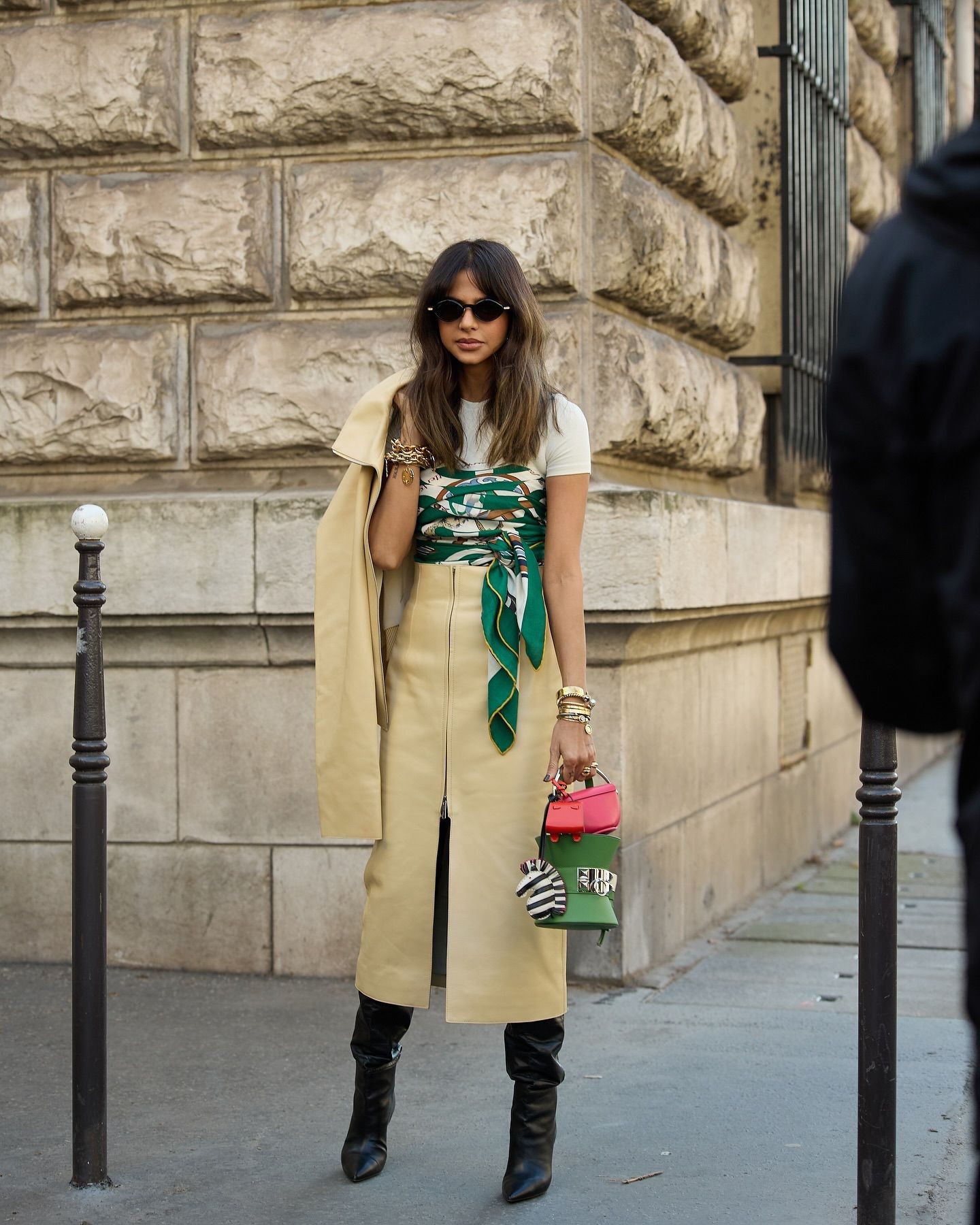
In 1937, Robert Dumas, the son-in-law of Émile Hermès, launched the house's first silk scarf, Jeu des omnibus et dames blanches. The house itself began a hundred years earlier, in 1837, when the harness-maker Thierry Hermès opened a workshop in Paris. A company that made harnesses ended up famous for a square of silk. I love that.
A Hermès scarf still carries the stable with it. The carré is named for its square shape and was inspired by riding silk, so bridles, saddles, jockeys and carriages keep turning up in the prints. I think that is what makes the brand interesting: it never stopped drawing the same horses, it just kept finding new ways to draw them. One note on what is below: most of these pieces are new from the brand, but two of them, the Brides de Gala and La Mecanique des Idees, are pre-owned.
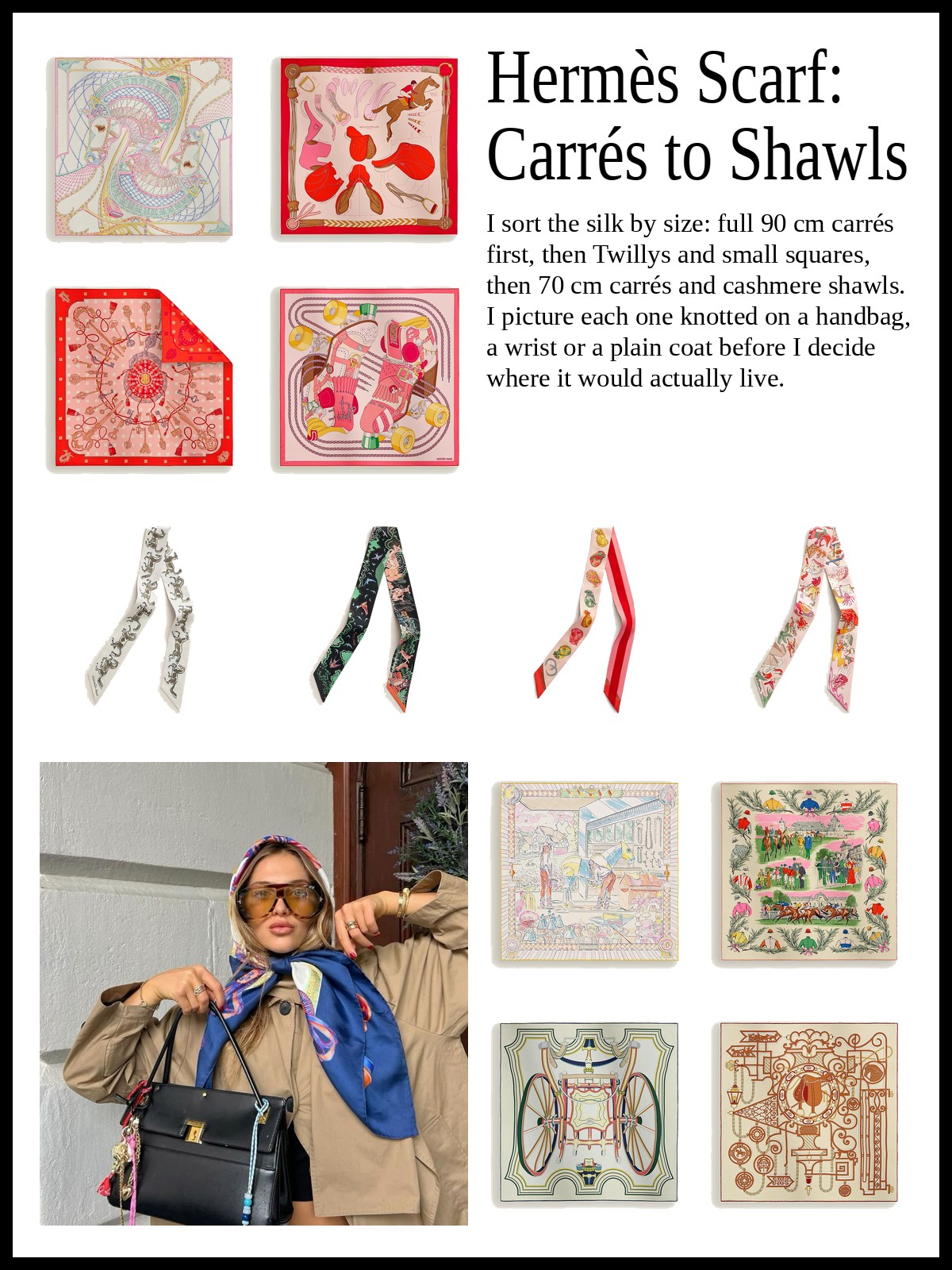
Start with the 90 cm carrés, the full-size ones. The Chevaux d'Hephaistos in pale pink and blue is the softest, and I would knot it loosely on a white shirt. The Selle en Eclats and the Derby 2000 are the racing ones, saddles and jockey boots in red and pink, and they like a navy blazer. The Les Cles double face is reversible, so you get two moods from one square. The Colliers et Laisses pour Chiens in taupe is the funniest, a bold dog collar and leash print that I would tie on a handbag handle. Harnais Legendaire is the most literal one, buckles and bridles that nod straight to the harness workshop, and the Pony Pit Stop double face is a second reversible square. Le Philateliste du Faubourg is the navy stamp collage, and Mon Cheval et Moi is the one for anyone who loves horses.
The pre-owned pair are the quiet picks. The white Brides de Gala is rated Excellent and the lime La Mecanique des Idees is rated Pristine. Before you buy any used carré, hold the edge up to the light: the hand-rolled hem should be even and soft, never flat or stitched. Whichever hermes scarf you pick, that hem is the first thing I would look at.
Hermès silk carrés 90

Chevaux d'Hephaistos Scarf 90
Hermès
$660

Selle en Eclats Scarf 90
Hermès
$660

Les Cles Double Face Scarf 90
Hermès
$800

Derby 2000 Scarf 90
Hermès
$660

Colliers et Laisses pour Chiens Scarf 90
Hermès
$660

La Nature en Voyage Scarf 90
Hermès
$660

Pre-Owned Brides de Gala Silk Scarf 90
Hermès
$535

Pre-Owned La Mecanique des Idees Silk Scarf 90
Hermès
$535
&link=https%3A%2F%2Fwww.hermes.com%2Fus%2Fen%2Fproduct%2Fle-philateliste-du-faubourg-scarf-90-H004205Sv12%2F)
Le Philateliste du Faubourg Scarf 90 (navy)
Hermès
$660

Pony Pit Stop Double Face Scarf 90
Hermès
$800

Harnais Legendaire Scarf 90
Hermès
$660

Mon Cheval et Moi scarf 90
Hermès
$660
Twillys for wrists and bag handles
Twillys are the narrow ones, and the first test is where you will actually tie them. If the answer is a bag handle, a ponytail or a belt loop, a ribbon beats a full square every time, and it takes up no room in a pocket.
The Chevaux en Liberte in white and gray is the easiest, and it looks good with a plain denim jacket. The Rewilding Nature in black and green is the one for a dark coat. The Jockey Long is embroidered, pink with red lining, so it has more weight and texture than the printed ribbons. The Academia Hippica in pale pink and the Boucles et Maillons in pink and yellow are lighter and sweeter, and I would wrap either one twice around a wrist. The Turf, Les Courses in deep teal is for anyone who finds pink a little much. The Bandana Leather Fringes is green and white with leather fringes, which makes it a bag charm more than a neck piece.
The Portrait de Boucle is a 45 cm square, tiny, with a pink buckle on an orange border. It is a good way into a Hermès scarf if a big carré feels like too much fabric. The other small ones are the Amis pour la Vie, the Grand Tralala and the Palonniers, all 45 cm, and the Jockey 55 is a touch bigger if you want a neckerchief.
What I would skip: a Twilly worn as a neck scarf on a high collar. It bunches. Keep it at the bag or the wrist.
In the fitting room, or at your own mirror, tug the ribbon gently. The edge should be neat and the print crisp, with no pulled threads.
Twillys and small silk scarves

Chevaux en Liberte Twilly
Hermès
$260

Rewilding Nature Twilly
Hermès
$260

Jockey Long Twilly
Hermès
$420

Academia Hippica Twilly
Hermès
$260

Boucles et Maillons Twilly
Hermès
$260

Turf, Les Courses Twilly
Hermès
$260

Bandana Leather Fringes Twilly
Hermès
$840

Portrait de Boucle Scarf 45
Hermès
$325

Amis pour la Vie scarf 45
Hermès
$380

Grand Tralala scarf 45
Hermès
$380

Palonniers scarf 45
Hermès
$325

Jockey scarf 55
Hermès
$780
Seventy centimeters or a full shawl
Size changes everything, so lay the piece flat before you decide. A 70 cm carré is a neat neck piece. A 140 cm shawl is a wrap, and it should feel like a small blanket.
The 70s are smaller, easier to tie and a little more playful. The Pony Pit Stop is a pastel stable scene that I would wear with a gray sweater. The Champ de Courses a Chantilly in ivory and green has jockey silks and laurel round the edge. The Les Roues de Phaeton in ecru and navy is the most graphic, all carriage wheels, and I would pair it with a striped top. The L'Enseigne du Sellier is a brown wrought-iron saddler's sign on ecru, a quiet nod to where the house started. The Jockey 70 in cashmere and silk is a touch warmer than the silk-only ones.
The shawls are cashmere and silk, 70 and 30 percent. The Selle de Collection has a big golden-brown saddle with jeweled corners. The Grand Apparat is an ecru bandana-style shawl with an orange border and carriage-horse medallions. The Flamingo Party Tattoo is the loudest, dense with flamingos and tropical leaves, and I would wear it over a plain black coat. The Mors a Jouets is a pleated bandana shawl, La Nouvelle Cite Cavaliere is a tonal pink map of a city with a rearing horse, the Flagship has a sailing ship in the middle, and the Les Leopards triangle is the one to fold once and wear over a coat.
What I would skip: the big shawl as a scarf-style knot at the neck. It is made to drape, so let it fall over one shoulder.
Check the weight when you hold it. A good shawl should drop straight from your hand, with no stiffness.
Carrés, triangles and cashmere shawls

Pony Pit Stop Scarf 70
Hermès
$500

Champ de Courses a Chantilly Scarf 70
Hermès
$500

Les Roues de Phaeton Scarf 70
Hermès
$500

L'Enseigne du Sellier Scarf 70
Hermès
$500

Jockey Scarf 70
Hermès
$900

Selle de Collection Shawl 140
Hermès
$1,575

Grand Apparat Bandana Shawl 140
Hermès
$1,575

Flamingo Party Tattoo Shawl 140
Hermès
$1,575

Mors a Jouets Bandana pleated shawl 140
Hermès
$2,300

Carreaux scarf 80
Hermès
$680

Petite Casaque Parthenon scarf
Hermès
$570

Fouets et Badines triangle
Hermès
$1,100

A propos de Bottes Exceptional embroidered scarf 90
Hermès
$5,650

Hermès Flagship shawl 140
Hermès
$1,575

Casaque Jumping scarf
Hermès
$1,050

Petite Casaque Lettres Equestres scarf
Hermès
$570

Double Face stole
Hermès
$1,625

Big H losange
Hermès
$1,725

City of Light scarf 90
Hermès
$660

Les Leopards triangle
Hermès
$1,100

Promenade Coquette scarf 70
Hermès
$500

Cinetique scarf
Hermès
$900

Della cavalleria Favolosa shawl 140
Hermès
$1,575

La Nouvelle Cite Cavaliere Shawl 140
Hermès
$1,575
How I would choose a piece
I would begin with the pre-owned pair, because each one has a stated condition rating. Check that the hem is hand-rolled and even, that the colors are bright, and that the silk feels smooth, with no snags, stains or perfume smell. Ask for any papers or box that come with it.
Then I would pick by how I dress. A Twilly if my outfits are plain and need a small spark, a 90 cm carré if I want to learn to tie it five ways, a shawl if I want one big piece for winter.
Grace Kelly famously used hers as a sling for an injured arm. I like that a thing this pretty was also meant to be used. If you want to keep browsing, I also put together How to Wear a Handkerchief Scarf and The Head Scarf Solves Three Problems At Once.






