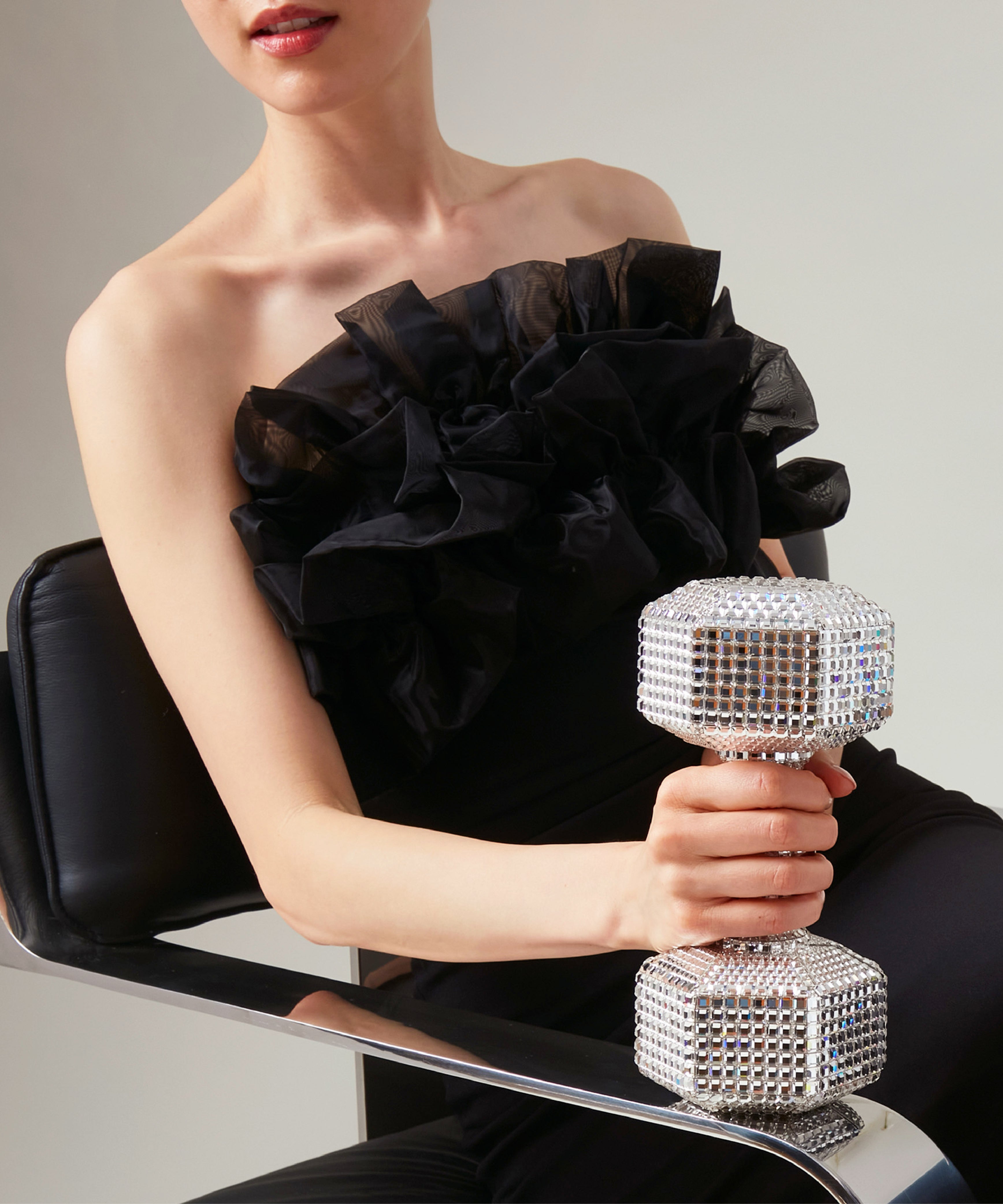
Judith Leiber, a Budapest-trained handbag maker who survived the Nazi occupation and emigrated to New York in 1947, started her own company there in 1963 after twelve years working for designer Nettie Rosenstein. A shipment of poorly plated brass frames pushed her to cover the flaws in crystals, and that fix became the house's signature minaudière, the small, sculptural evening bag later carried by numerous First Ladies.
Judith Leiber Couture
Bags
Every Judith Leiber bag still traces back to a genuinely accidental discovery, a batch of spotted metal frames that Leiber decided to disguise with rhinestones instead of scrapping. That improvisation, made in the 1960s, is the reason the house is still associated with crystal-covered surfaces decades later. What's shown here carries that same logic forward into the current range.

Envelope Billions Crystal Clutch
Judith Leiber Couture
$1,495

Gemma Crystal Clutch
Judith Leiber Couture
$1,695

Gemma Crystal Clutch
Judith Leiber Couture
$1,695

Slim Slide Crystal Clutch
Judith Leiber Couture
$3,195

Slim Slide Crystal Clutch
Judith Leiber Couture
$3,195

Petit Coeur L'amour Prosecco Crystal Clutch
Judith Leiber Couture
$1,695

Petit Coeur L'amour Prosecco Crystal Clutch
Judith Leiber Couture
$1,695

Petit Coeur L'amour Prosecco Crystal Clutch
Judith Leiber Couture
$1,695

Petit Coeur L'amour Prosecco Crystal Clutch
Judith Leiber Couture
$1,695

Gemma Satin Clutch
Judith Leiber Couture
$1,295

Gemma Satin Clutch
Judith Leiber Couture
$1,295

Mini Gummy Bear Crystal Clutch
Judith Leiber Couture
$695

Mini Gummy Bear Crystal Clutch
Judith Leiber Couture
$695

Mini Gummy Bear Crystal Clutch
Judith Leiber Couture
$695

Miniature Got a Light? Crystal Clutch
Judith Leiber Couture
$595

Miniature Got a Light? Crystal Clutch
Judith Leiber Couture
$595

Willow Crystal Woven Top Handle Clutch
Judith Leiber Couture
$1,495

Perry Crystal Clutch
Judith Leiber Couture
$1,495

Perry Crystal Clutch
Judith Leiber Couture
$1,495

Perry Crystal Clutch
Judith Leiber Couture
$1,495

Deluxe Cheeseburger Basket Clutch
Judith Leiber Couture
$1,495

Sparkle Net Satin Pouch
Judith Leiber Couture
$995

Sparkle Net Satin Pouch
Judith Leiber Couture
$995

Fizzy Crystal Clutch
Judith Leiber Couture
$995
More Bags
Leiber trained as an apprentice at Pessl, one of Budapest's most respected handbag makers, before she ever ran her own workroom, and that hands-on foundation is part of why the house's construction has always mattered as much as its sparkle. She personally designed and helped fabricate thousands of bags before selling the company in 1993. This second wall shows more of that range, from whimsical shapes to more classic ones.

Fizzy Crystal Clutch
Judith Leiber Couture
$995

Fizzy Crystal Clutch
Judith Leiber Couture
$995

Fizzy Crystal Clutch
Judith Leiber Couture
$995

Slim Slide Crystal Clutch
Judith Leiber Couture
$3,195

Long Slide Crystal Clutch
Judith Leiber Couture
$3,195

Long Slide Crystal Clutch
Judith Leiber Couture
$3,195

Piper Prosecco Crystal Clutch
Judith Leiber Couture
$1,695

Soap Dish Crystal Clutch
Judith Leiber Couture
$2,595

Mini Gummy Bear Crystal Clutch
Judith Leiber Couture
$695

Espresso Martini Bag
Judith Leiber Couture
$5,795

Perry Crystal Clutch
Judith Leiber Couture
$1,495

Isla Rattan Basket Top-Handle Bag
Judith Leiber Couture
$995

Fizzoni Full-Beaded Clutch Bag
Judith Leiber Couture
$1,695

Sparkle Crystal Net Top-Handle Bag
Judith Leiber Couture
$995

Bow Crystal Top-Handle Bag
Judith Leiber Couture
$1,995

Perry Beaded Crystal Clutch Bag
Judith Leiber Couture
$1,495
Our honest take
Judith Leiber's bags can look like a novelty from a distance, all animal shapes and crystal surfaces, but the house's actual claim to fame is a craftsperson's backstory: an immigrant who trained formally in handbag construction before fashion ever asked her to be decorative. That grounding is why the whimsy holds up as craft rather than gimmick. The edit works best when you shop it for the construction, not just the shine.