Mario Prada and his brother Martino opened a leather goods shop called Fratelli Prada in Milan's Galleria Vittorio Emanuele II in 1913, selling imported English trunks and travel accessories to the city's elite. His granddaughter Miuccia Prada took over in 1978 and, working with Patrizio Bertelli, turned a nylon backpack into the idea that a utilitarian material could sit at the center of a luxury house.
Prada
Shoes
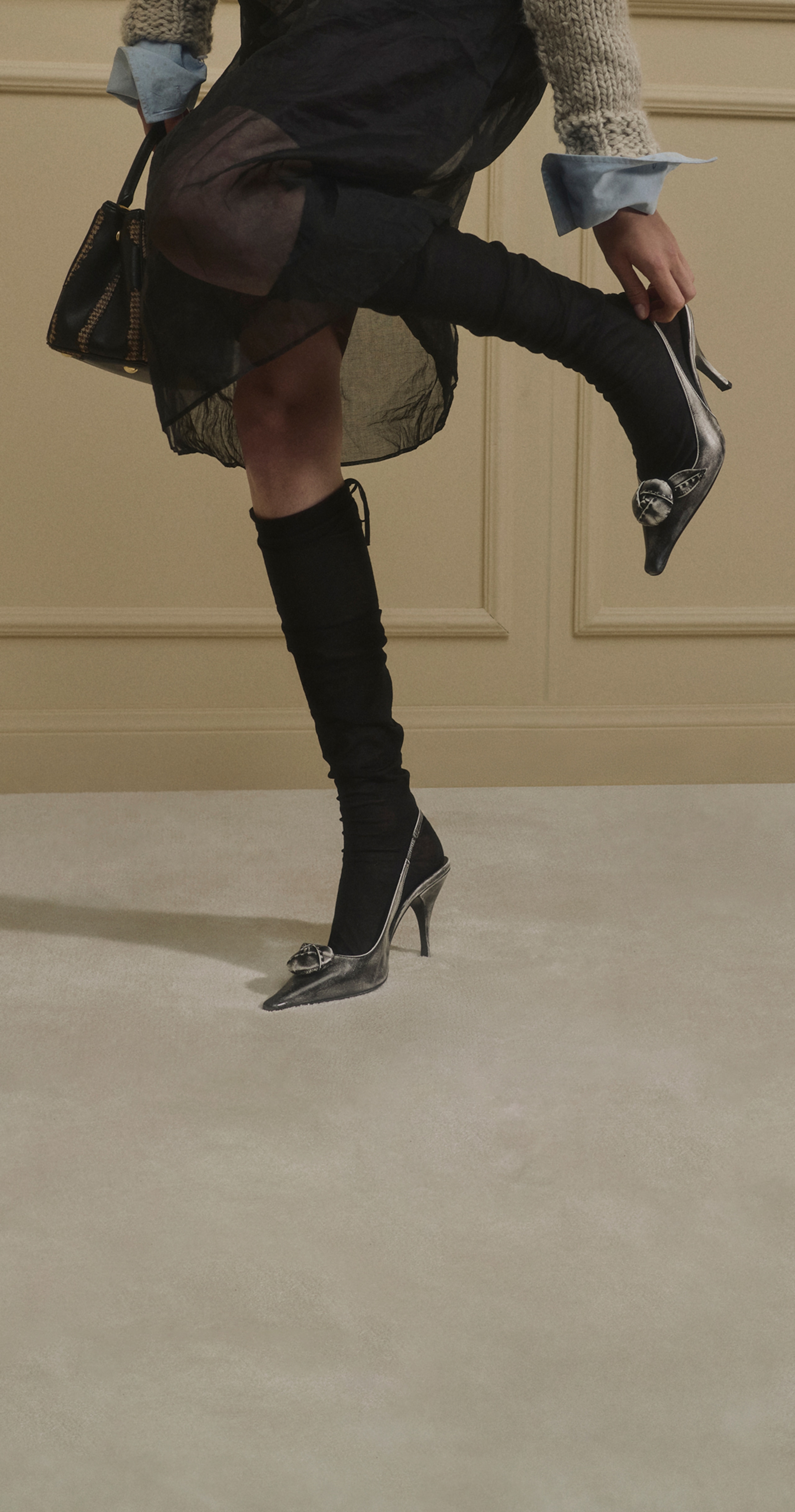
Prada added its first women's footwear collection in 1979, not long after Miuccia Prada started shaping the house's direction, and shoes have stayed a core category ever since. The house treats a shoe the way it treats a bag, as an engineering problem first, decoration second.

Embellished Satin Slingback Pumps
Prada
$1,950

Decollete Fiori Leather Pumps
Prada
$1,550

Leather Pumps
Prada
$1,250

Buckled Leather Sandals
Prada
$1,020

Leather Sandals
Prada
$995

Tronchetti Leather Boots
Prada
$1,820

Leather Pumps
Prada
$1,170

Leather Loafers
Prada
$1,290

Leather Pumps
Prada
$1,290

Cashmere Ballet Flats
Prada
$1,020

Leather Sandals
Prada
$1,200

Leather Pumps
Prada
$1,420

Antiqued Leather Pumps
Prada
$1,550

Leather Sandals
Prada
$995

Patent Leather Ballet Flats
Prada
$1,050

Ruched Leather Loafers
Prada
$1,250

Leather Loafer Pumps
Prada
$1,420

Shearling Chukka Boots
Prada
$1,550

Shearling Mules
Prada
$1,420

Leather Platform Loafer Pumps
Prada
$1,420

Ballerina Leather Flats
Prada
$1,250

Leather Mid-Calf Boots
Prada
$1,990

Crocheted Sandals
Prada
$1,100

Crocheted Ballet Flats
Prada
$1,250
More Shoes
A second wall of the same instinct, ranging across heel heights and finishes without losing the slightly severe, intellectual mood the house is known for. Nothing here is trying especially hard to be liked, which is very on brand.

Leather Knee Boots
Prada
$2,250

Canvas Pumps
Prada
$1,200

Leather, Raffia Sandals
Prada
$995

Leather Loafers
Prada
$1,200

Grosgrain-Trimmed Leather Sandals
Prada
$1,070

Leather Slingback Pumps
Prada
$1,200

Leopard-Print Pony Hair Mary Jane Ballet Flats
Prada
$1,250

Raffia Slingback Ballet Flats
Prada
$1,200

Metallic Leather Pumps
Prada
$1,200

Satin Mules
Prada
$1,120

Knit Wool Pumps
Prada
$1,370

Suede Loafer Mules
Prada
$1,120

Collapse Suede-Trimmed Re-Nylon Sneakers
Prada
$975

Leather Slingback Pumps
Prada
$1,200

Suede Sneakers
Prada
$975

Collapse Suede-Trimmed Re-Nylon Sneakers
Prada
$975

Leather Loafers
Prada
$1,200

Montecarlo Re-Edition 2005 Suede-Trimmed Mesh Sneakers
Prada
$975

Mesh Slingback Pumps
Prada
$1,200

Saint Tropez Shearling Loafers
Prada
$1,200

Mesh Slingback Pumps
Prada
$1,200

Collapse Cotton Canvas Sneakers
Prada
$1,120

Re-Edition 1999 Equal Leather Loafers
Prada
$1,250

Re-Edition 1999 Equal Leather Knee Boots
Prada
$2,450
Still more Shoes
More of the same category, proof of how much real estate footwear occupies in the current collection. The range moves between the utilitarian and the more directional, a contrast Miuccia Prada has leaned on since she first started experimenting with industrial nylon in the 1970s.

Suede Loafers
Prada
$1,200

Montecarlo Re-Edition 2005 Suede-Trimmed Re-Nylon Sneakers
Prada
$1,100

Metallic Leather Wedge Sandals
Prada
$1,250

Antiqued Leather Slingback Pumps
Prada
$1,450

Suede Ankle Boots
Prada
$1,650

Rubber Thong Sandals
Prada
$750

Crystal-Embellished Suede Ballet Flats
Prada
$1,370

Saffiano Leather Sandals
Prada
$1,200

Leather Loafers
Prada
$990

Velvet Pumps
Prada
$1,200

Downtown Platform Leather Sneakers
Prada
$1,100

Down-Quilted Nylon Ankle Boots
Prada
$1,220

Logo-Detailed Leather Sandals
Prada
$1,250

Satin Mules
Prada
$1,150

Metallic Leather Sandals
Prada
$1,250

Leather Loafers
Prada
$1,200

Suede Loafer Mules
Prada
$1,120

Suede Western Boots
Prada
$1,950

Leather Ballet Flats
Prada
$1,150

Leather Slingback Loafer Pumps
Prada
$1,200
Tops and shirting
Prada didn't add a full women's ready-to-wear collection until 1988, comparatively late for a house already decades old, and the category still carries that slightly cerebral, considered quality. Shirting here tends toward precise rather than flowy.

Alpaca Knit Tank Top
Prada
$1,250

Ribbed Wool Top
Prada
$1,820

Striped Cashmere Silk Top
Prada
$2,300

Argyle Cashmere Top
Prada
$2,450

Striped Cotton Shirt
Prada
$2,400

Crinkled Poplin Shirt
Prada
$1,950

Duchesse Silk Top
Prada
$1,250

Cotton Shirt
Prada
$1,200

Striped Button-Down Poplin Shirt
Prada
$2,400

Cashmere Top
Prada
$3,800

Argyle Cashmere Polo
Prada
$2,650

Tie-Neck Cotton Shirt
Prada
$2,150

Strapless Pinstriped Wool Cropped Top
Prada
$950

Charm-Detailed Knit Wool Top
Prada
$2,600

Pearl-Embellished Knit Wool-Cashmere Bustier Top
Prada
$2,200

Cashmere-Silk Tank Top
Prada
$1,990

Tie-Neck Marocain-Silk Shirt
Prada
$2,550

Molded Cotton Jersey T-Shirt
Prada
$1,520

Silk Crepe de Chine Cropped Top
Prada
$895

Cotton Pique Polo Shirt
Prada
$1,650

Floral Georgette Shirt
Prada
$2,400

Bouquet-Print Cotton Tank Top
Prada
$1,290

Embellished Neckline Poplin Shirt
Prada
$2,550

Cotton Polo Shirt
Prada
$1,850
More Tops and shirting
A further stretch of the same category, still working the house's ongoing interest in a slightly off, intellectualized take on classic shapes. It rewards a closer look at the cut rather than an obvious print or logo.

Oxford Shirt
Prada
$1,650

Striped Cotton T-Shirt
Prada
$2,050

Cotton Sweatshirt
Prada
$1,590

Jacquard Cotton PJ Top
Prada
$2,250

Velvet Cami Top
Prada
$950

Jersey T-Shirt
Prada
$1,170

Cotton Jersey T-Shirt
Prada
$995

Cotton Jersey T-Shirt
Prada
$995

Mohair-Blend Knit Polo Top
Prada
$1,200

Oversized Cotton-Poplin Shirt
Prada
$1,290

Printed Radzmire Tie-Neck Top
Prada
$1,830

Sequined Top
Prada
$3,450
Accessories
Accessories sit close to where the modern house actually began, small leather goods and travel items, before nylon and ready-to-wear ever entered the picture. The category still trades on precision finishing more than embellishment.

Flower Knee-High Cotton Socks
Prada
$1,320

Flower Cotton Socks
Prada
$1,320

Metallic Leather Belt
Prada
$525

Horseshoe Buckle Leather Belt
Prada
$1,170

Horseshoe Buckle Leather Belt
Prada
$1,170

Velvet Hair Clip
Prada
$495

Square-Frame Acetate Glasses
Prada
$490

Leather Belt
Prada
$525

Square-Frame Acetate Glasses
Prada
$490

Heritage-Print Silk Twill Scarf
Prada
$295

Square-Frame Acetate Sunglasses
Prada
$525

Square-Frame Acetate Sunglasses
Prada
$390

Square-Frame Acetate Sunglasses
Prada
$525

Faux Fur Collar
Prada
$1,920

Square-Frame Acetate Sunglasses
Prada
$520

Square-Frame Acetate Glasses
Prada
$350

Metal Hair Clip
Prada
$750

Printed Silk Twill Scarf
Prada
$330

Leather Belt
Prada
$750

Leather Gloves
Prada
$1,100

Square-Frame Metal Sunglasses
Prada
$490

Faux-Fur Stole
Prada
$1,900

Square-Frame Acetate Sunglasses
Prada
$390

Round Sunglasses
Prada
$429
More Accessories
More of the smaller pieces that round out a full Prada wardrobe, continuing a lineage that runs back to the original 1913 shop's trunks and travel cases. The scale has changed enormously since then, the attention to material has not.


Bags
Bags are arguably the house's founding category, and the current range still shows the tension between traditional leather craft and the harder, more architectural shapes Miuccia Prada introduced once she began pushing the house past its trunk-shop origins.

Passage Nylon-Trimmed Leather Bag
Prada
$3,600

Bonnie Leather Top Handle Bag
Prada
$3,200

Carry Mini Leather Bag
Prada
$2,550

Buckled Leather Top Handle Bag
Prada
$4,300

Aimee Leather Shoulder Bag
Prada
$3,700

Passage Nylon and Leather Shoulder Bag
Prada
$4,000

Antique Folding Leather Bag
Prada
$1,050

Chérie Re-Nylon Mini Bag
Prada
$1,720

Bonnie Small Suede Bag
Prada
$2,950

Bonnie Leather Bag
Prada
$3,400

Bonnie Leather Bag
Prada
$3,700

Wish Re-Nylon Pouch
Prada
$775

Re-Edition 2005 Re-Nylon Shoulder Bag
Prada
$1,290

Corsaire Fringed Suede Crossbody Bag
Prada
$3,700

Wish Re-Nylon Pouch
Prada
$775

Duet Re-Nylon Bucket Bag
Prada
$1,950

Buckle Leather Bucket Bag
Prada
$5,500

Re-Nylon Mini Pouch
Prada
$1,220

Noué Cotton Macramé Bag
Prada
$2,150

Wish Re-Nylon Pouch
Prada
$695

Explore Small Suede Bag
Prada
$3,500

Leather Crossbody Bag
Prada
$1,290

Nylon Tote Bag
Prada
$2,400

Medium Leather Shoulder Bag
Prada
$4,500
Skirts
Skirts round out the ready-to-wear side of the house, part of the category that only fully arrived in 1988. They tend to favor structure and a clean line over anything overtly decorative, in keeping with the label's general temperament.

Layered Poplin and Wool Midi Skirt
Prada
$3,100

Striped Cupro Midi Skirt
Prada
$1,950

Pleated Cotton-Poplin Midi Skirt
Prada
$2,200

Sheer Organza Skort
Prada
$1,550

Suede Mini Skirt
Prada
$3,450

Mixed-Media Midi Wrap Skirt
Prada
$5,300

Duchesse Embroidered Silk Midi Skirt
Prada
$11,500

Cashmere Midi Skirt
Prada
$1,590

Herringbone Cotton Mini Skirt
Prada
$2,400

Silk Crepe de Chine Mini Wrap Skirt
Prada
$1,850

Lace Midi Pencil Skirt
Prada
$3,100

Cotton Pique Midi Skirt
Prada
$950

Checked Cotton Midi Skirt
Prada
$1,920

Embroidered Silk-Chiffon Midi Drawstring Skirt
Prada
$3,850

Silk Taffeta Midi Skirt
Prada
$3,550

Velvet Midi Skirt
Prada
$1,100

Sequined Midi Skirt
Prada
$3,850

Belted Gabardine Midi Skirt
Prada
$1,610

Pinstriped Wool Midi Skirt
Prada
$1,430

Button-Embellished Mohair-Blend Skirt
Prada
$1,260
More from the collection
Additional pieces from the current range, still filtered through the same push and pull between austere material choices and a fairly maximalist creative instinct that has defined the house since Miuccia took over in the late 1970s.

Shearling-Trimmed Nylon Jacket
Prada
$7,800

Fleece-Lined Cotton Cropped Jacket
Prada
$5,600

Shearling-Trimmed Suede Caban Jacket
Prada
$10,000

Cropped Leather Jacket
Prada
$7,600

Wool-Blend Fleece Jacket
Prada
$3,300

Shearling-Trimmed Leather Jacket
Prada
$7,200

Sheer-Knit Cashmere Vest
Prada
$1,820

Cotton Jacket
Prada
$3,600

Feather-Embellished Wool Jacket
Prada
$6,800

Trompe-l'Oeil Print Cotton-Drill Caban Jacket
Prada
$3,600

Leather Biker Jacket
Prada
$8,200

Shearling-Trimmed Cotton Down Jacket
Prada
$6,500

Oversized Wool Jacket
Prada
$6,500

Single-Breasted Pinstriped Wool Jacket
Prada
$3,650

Quilted Corduroy Trim Jacket
Prada
$3,550

Logo-Detail Cotton Crop Jacket
Prada
$2,700

Color-Blocked Wool-Cashmere Sweater
Prada
$3,200

Argyle Cashmere Sweater
Prada
$2,600

Striped Wool-Silk Cardigan
Prada
$2,600

Embellished Wool-Cashmere Sweater
Prada
$2,550

Cashmere Knit Sweater
Prada
$2,550

Cropped Argyle Cashmere Sweater
Prada
$2,350

Wool Cardigan
Prada
$3,000

Embellished Wool-Cashmere Sweater
Prada
$2,550
More from the collection
Another stretch of the current assortment, spanning categories the house has added over more than a century, from its original leather-goods roots through ready-to-wear, menswear and the Miu Miu-adjacent design sensibility that still shows up occasionally in the main line.

Embroidered Silk Sweater
Prada
$2,050

Ribbed-Knit Beanie
Prada
$595

Shearling-Trimmed Wool Cardigan
Prada
$3,300

Embellished Cashmere Sweater
Prada
$3,850

Embellished Silk Mini Dress
Prada
$4,900

Striped Jersey Midi Dress
Prada
$3,200

Wool Mini Shift Dress
Prada
$4,600

Bra-Detailed Pleated Voile Midi Dress
Prada
$5,800

Chevron Wool Mini Dress
Prada
$3,050

Knit and Wool Midi Dress
Prada
$2,950

Crystal-Trimmed Sablé Midi Dress
Prada
$4,400

Cotton Pique Mini Dress
Prada
$1,290

Embellished Compact-Sablé Mini Dress
Prada
$5,300

Feather-Embellished Sable Midi Dress
Prada
$4,300

Crystal Bib Silk Taffeta Mini Dress
Prada
$10,500

Wool Straight-Leg Pants
Prada
$1,450

Ribbed-Knit Cotton Shorts
Prada
$1,220

Pleated Grisaille-Wool Shorts
Prada
$1,920

Cotton-Poplin Bloomer Shorts
Prada
$750

Logo-Detailed Stretch-Jersey Biker Shorts
Prada
$850

Cotton Poplin Shorts
Prada
$750

Mohair-Blend Wide-Leg Pants
Prada
$1,260

Houndstooth Wool Coat
Prada
$6,300

Printed Cotton-Blend Coat
Prada
$4,300
More from the collection
The remainder of what this edit is pulling together, a reminder of just how wide the Prada range has become since a small Milan trunk shop opened over a hundred years ago in the Galleria Vittorio Emanuele II.

Virgin Wool Coat
Prada
$2,700

Plaid Wool-Leather Belted Coat
Prada
$6,400

Crystal Flowers Brooch
Prada
$1,050

Washed Washed Classic-Fit Jeans
Prada
$1,720

Square Eyeglasses
Prada
$489

Aviator Sunglasses
Prada
$464

Scultoreo Narrow Sunglasses
Prada
$548

Re-Nylon Pouch
Prada
$625

Re-Edition 1978 Small Re-Nylon Backpack
Prada
$2,250

Belted A-Line Skirt
Prada
$2,700

Belted Cotton-Blend Mini Skirt
Prada
$2,050

Embellished Floral Mesh A-Line Skirt
Prada
$5,000
Our honest take
Very few houses can claim over a century of continuous operation and still feel intellectually restless, but Prada mostly manages it by treating its own history as raw material rather than a script to repeat. Whether that reads as visionary or simply consistent probably depends on how you feel about nylon.