Emilio Pucci, a Florentine aristocrat, founded his namesake house in 1947 after a photograph of his own streamlined ski outfit reached Harper's Bazaar and got him commissioned to design for the magazine. He opened his first boutique on Capri around 1949 and built the label on lightweight silk jersey and swirling geometric prints that made him a fixture of 1960s jet-set style.
Pucci
Accessories
Pucci's prints have always traveled best on accessories, since the silk scarf was one of the house's original signature products alongside the clothing. These pieces carry that same appetite for saturated, kaleidoscopic pattern in a smaller, easier dose.

Acetate Sunglasses
Pucci
$335

Rectangle-Frame Acetate Sunglasses
Pucci
$335

Acetate Sunglasses
Pucci
$455

Rectangle-Frame Metal Sunglasses
Pucci
$360

Rectangle-Frame Metal Sunglasses
Pucci
$360

Acetate Sunglasses
Pucci
$340

Acetate Sunglasses
Pucci
$340

Metal Sunglasses
Pucci
$545

Round-Frame Acetate Sunglasses
Pucci
$500

Round-Frame Acetate Sunglasses
Pucci
$500

Round-Frame Acetate Sunglasses
Pucci
$500

Acetate Sunglasses
Pucci
$485

Acetate Sunglasses
Pucci
$330

Oval-Frame Acetate Sunglasses
Pucci
$450

Logo Acetate & Metal Oval Sunglasses
Pucci
$500

Cat-Eye Acete Sunglasses
Pucci
$455

Filigree Acetate Oval Sunglasses
Pucci
$485

Cat-Eye Acetate Sunglasses
Pucci
$455

Butterfly Acetate Sunglasses
Pucci
$485

Cat Eye Sunglasses
Pucci
$360
Dresses
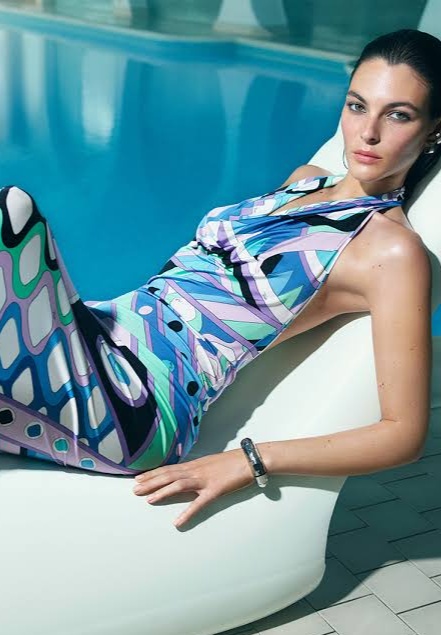
Dresses are the category Pucci is most associated with historically, built originally in lightweight, wrinkle-resistant silk jersey at the urging of Neiman Marcus's Stanley Marcus. The prints here descend directly from that decision to make clothing that traveled well and photographed even better.

Printed Semi-Sheer Jersey Maxi Dress
Pucci
$2,740

Asymmetric Silk Midi Dress
Pucci
$2,585

Printed Silk-Twill Maxi Dress
Pucci
$2,290

Printed Jersey Mini Dress
Pucci
$1,195

Patterned-Jacquard Knit Maxi Dress
Pucci
$2,440

Exclusive La Isla Embroidered Kaftan Maxi Dress
Pucci
$5,995

Printed Silk Crepe De Chine Maxi Dress
Pucci
$1,685

Crepe De Chine Maxi Dress
Pucci
$1,690

Silk Twill Caftan
Pucci
$2,915

Draped Cotton Poplin Caftan
Pucci
$1,455

Printed Silk Twill Maxi Dress
Pucci
$2,300

Printed Mesh Mini Dress
Pucci
$1,155

Mock-Neck Labirinto-Print Mesh Maxi Dress
Pucci
$1,365

Iride Cowl-Neck Jersey Satin Mini Dress
Pucci
$1,060

Orchidee Silk Crepe De Chine Maxi Dress
Pucci
$1,690

Jersey Satin Slip Dress
Pucci
$686
Tops and shirting
Tops carry the same print-forward instinct as the dresses, scaled down to a single piece. Pucci built a reputation on pattern doing the work that structure might do elsewhere, and that logic still applies here.


Swim
Swim is close to where this whole house started, since Emilio Pucci moved from skiwear into swimwear and resort pieces almost immediately after his first boutique opened on Capri. It is the category with the most direct line back to the label's founding moment.


More from the collection
The rest of the current assortment, covering what the house is offering this season beyond the categories above. It gives a fuller sense of how far Pucci's print language extends across a single collection.

Pilot Sunglasses
Pucci
$480

Tulle Long Sleeve Dress
Pucci
$686

Tulle Long Sleeve Top
Pucci
$486

Lycra Triangle Bikini Top
Pucci
$187

Lycra Triangle Bikini Top
Pucci
$198

Lycra Tie Side Bikini Bottom
Pucci
$158

Printed Silk-Twill Mini Skirt
Pucci
$1,505

Gradient Poplin Maxi Skirt
Pucci
$1,215

Pleated Cotton Muslin Maxi Skirt
Pucci
$1,520

Cotton Pareo
Pucci
$228

Cotton Pareo
Pucci
$336

Cotton Pareo
Pucci
$336
Our honest take
Pucci's prints are one of the rare fashion signatures that are instantly identifiable without a logo in sight, and that alone says something about how well the original idea was built. The house can lean nostalgic under different creative regimes, so the more interesting pieces in any given edit tend to be the ones applying the archive prints to a newer silhouette rather than just repeating them.