You can size a ring at home accurately with a strip of paper and a ruler. Wrap a non-stretchy strip snugly around the base of the finger, make sure it will pass over your knuckle, mark where it overlaps, then measure the length in millimetres and match it to a circumference chart.
Ring Sizing at Home
Measure twice, in the afternoon

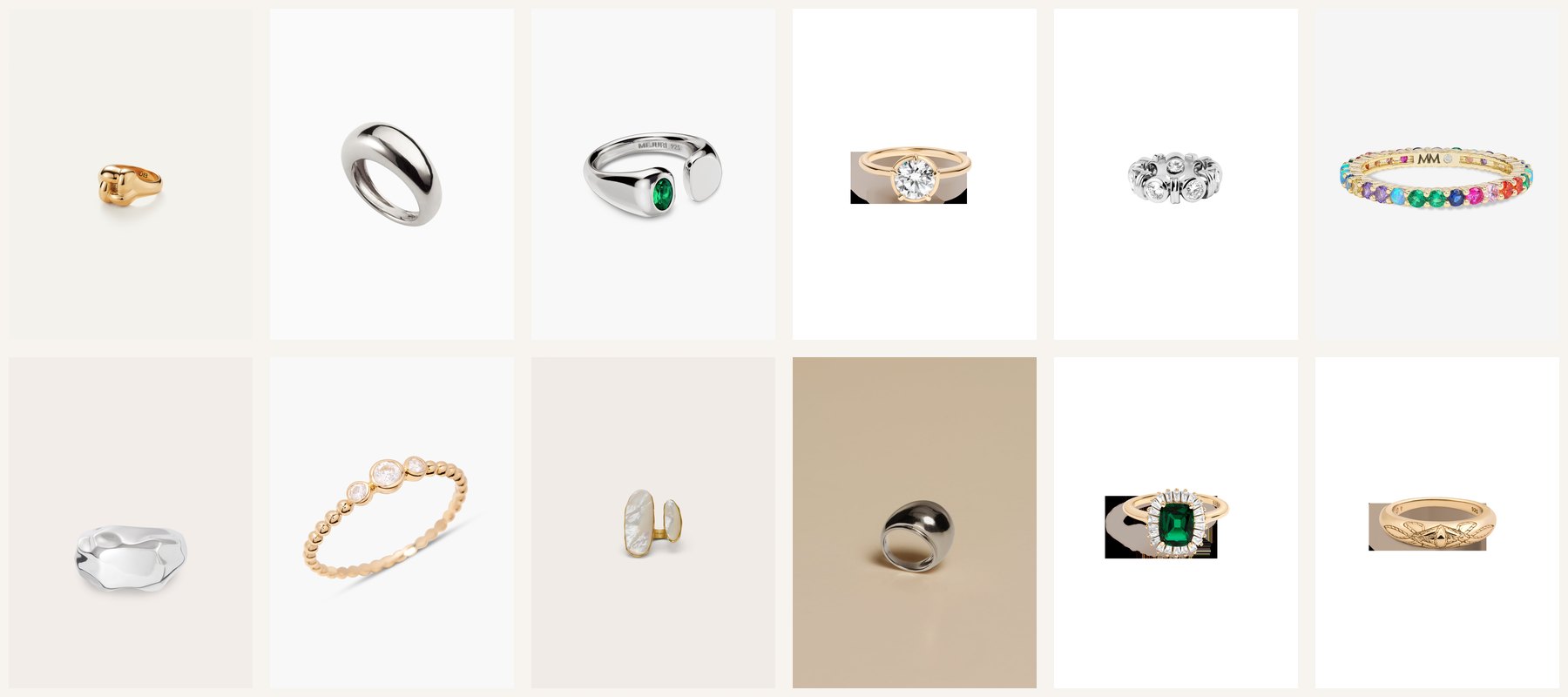
The measurement takes two minutes. The timing matters more.
You can size a ring at home accurately with a strip of paper and a ruler. Wrap a non-stretchy strip snugly around the base of the finger, make sure it will pass over your knuckle, mark where it overlaps, then measure the length in millimetres and match it to a circumference chart. A US size 6 is about 51.8mm around and 16.5mm across, and a size 7 is about 54.4mm and 17.3mm. That is the whole method, and jewellers from Blue Nile to Gabriel and Co publish the same one.
The part people get wrong is when they measure. Fingers change size through the day with temperature, hydration and salt, commonly by a quarter to a half size. Most jewellers, including Astley Clarke, recommend measuring at the end of the day when fingers are at their largest, and sizing up if you fall between two sizes. Measure once in the morning and you will order a ring you cannot get on in August.
Below, three rings and how to size each one: the signet, the statement ring and the stacking band. Mejuri, Dorsey, Jenny Bird and Melinda Maria feature, and Aurate New York gets the Label Love.
Let's Shop. The Signet
A signet is the ring I would buy first if you are building slowly, because it sits flat, it does not catch on clothing, and it reads as considered rather than decorative.
Sizing note that is specific to this shape: a signet has a wide, heavy face and often a thick shank, and a wide band always feels tighter than a thin one at the same nominal size. Astley Clarke's own guidance is to consider going a full size larger on a particularly thick band. Pinky signets are the low-risk entry point since pinkies are less prone to swelling. Mejuri and Aurate do the clean modern versions, Brook & York and Melinda Maria the affordable ones, and Liffner's is the piece to buy if this is the only ring you plan to own.

Woven Square Signet Ring
Jenny Bird
$108

Aurate x Frye: Western Stitch Mini Dome Ring
Aurate New York
$298

Sunken Stone Signet Ring Gold
Liffner
$1,450

Fern Signet Ring
Brook & York
$78

Courage Signet Ring
Mejuri
$198

She's a Boss Signet Ring - Gold
Melinda Maria
$75

Carter Baguette Dome Ring
Brook & York
$20

Jude Pinky Signet Ring
Mejuri
$198
The Statement Ring
A statement ring is the one where fit is least forgiving, because a heavy setting will rotate on the finger if the ring is even slightly loose, and you will spend the day turning it back round.
So size this one snug rather than comfortable, and check it by lowering your hand and shaking it gently. If the stone swings to the underside of your finger, it is too big. Also think about the neighbours: a tall setting will not sit flush against a wedding band or a stacking ring, so if you wear rings together, choose a lower dome or a bezel. Dorsey and Aurate cover the diamond and lab-grown end, Mejuri and Brook & York the mid range, and Cult Gaia and Jenni Kayne the sculptural pieces where the shape is the point rather than the stone.

Domed Ring - By AGMES
St. Agni
$385

RHEN ROUND-CUT RING IN MOISSANITE, STERLING SILVER
Dorsey
$510

Lumi 14K Gold Three Diamond Ring
Brook & York
$515

Horizontal Baguette Lab Grown Diamond Eternity Ring
Aurate New York
$1,715

AMI RING - MOTHER OF PEARL
Cult Gaia
$228

"Oh She Fancy" Stacked Diamond Ring - Gold
Melinda Maria
$75

Diamonds Line Ring
Mejuri
$448

Felix Dome Ring
Jenni Kayne
$2,695
The Stacking Band
Stacking bands are the most useful rings to own and the easiest to size, because they are thin, so they run closest to your measured size, and because a stack tolerates a little variation.
Two practical notes. Thin bands bend, so a very fine band in high-karat gold or vermeil will go oval over time with daily wear, and the fix is either a slightly heavier gauge or accepting it as part of the deal. And a stack of three thin bands takes up more space than you expect, so if you already wear a ring on that finger, measure with it on. Jenny Bird and Aurate are the everyday picks, Brook & York the cheapest way to build a stack, Liffner and Mejuri the pieces that hold their own alone. Melinda Maria's are the ones I would wear on holiday and not worry about.

Noa Open Signet Ring
Mejuri
$198

Heiress Ring 2mm - Gold
Melinda Maria
$65

Bold Puzzle Stacking Ring
Mejuri
$158

MAXIME THREE-ROW RING IN LAB BLUE SAPPHIRE AND MOISSANITE, STERLING SILVER
Dorsey
$725

VEDA RING - BRUSHED BRASS
Cult Gaia
$128

Maeve Heart Enamel Ring
Brook & York
$57

Ombré Rainbow Baguette Eternity Ring
Aurate New York
$318

Leona Ring
Jenny Bird
$128
Label Love: Aurate New York
Aurate is the section this month because it publishes the thing that matters most in fine jewellery, which is what the metal actually is. The range spans solid 14K and 18K gold, vermeil and lab-grown diamonds, and it says which is which, which makes it possible to work out what you are paying for.
What that means practically. The solid gold pieces are the ones to buy if you never take a ring off, since they will not wear through the way plating does. The vermeil pieces are heavy gold over sterling and are a real step up from plated brass. The lab-grown diamond styles are where the price advantage is clearest against a natural stone. My picks would be the Crossover for a stack and one of the Georgian styles if you want a single ring to wear for years. Sizing runs true, and the wide styles follow the thicker-band rule above.

1ct Round Lab Grown Diamond Georgian Ring
Aurate New York
$1,498

Kinetic Ring
Aurate New York
$368

Lab Grown White Sapphire Birthstone Heritage Ring
Aurate New York
$298

Princess Cut Lab Grown Diamond Eternity Ring
Aurate New York
$1,805

Pearl Bud Ring
Aurate New York
$298

2ct Pear Lab Grown Diamond Georgian Ring
Aurate New York
$1,898

Unbreakable Crossover Ring
Aurate New York
$38

Oval Lab Grown Diamond Eternity Ring
Aurate New York
$2,689
The Shopping List
This month's rings, all on my radar.
Aurate lab-grown green emerald Alexandra ring, the colour I keep coming back to.
Liffner Ice Cube pinky ring in silver, a pinky ring that is not twee.
Dorsey Maxime three-row in lab ruby and moissanite, the loudest thing on the list.
Mejuri Stacker, the plainest and the one I would buy three of.
Brook & York Jessica vermeil birthstone ring, the cheapest real-metal option here.
St. Agni Somni ring in black, sculptural and completely unlike the rest.
Cult Gaia Ami mini in turquoise multi, for summer.
Melinda Maria She's a Boss signet in silver, the low-commitment signet.

Lab Grown Green Emerald Alexandra Ring
Aurate New York
$298

Ice Cube Pinky Ring Silver
Liffner
$1,350

MAXIME THREE-ROW RING IN LAB RUBY AND MOISSANITE, STERLING SILVER
Dorsey
$695

Stacker Ring
Mejuri
$168

Jessica Vermeil Birthstone Ring
Brook & York
$115

Somni Ring - Black - By Ayllón
St. Agni
$135

AMI MINI RING - TURQUOISE MULTI
Cult Gaia
$198

She's a Boss Signet Ring - Silver
Melinda Maria
$75
Style Notes
How I buy rings without a jeweller.
Measure in the late afternoon, and measure three times on different days. One measurement is not a size.
Size the knuckle, not the base. The ring has to pass the knuckle, so if your knuckle is much larger, size to clear it and expect a little movement at the base.
Add a size for a wide band. Anything thick or domed will fit tighter than a thin band of the same size.
Snug for heavy, comfortable for thin. A heavy setting that spins is more annoying than one that is slightly firm.
If you take one thing away: measure at the end of the day and round up, not down. A ring half a size loose can be worn with a sizing bead. A ring half a size tight cannot be worn at all, and that is the one that ends up in a drawer.