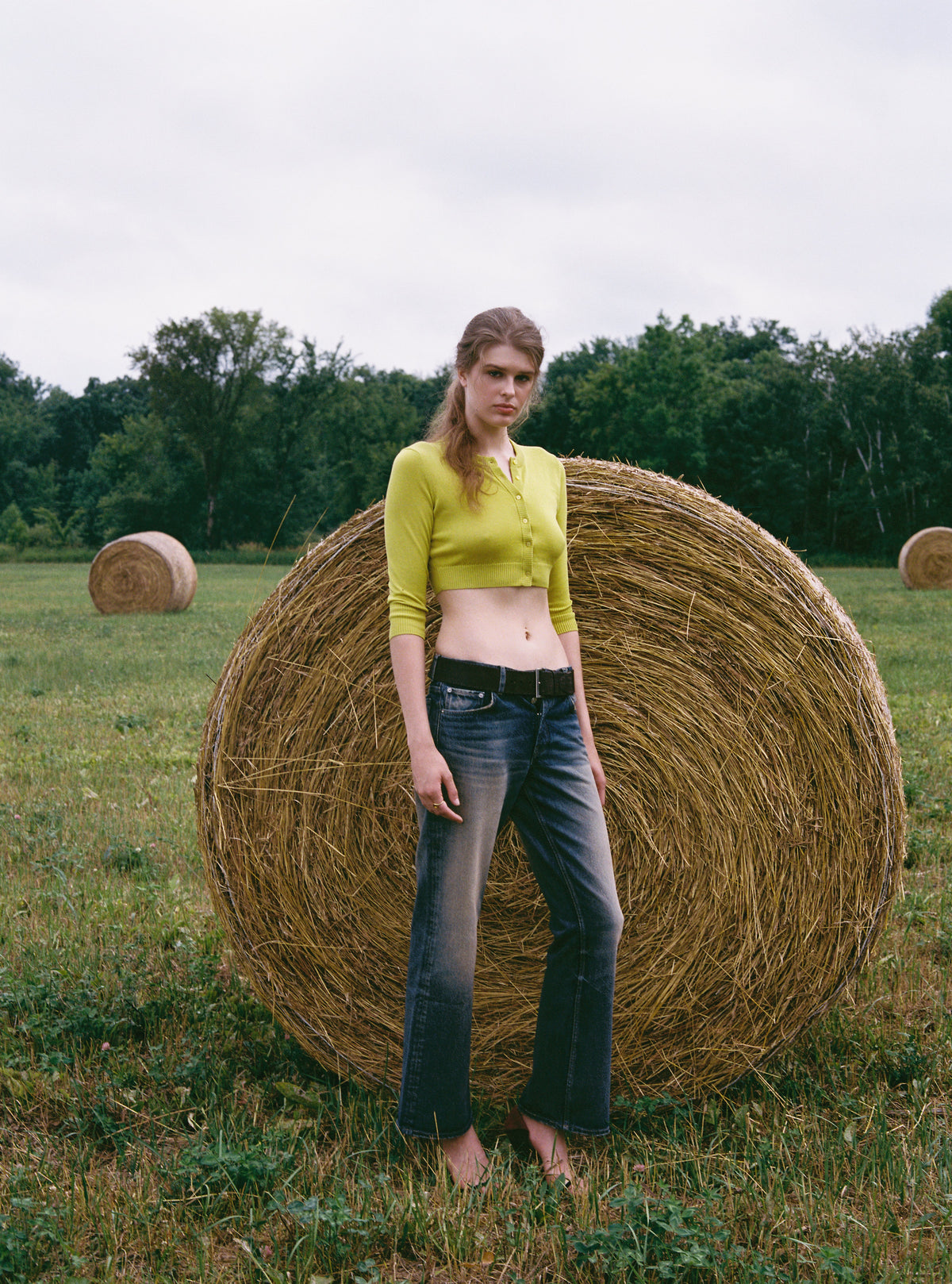
Sharon Wauchob trained at Central Saint Martins and worked with Koji Tatsuno and Louis Vuitton before launching her own label in Paris in 1998. Her clothes sit between precise and romantic, using satin, fringe, lace, and asymmetric lines to keep that tension visible. This edit separates the dresses and tops from the tailoring built with the same controlled interruption.
Sharon Wauchob

Draped Dresses and Tops
Sharon Wauchob's dresses and tops sit between precise and romantic rather than choosing one register. Fringe and feather show up as trim rather than as spectacle, most clearly on the Katia fringed satin-twill midi dress, which uses movement instead of print to make its case. Elsewhere the same tension shows in scarf detailing and asymmetric lines, like the Sata gathered duchesse silk-satin blouse, which drapes rather than sits flat. These pieces are not background clothing, but they reward a simple shoe and a room that is not competing for attention. Wear one and let everything else go quiet.

Willla asymmetric wool tank
Sharon Wauchob
$870

Katia fringed satin-twill midi dress
Sharon Wauchob
$1,780

Anita scarf-detailed satin T-shirt
Sharon Wauchob
$710

Sata gathered duchesse silk-satin blouse
Sharon Wauchob
$1,665

Edita silk maxi dress
Sharon Wauchob
$1,235

Sara feather-trimmed silk-crepe mini dress
Sharon Wauchob
$1,530

Draped silk-satin maxi dress
Sharon Wauchob
$1,455

Olga layered silk tank
Sharon Wauchob
$795

Tulipa gathered lace-trimmed jersey and leather midi dress
Sharon Wauchob
$2,470

Cato feather-trimmed silk tank
Sharon Wauchob
$1,020

Capucines scalloped lace-trimmed silk crepe de chine camisole
Sharon Wauchob
$545

Tie-detailed silk tank
Sharon Wauchob
$490
Tailoring With a Soft Edge
The tailoring here is less about corporate polish than about a controlled interruption in an otherwise clean shape. Straight-leg pants get the most variation, from the plain Tuileries satin straight-leg pants to a tulle-trimmed version of the same silhouette, which adds texture without changing the cut. The Feathers-embellished silk cape takes the opposite approach, letting one dramatic material carry an otherwise simple shape. Wauchob has described fashion as a form of escape, and that idea plays out here as one unexpected element per outfit rather than several competing at once. A blazer or a belted jacket in this range works as the quiet anchor for whichever piece is doing the talking.

Tuileries satin straight-leg pants
Sharon Wauchob
$615

Sue paneled satin straight-leg pants
Sharon Wauchob
$745

Feathers-embellished silk cape
Sharon Wauchob
$2,140

Tria asymmetric duchesse-satin midi skirt
Sharon Wauchob
$1,345

Clio belted wool straight-leg pants
Sharon Wauchob
$780

Ruffled silk wide-leg pants
Sharon Wauchob
$1,740

Draped silk blouson jacket
Sharon Wauchob
$655

Wool blend blazer
Sharon Wauchob
$1,195

The Vardar silk-blend straight-leg pants
Sharon Wauchob
$690

Desia asymmetric silk-crepe midi skirt
Sharon Wauchob
$875

Tuileries satin-trimmed silk-tulle straight-leg pants
Sharon Wauchob
$615

Bretagne belted silk jacket
Sharon Wauchob
$780
Our honest take
Sharon Wauchob is for someone who wants elegance with a slight disturbance built into the frame rather than smoothed out of it. The dresses and tops carry that tension through fringe, feather, and asymmetric lines, while the tailoring plays the same game more quietly, through drape and one unexpected material per outfit. This is too expressive a collection for a strict capsule, since half the point is the interruption rather than the ease. It works best as the one piece that gives a familiar wardrobe a sharper edge for a single evening rather than as an everyday uniform. Keep the styling around each piece deliberately plain, since the interesting thing is already happening in the fabric or the line. If you take one thing away, pick the piece with the most interesting line and let every other decision in the outfit stay quiet.