Tangle Teezer began with a hairdresser's lightbulb moment in 2003, was turned down on a TV pitch show, and went on to win a Queen's Award. Here are its four best-known brushes, other paddles and detangling brushes worth a look, and the leave-in sprays that make knots let go.
Tangle Teezer Was Turned Down on Television and Sold Anyway
In 2003, a hairdresser and colorist named Shaun Pulfrey had what he calls his lightbulb moment, and the first Tangle Teezer arrived in 2007. Even the name has a small story: the TEEZER spelling was picked for extra fizz. That same year he took the idea to the Dragons' Den, where the panel turned him down, and then the website crashed with about 1,500 orders after the episode aired. I like that order of events. The product got the last word.
It kept going, too. The Original won the Queen's Award for Innovation in 2012, and the Queen's Award for International Trade in 2014, and it began appearing on shelves in Britain in 2008. What I love about it is how ordinary it is. No handle, a compact oval, and flexible teeth that slide through wet hair and let go of knots without a fight.
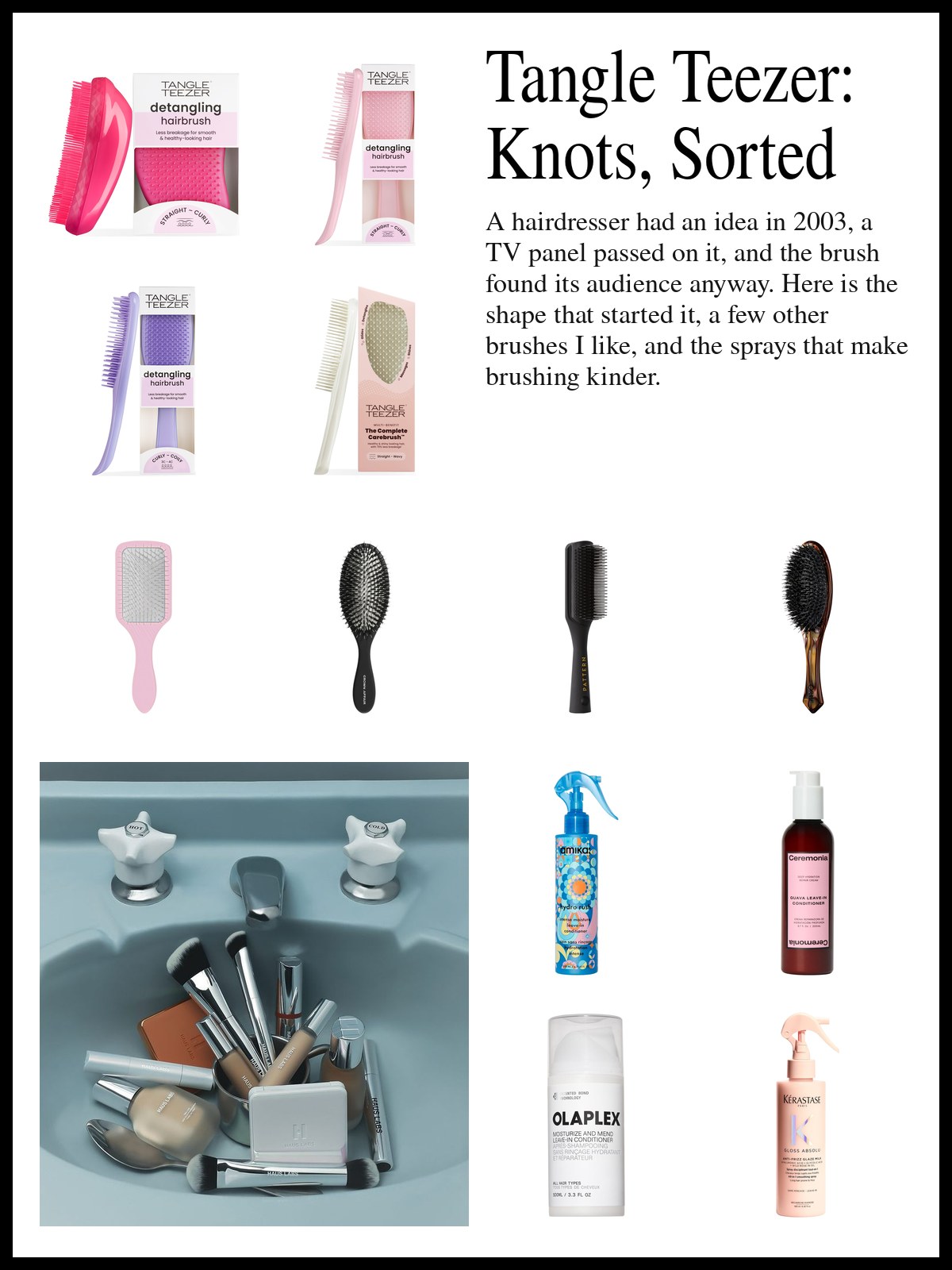
The Tangle Teezer Original is the one to start with. The Ultimate Detangler is the other one I reach for, and the Naturally Curly version is made for curls and coils. The Complete Carebrush Straight To Wavy is made for straight to wavy hair, and it works as a gentle daily brush.
Hold it near the ends first, then move upward. I keep the Original in a gym bag because it survives being thrown in with everything else, and the Ultimate Detangler by the bathroom mirror for the slow, careful sessions. Wet or dry, use short strokes and let the teeth do the work rather than pressing down.


Paddles, boar bristles and shower brushes
A brush drawer eventually needs more than one thing in it. I keep a few different shapes, each with its own job, and I reach for them depending on how the hair feels that day.
Mane's Ready or Knot is a detangling paddle, good on dry hair that has gone a little wild overnight. Crown Affair's Dual-Bristle Boar Hair Brush No. 001 is designed for all hair textures, and the boar bristles are the classic route to a smooth, glossy finish. Oribe's Flat Boar Bristle Brush is the more classic, flatter take on that idea.
Pattern Beauty's Shower Detangling Brush is made for wet hair with conditioner in it, and the shower is honestly where most of my knots come undone. Moroccanoil's Ceramic Paddle Brush is a paddle for blow drying, and ghd's Paddle Brush belongs to the same family, with a broad face for smoothing long hair.
Here is a small test. If a brush gets stuck halfway down, stop and go back to the ends instead of forcing it. Tugging from the top is how you end up with broken hair and a sore scalp. Clean the bristles every week, because trapped hair and product make any brush drag. Pull the caught hair out with a comb, rinse in lukewarm water with a little mild shampoo, and let it dry bristle side down so water does not sit in the base.
Detangling brushes and wide-tooth combs

Ready or Knot Detangling Paddle Hair Brush
Mane
$15

The Dual-Bristle Boar Hair Brush No. 001 for All Hair Textures
Crown Affair
$118

Shower Detangling Brush
Pattern Beauty
$19

Flat Boar Bristle Hair Brush
Oribe
$100

Ceramic Paddle Brush
Moroccanoil
$32

Paddle Brush
ghd
$35

Detangle & Massage Brush
The Hair Edit
$13.99

The Large Detangling Comb
La Bonne Brosse
$54
Leave-in sprays that give knots some slip
Brushing goes better when hair has slip, and slip comes from a leave-in. I use one whenever I know a knot is coming, which is after a swim, a long flight, or a night in a bun.
amika's Hydro Rush is a moisturizing leave-in with hyaluronic acid. Ceremonia's Guava Hydrating Leave-In is a hydrating leave-in conditioner. Olaplex's No.5L is a leave-in for split ends, so I use it on the lower half of my length. Melanin Haircare's Multi-Use Softening Leave In is a softener that works on curls and coils as well as straighter textures.
Kérastase's Gloss Absolu is an all-in-one anti-frizz spray. dae's Mirage Mist is a leave-in in mist form, and I would pick it if a heavier cream tends to weigh your hair down.
What I would skip: brushing hair that is soaking wet with a fine-tooth tool and no product, and any leave-in sprayed heavily on the scalp. Wet hair stretches and snaps, so start at the ends, comb through the conditioner first, and only then let the brush follow. A spray works best in small amounts, misted from a hand's length away and worked through in sections. If your hair feels sticky or coated by the second day, you used too much, and a rinse fixes it.
Detangling sprays

Hydro Rush Intense Moisture Leave-In Conditioner with Hyaluronic Acid
amika
$31

Guava Hydrating Leave-In Conditioner
Ceremonia
$30

No.5L Moisturize & Mend Leave-In Conditioner for Split Ends
Olaplex
$34

Gloss Absolu All In One Anti-Frizz Spray
Kérastase
$52

Multi-Use Softening Leave In Conditioner
Melanin Haircare
$36

Mirage Mist Leave-In Conditioner
dae
$30

Run Through Detangling Hair Primer
Oribe
$39

Prep Rally Prime & Prep Detangler
Drybar
$29
Choosing what suits your hair
Choosing between all of these comes down to your hair and your habit. Curly and coily hair usually likes a wet brush with lots of slip. Fine straight hair likes a light mist and a gentler shape. Thick, long hair often wants a paddle.
I would keep one brush in the bag, one at the sink, and one spray that you actually like the smell of, since the routine only works if you do it. Take your time with knots, and work from the tips up. A slower two minutes in the morning saves you the breakage that quick, frustrated pulling causes, and it makes a braid or ponytail sit much more smoothly afterward. If you find your hair is breaking a lot or thinning, mention it to a doctor or a good stylist before blaming the brush. Whatever you pick, use it gently and keep it clean, and it will last far longer than the first burst of enthusiasm.