The best face masks for acne are not all clay, because breakouts need different help on different nights. Here are the clarifying and exfoliating masks for congestion, the soothing masks for red, irritated skin, and the pimple patches for single spots.
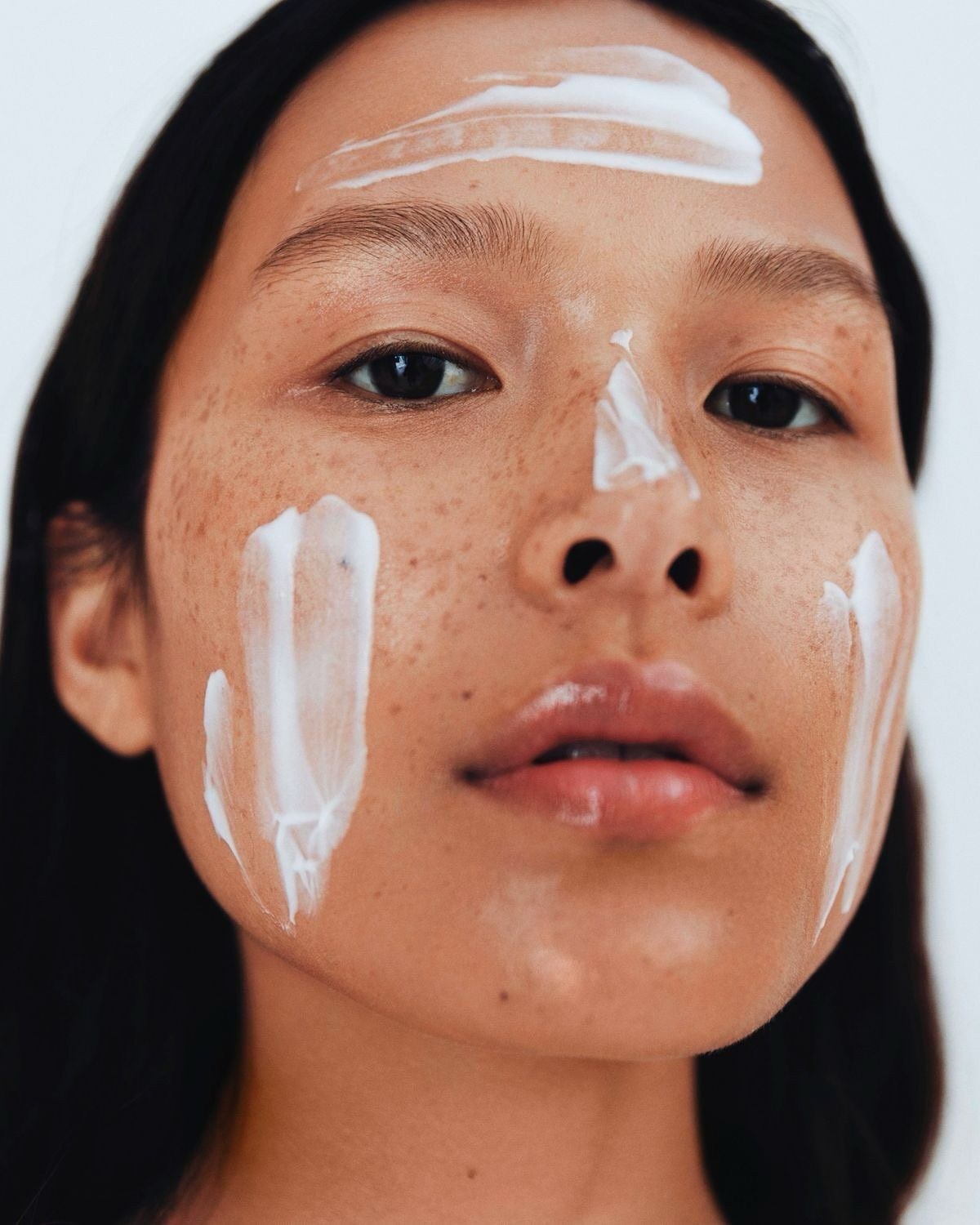
The Best Face Masks for Acne Are Not All Clay
Hydrocolloid dressings were first sold for wounds, in the UK in 1982 and in the US a year later. The same moisture-trapping material, cut into small clear dots, became the pimple patch much later, and it is now one of the easiest things to reach for when a single spot appears. That history says something useful about masks for breakouts: they do different jobs, and the best face masks for acne are not all clay. Some clear congestion, some calm red, irritated skin, and some protect one angry spot overnight.
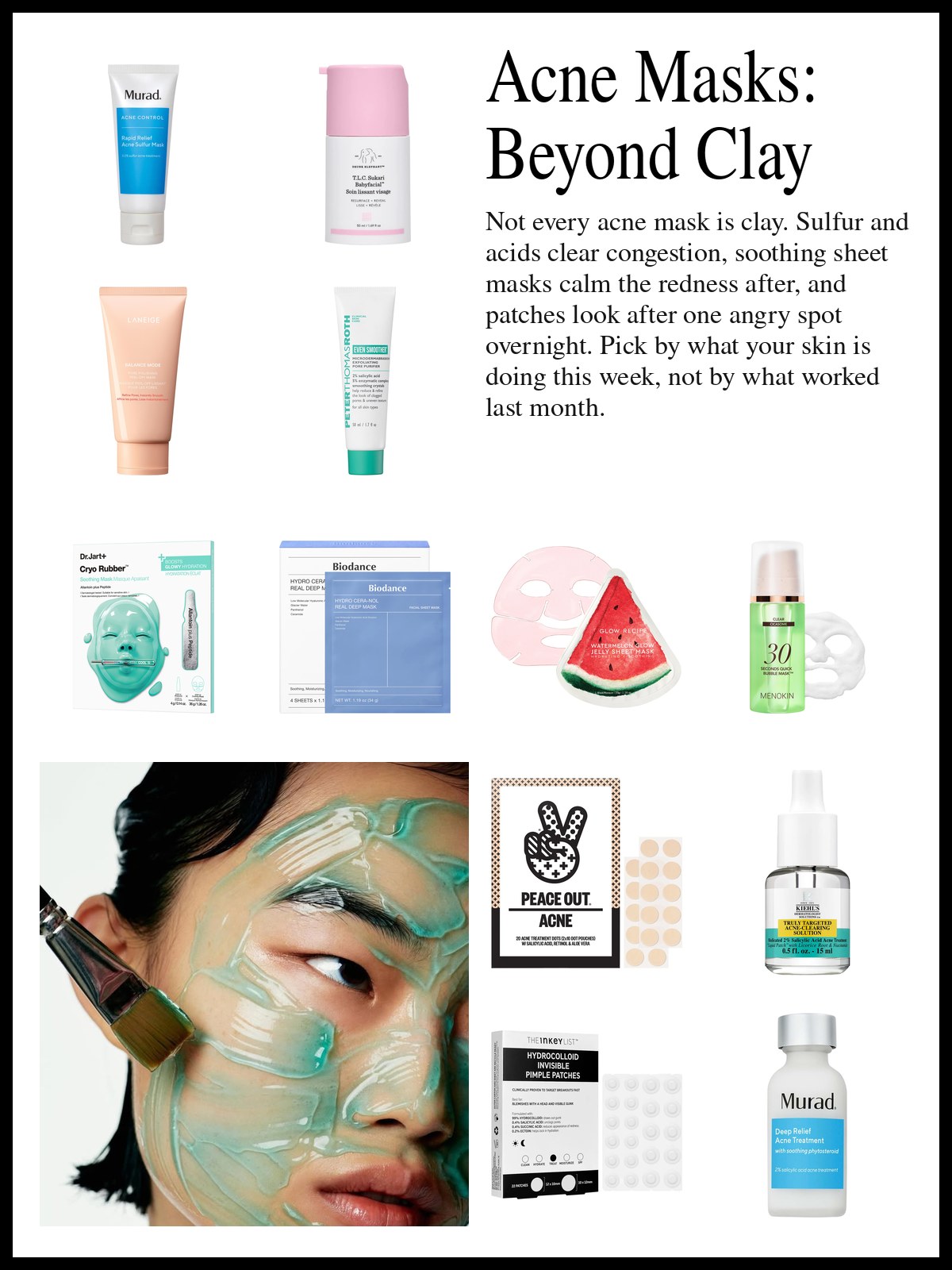
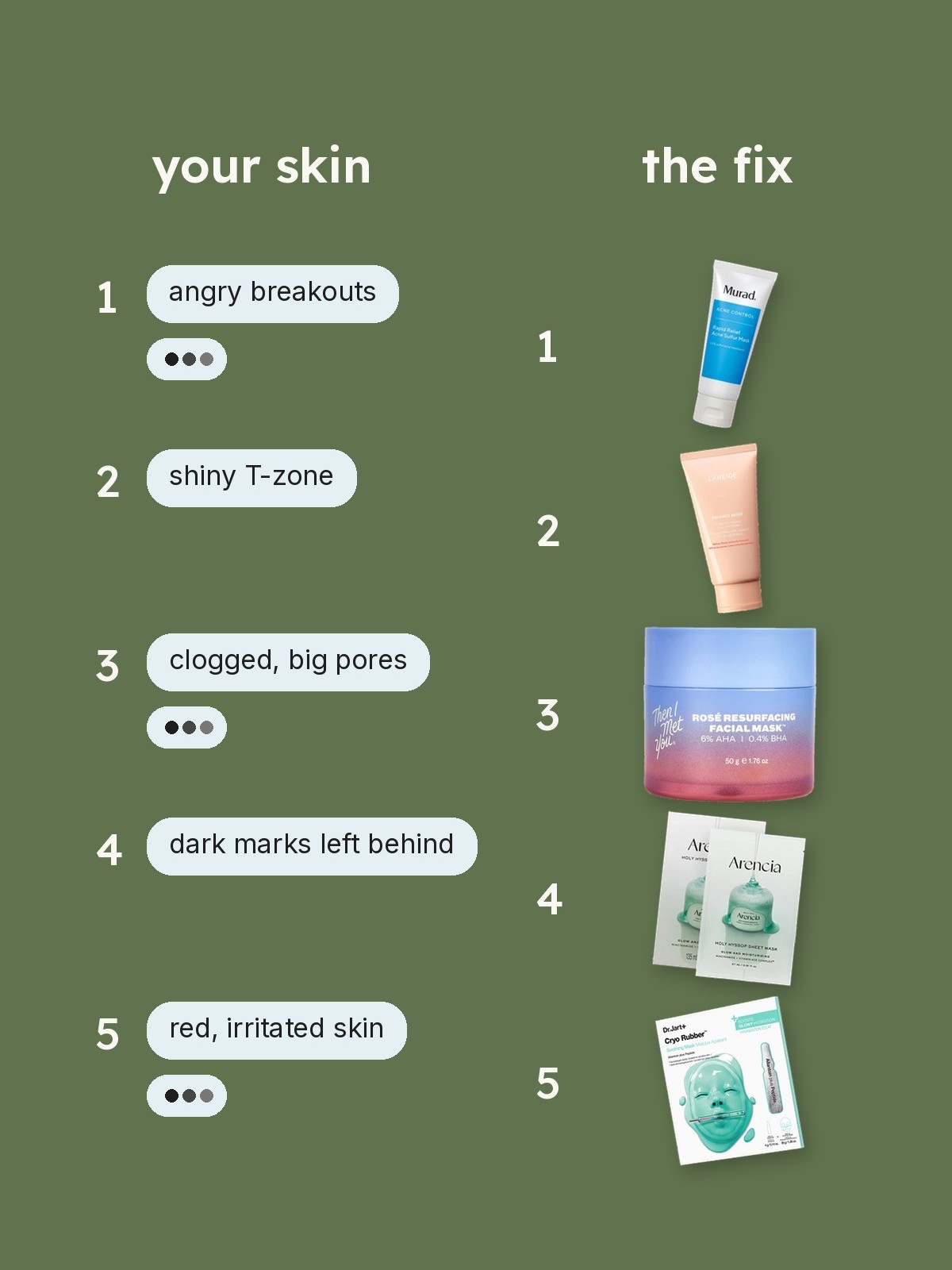
Start with clarifying masks for congestion, blackheads and oiliness, used once or twice a week. Murad's Rapid Relief mask pairs sulfur and clay with salicylic acid. Topicals' Clearly is a clarifying and calming mask made for breakout-prone skin, and Dr. Barbara Sturm's Clarifying Mask is made to control oil while soothing. Laneige's Balance Mode is a peel-off mask with salicylic acid for pores.
Exfoliating masks go further. Drunk Elephant's Babyfacial combines 25% AHA and 2% BHA, a strong mask for experienced skin only. Then I Met You's Rosé mask pairs BHA and AHA, and Peter Thomas Roth's Even Smoother is a microdermabrasion pore purifier with salicylic acid. Arencia's Holy Hyssop sheet masks, with vitamin C, are made for the marks breakouts leave behind.
Use only one exfoliating mask a week, and not on the same night as a retinoid or other acid. Follow with a plain moisturizer, and wear sunscreen the next morning. Exfoliated skin is more sensitive to sun for a few days, even in winter.
Face Mask for Acne: Clarifying and Exfoliating

Rapid Relief Acne Sulfur Clay Mask with Salicylic Acid
Murad
$50

TLC Sukari Babyfacial 25% AHA/ 2% BHA Exfoliating Mask
Drunk Elephant
$80

Clearly Clarifying & Calming Mask For Breakout-Prone Skin
Topicals
$26

Balance Mode Pore Polishing Peel-Off Face Mask with Salicylic Acid to Control Shine & Smooth Texture
Laneige
$24

Even Smoother™ Microdermabrasion Exfoliating Pore Purifier with Salicylic Acid for Oil Control
Peter Thomas Roth
$49

Rosé Resurfacing & Brightening BHA + AHA Facial Mask for Minimized Pores
Then I Met You
$58

Holy Hyssop Brightening Sheet Mask 5-Pack for Post-Acne Marks with Vitamin A, C, E, and Niacinamide
Arencia
$16

Clarifying Mask — Clarifying & Soothing Face Mask to Control Oil, Reduce Breakouts & Refine Pores
Dr. Barbara Sturm
$150
Soothing masks for red, irritated skin
Breakouts often come with redness and a sore, tight feeling, especially if you are using strong actives. On those nights, the right mask is a calm one, and sheet and gel masks are the easiest.
Dr. Jart+'s Cryo Rubber mask with allantoin is a two step rubber mask made to feel cool on the skin. Their Soothing Hydra Solution mask is a simple sheet for irritated skin. Biodance's Hydro Cera-nol masks come in a four pack and are made for dryness and redness, and their Sea Kelp masks are made for calming and oil control. Glow Recipe's Watermelon Glow jelly sheet mask is hydrating and soothing.
Abib's Gummy Sheet Mask with heartleaf is made for sensitive skin, and MENOKIN's 30 sec Quick Bubble Mask with cica is a fast, foaming option for a busy evening. Hanyul's Artemisia hydrogel masks, with centella and panthenol, come four to a box and are thicker and more gel-like than a paper sheet.
Keep sheet masks in the fridge for an extra cool feeling, and apply to clean skin. Leave them on for the time on the box, usually fifteen to twenty minutes, then pat in what is left and follow with moisturizer.
Soothing masks pair well with an active routine. Use your acid or retinoid on its nights, and a calming mask on the nights in between, when your skin needs a rest. That rhythm can be much easier on skin than strong products every night, and irritated skin often breaks out more, not less. If a mask stings or leaves you redder than before, rinse it off and skip that one next time.
Calming masks for the nights between actives

Cryo Rubber™ Soothing Face Mask with Allantoin
Dr. Jart+
$16.5

Hydro Cera-nol Real Deep Mask - 4 pack for Dryness Relief & Redness Soothing
Biodance
$19

Watermelon Glow Hydrating & Soothing Jelly Sheet Mask
Glow Recipe
$8

30 sec Quick Bubble Mask, Clear
MENOKIN
$32

Gummy Sheet Mask Heartleaf Sticker Korean Face Mask for Sensitive Skin, Soothing & Redness Relief
Abib
$4

Refreshing Sea Kelp Real Deep Mask - 4 pack for Calming & Sebum Control
Biodance
$19

Soothing Hydra Solution™ PRO Face Mask for Irritated Skin
Dr. Jart+
$10.5

Korean Artemisia Soothing Hydrogel Sheet Mask Set with Centella Asiatica + Panthenol
Hanyul
$19
Patches for single spots
For one spot, a patch beats a whole face mask. Hydrocolloid patches absorb fluid from a spot that has come to a head and, just as usefully, stop you from picking at it.
Peace Out's patches combine salicylic acid and hydrocolloid, and The INKEY List's invisible patches do the same in a thinner, clearer dot for daytime. rhode's Spotwear hydrocolloid patches are simple and discreet. Dr. Idriss's Patch It patches use azelaic acid instead of salicylic. Sephora Collection's Quick Clear Patches are hydrocolloid too, six clear and six colored in a box, so you can choose whether anyone notices.
Liquid patches are a newer idea, a liquid you dab on that dries into a thin film. Kiehl's Truly Targeted liquid patch and Murad's Deep Relief liquid patch both carry salicylic acid, and they are less visible under makeup.
Peace Out's Early Stage patch has tiny microneedles with 2% salicylic acid, made for the spot you feel coming under the skin before it shows.
Put a patch on clean, dry skin, with no moisturizer underneath, or it will not stick. Leave it for several hours or overnight, and replace it when it turns white.
What I would skip: patches on an open or bleeding spot, or on a deep, painful cyst. Those need a dermatologist, not a sticker. I would also skip squeezing a spot and then covering it, which can make it worse. And skip clay masks on skin that is already red and raw. Calm it first, then clarify later in the week. Store patches in a dry place, since humidity can weaken the adhesive.
Pimple patches for single spots

Salicylic Acid & Hydrocolloid Acne Treatment Pimple Patches
Peace Out
$19

Truly Targeted Acne-Clearing Liquid Pimple Patch with Salicylic Acid
Kiehl's Since 1851
$30

Hydrocolloid Invisible Pimple Patches + Salicylic Acid
The INKEY List
$10

Deep Relief Acne Treatment with Salicylic Acid Liquid Pimple Patch for Painful Acne
Murad
$48

Spotwear Hydrocolloid Patches
rhode
$16

Patch It Azelaic Acid Rescue Pimple Patches
Dr. Idriss
$18

2% Salicylic Acid Early Stage Acne Microneedle Pimple Patch
Peace Out
$20

Quick Clear Patches
Sephora Collection
$6
Pick by what your skin is doing
The simplest approach is to choose each mask by what your skin is doing this week, not by what worked last month. Congested and oily, reach for a clarifying mask. Red and tight, pick a soothing sheet. One spot, use a patch.
Keep a box of patches in your bag and a soothing mask in the fridge. If breakouts are frequent, painful or leaving marks, see a dermatologist. Masks help at home, but persistent acne often needs prescription care, and the earlier you start, the fewer marks it tends to leave behind. Change your pillowcase every few days during a breakout, and keep hair products off your forehead. If you want to keep browsing, I also put together Face Masks Skincare Fans Keep Coming Back To and Hair Wax, Pomade or Clay.