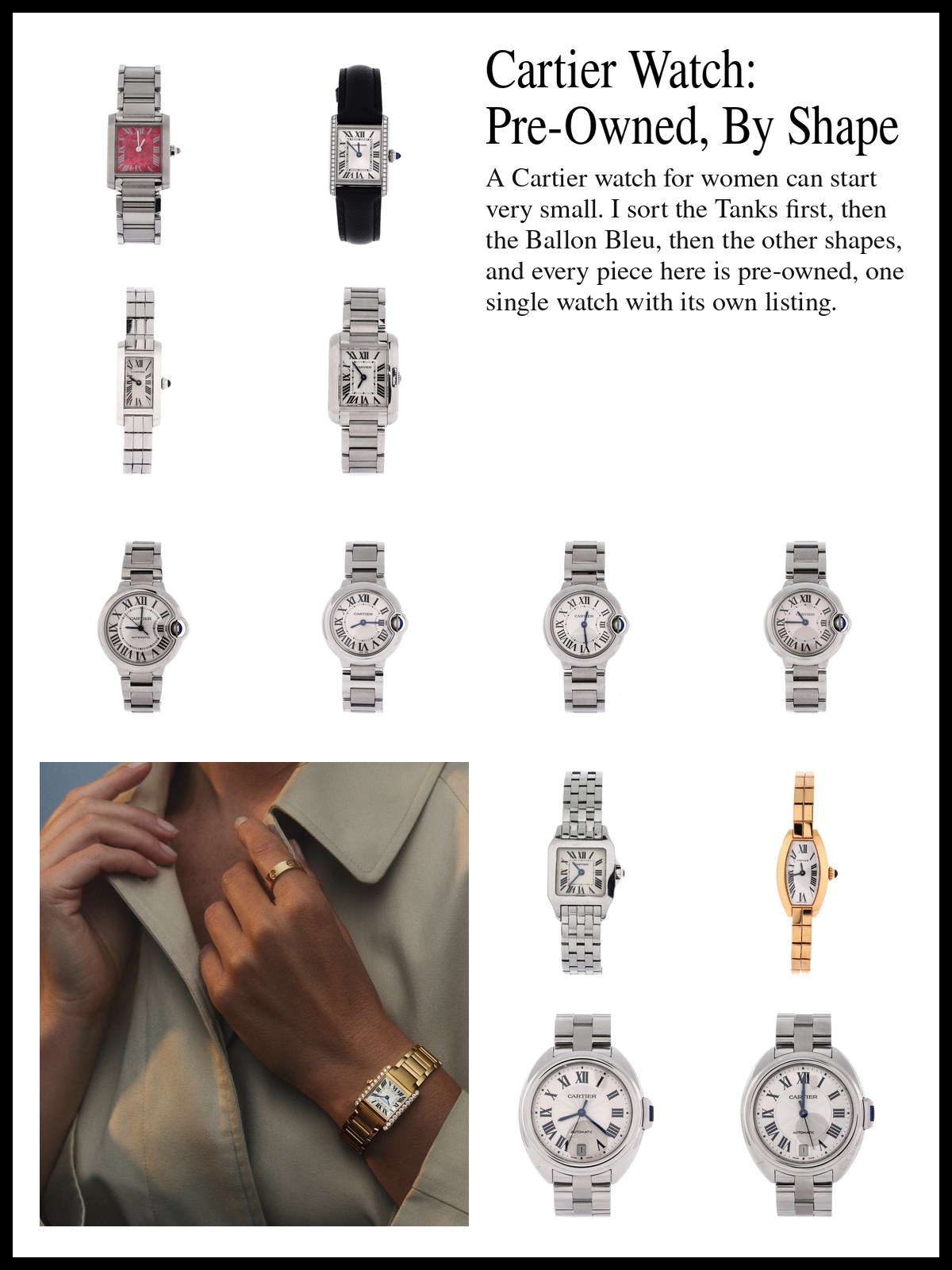
A Cartier watch for women is easiest to choose by shape, so this edit walks through pre-owned Tanks, the Ballon Bleu and a few other Cartier cases. I go by case size and the details you can read in each name.
The Cartier Watch for Women: Small Tanks, Ballon Bleus and Mid-Size Rounds
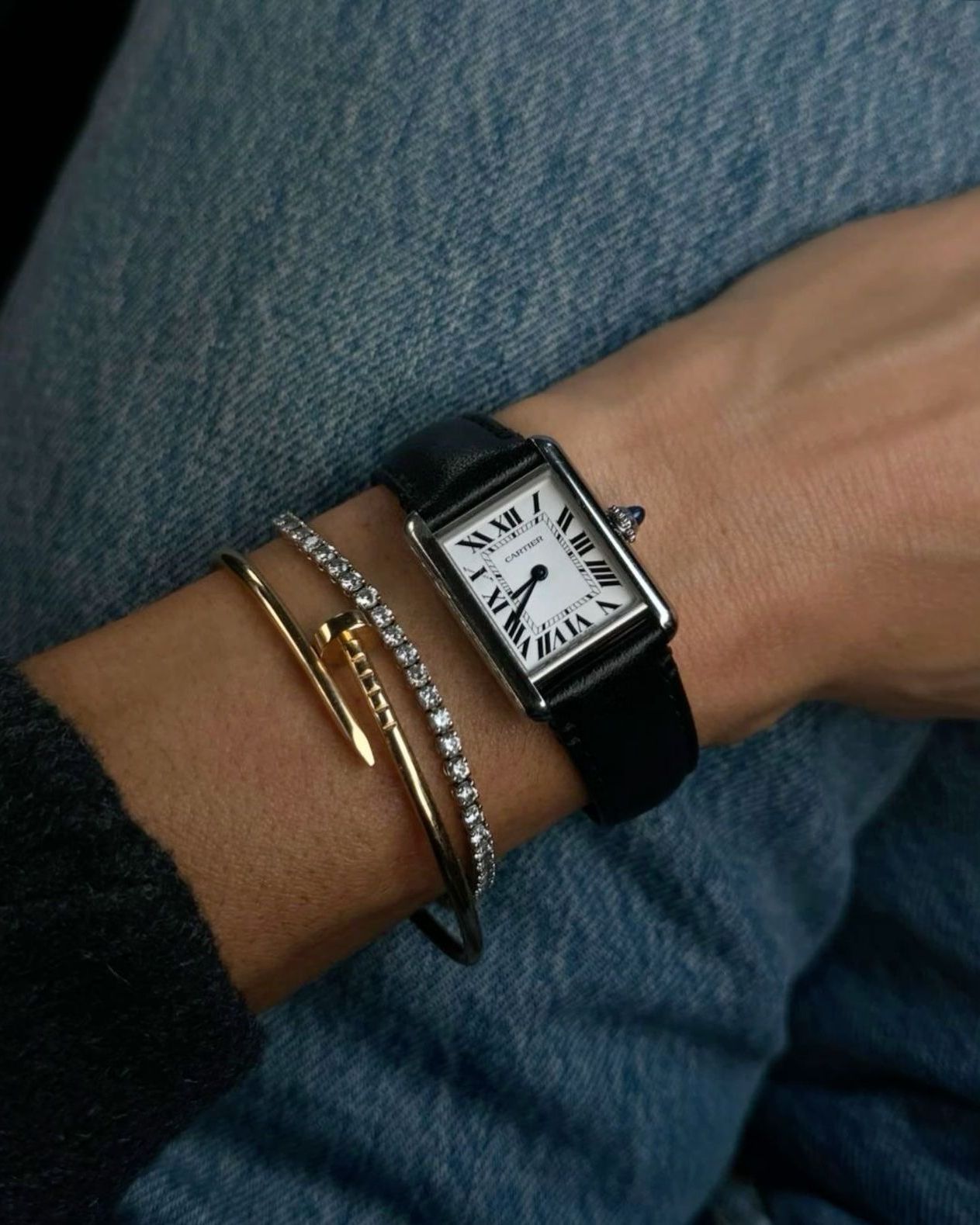
I always start a Cartier watch for women with the Tank, because its story is easy to check. Hodinkee says Louis Cartier's Tank was first sold as the Tank Normale in 1919, and calls it the first Tank watch. The Fondation de la Haute Horlogerie traces it to a 1917 prototype shown to General John Pershing, and says it already had Roman numerals, a railway minutes track, blue steel hands and a sapphire cabochon crown. Cartier has always said the shape was inspired by the Renault FT tank of WWI, and the wide treads became the brancards, the sides of the case.
The house itself is older. Business Insider reports that Cartier was founded in Paris in 1847 by Louis-François Cartier, who took over his old master's shop. Keep that in mind when you look at the grid below, because every watch here is pre-owned, sold secondhand, and each listing is a single piece rather than a size run.
The Tank Francaise gets the most room, and it is a good lesson in case size. The Fondation de la Haute Horlogerie dates it to 1996. There is the limited edition in stainless steel 20mm, the stainless steel and yellow gold 20mm, the one with diamond markers at 20mm, two more plain stainless steel 20mm listings, and a 25mm. Hold the 20mm and the 25mm against your wrist bone if you can, and notice how far the strap sits from the lugs. The Chronoflex Chronograph at 28mm is the largest in the grid and the only one with a chronograph function in its name.
Then the variations. The Tank Anglaise appears twice in stainless steel at 23mm, and the Fondation says it joined the collection in 2012, with its crown built into the right-hand side of the case. The Tank Solo in stainless steel at 24mm is the plainest of the group. The Must de Cartier Tank, with its diamond bezel and leather strap at 22mm, comes from a line the Fondation says was created in 1977 to reach a wider audience. The smallest is the Tank Allongee Laniere at 14mm in white gold, a version of the elongated Tank dated to 1922. All of them are quartz, which means they are battery-powered.
Tank Watches

Pre-Owned Limited Edition Tank Francaise Quartz Watch Stainless Steel 20
Cartier
$4,025

Pre-Owned Must de Cartier Tank Quartz Watch Stainless Steel and Leather with Diamond Bezel 22
Cartier
$6,790

Pre-Owned Tank Allongee Laniere Quartz Watch White Gold 14
Cartier
$15,290

Pre-Owned Tank Anglaise Quartz Watch Stainless Steel 23, Great Condition
Cartier
$4,440

Pre-Owned Tank Anglaise Quartz Watch Stainless Steel 23, Excellent Condition
Cartier
$4,655

Pre-Owned Tank Francaise Chronoflex Chronograph Quartz Watch Stainless Steel 28
Cartier
$3,835

Pre-Owned Tank Francaise Quartz Watch Stainless Steel 20, Excellent Condition
Cartier
$4,680

Pre-Owned Tank Francaise Quartz Watch Stainless Steel 20, Great Condition
Cartier
$4,230

Pre-Owned Tank Francaise Quartz Watch Stainless Steel 25
Cartier
$4,465

Pre-Owned Tank Francaise Quartz Watch Stainless Steel and Yellow Gold 20
Cartier
$6,170

Pre-Owned Tank Francaise Quartz Watch Stainless Steel with Diamond Markers 20
Cartier
$6,265

Pre-Owned Tank Solo Quartz Watch Stainless Steel 24
Cartier
$5,275
The Ballon Bleu in 28mm and 33mm
The Ballon Bleu is the round one, and it is a much younger idea than the Tank. Hodinkee says it was introduced in 2007 and is available from 26mm to 42mm, so the two sizes here, 28mm and 33mm, sit at the small end of that range. Cartier describes a doubly convex design, with an arch that protects its blue cabochon, and on its product pages the crown is a fluted crown set with a cabochon synthetic spinel. That protected crown is the detail I look at first, because it is what keeps a round case from reading like a plain circle.
Start with the six 28mm quartz watches. Four are plain stainless steel listings of the same Ballon Bleu de Cartier. Then there is the 28mm with a diamond bezel and the 28mm with diamond markers, both stainless steel. The plain ones are the quietest in the grid, and I would wear any of them with a white shirt and jeans. The diamond bezel is the dressier one, so I would keep the rest of the outfit very simple around it.
The two 33mm watches are the only automatics here. An automatic mechanical movement is powered by the motion of the wearer's wrist, while quartz is battery-powered. That is the practical difference between the 33mm watches and everything else in this grid, and it is worth knowing before you choose, because a watch that runs on wrist motion likes to be worn most days.
My fitting-room test is the cuff. Put the watch on over a shirt sleeve, a knit and a trench, and see whether the round case catches. A 28mm tends to slide under most cuffs. The 33mm watches will show more, which is the point if you want the watch to be noticed. Every one of these is pre-owned and a single piece, so go through the listing photos closely before you pick one.
The Ballon Bleu in 28mm and 33mm

Pre-Owned Ballon Bleu de Cartier Automatic Watch Stainless Steel 33
Cartier
$5,035

Pre-Owned Ballon Bleu de Cartier Quartz Watch Stainless Steel 28, Excellent Condition
Cartier
$5,545

Pre-Owned Ballon Bleu de Cartier Quartz Watch Stainless Steel 28, Very Good Condition
Cartier
$4,850

Pre-Owned Ballon Bleu de Cartier Quartz Watch Stainless Steel 28, Great Condition
Cartier
$4,580

Pre-Owned Ballon Bleu de Cartier Quartz Watch Stainless Steel with Diamond Bezel 28
Cartier
$7,320

Pre-Owned Ballon Bleu de Cartier Quartz Watch Stainless Steel with Diamond Markers 28
Cartier
$6,510

Pre-Owned Ballon Bleu de Cartier Quartz Watch Stainless Steel 28
Cartier
$5,215

Pre-Owned Ballon Bleu de Cartier Automatic Watch Stainless Steel 33
Cartier
$5,490
Cartier Shapes Beyond the Tank and the Ballon Bleu
This is the group I find the most fun, because the shapes stop being rectangles. It also has a split I want to be clear about. Two pieces are properly small: the Santos Demoiselle in stainless steel at 20mm and the Mini Tonneau Lanier in yellow gold at 16mm. The other six are mid-size watches at 35 to 36mm that many women wear, so I would not call them small.
Start with the Santos. Cartier says that in 1904 Louis Cartier granted the aviator Alberto Santos Dumont's wish to tell time while flying, producing one of the first ever wristwatches. The Demoiselle is the small, quiet version of that idea. The Tonneau came two years later, in 1906, and tonneau is the French word for barrel, which is the shape of the case. It was later made in a smaller size for women in the 1980s and 1990s, some with diamonds on the bezel, so a 16mm Mini Tonneau fits that line well.
Now the mid-size rounds. Hodinkee reports Cartier launched the Cle de Cartier at SIHH in January 2015, named for its key-like oblong winding crown set into the side of the case. Here it is an automatic at 35mm three times: two in stainless steel and one in stainless steel and rose gold. The Pasha C comes in stainless steel at 35mm, and as a GMT, also in stainless steel at 35mm. The Rake says the Pasha de Cartier arrived in 1985, designed with Gerald Genta, a round watch that stood out among Cartier's ovals and rectangles, with a screw-down crown cap on a small chain. The Ronde Solo de Cartier in stainless steel at 36mm is a quartz and the plainest of the group.
What I would skip: do not choose a mid-size watch on the idea that it will disappear under a cuff. Try the 35mm and 36mm watches next to the 16mm and 20mm ones, and choose between a watch you notice and one you find by accident.
Cartier Shapes Beyond the Tank and the Ballon Bleu

Pre-Owned Santos Demoiselle Quartz Watch Stainless Steel 20
Cartier
$4,225

Pre-Owned Mini Tonneau Lanier Quartz Watch Yellow Gold 16
Cartier
$14,665

Pre-Owned Cle de Cartier Automatic Watch Stainless Steel 35, Excellent Condition
Cartier
$4,120

Pre-Owned Cle de Cartier Automatic Watch Stainless Steel 35, Great Condition
Cartier
$4,440

Pre-Owned Cle de Cartier Automatic Watch Stainless Steel and Rose Gold 35
Cartier
$5,710

Pre-Owned Pasha C Automatic Watch Stainless Steel 35
Cartier
$3,360

Pre-Owned Pasha C GMT Automatic Watch Stainless Steel 35
Cartier
$3,045

Pre-Owned Ronde Solo de Cartier Quartz Watch Stainless Steel 36
Cartier
$3,725
How I would choose one
Here is how I would choose. First, decide on shape: a rectangle, a round, or the odd one. Then use your wrist bone as the ruler, because the same number in millimeters can look quite different on a Tank than on a round case. Try the watch with the sleeves you actually wear.
Second, decide quartz or automatic. The first is battery-powered and the second runs on the motion of your wrist, and both appear in this edit. Third, decide how much detail you want: a plain dial, diamond markers, a diamond bezel, or two metals together.
Last, remember that every watch here is pre-owned and one single piece. If a listing speaks to you, read it, look at every photo, and go with the one you keep coming back to. If you want to keep browsing, I also put together Cartier Panthère Watch and Gucci Watch for Women.






