The Denman brush began with an inventor in Northern Ireland who wanted something better for his sister's curls, and it is still how many of us define a wash-day set. Here are the four classic styles, the round and paddle brushes that do other jobs, and the gels that make brushing through curls work.
The Denman Brush: A Curly-Haired Sister, a Trip to America and Nylon
The story I love about the Denman brush starts in 1938, with a Northern Irish inventor called Jack Denman Dean. On a trip to America he came across nylon, and he made a brush from it for his curly-haired sister. The business itself was established in 1946, and through the 1950s and 60s it became a hairdressers' professional tool. Vidal Sassoon famously used the Denman D3 to shape the asymmetric bob he made for Mary Quant. Since 1972 the Rainey family has owned it, and the design and manufacturing are still in Bangor, Northern Ireland.
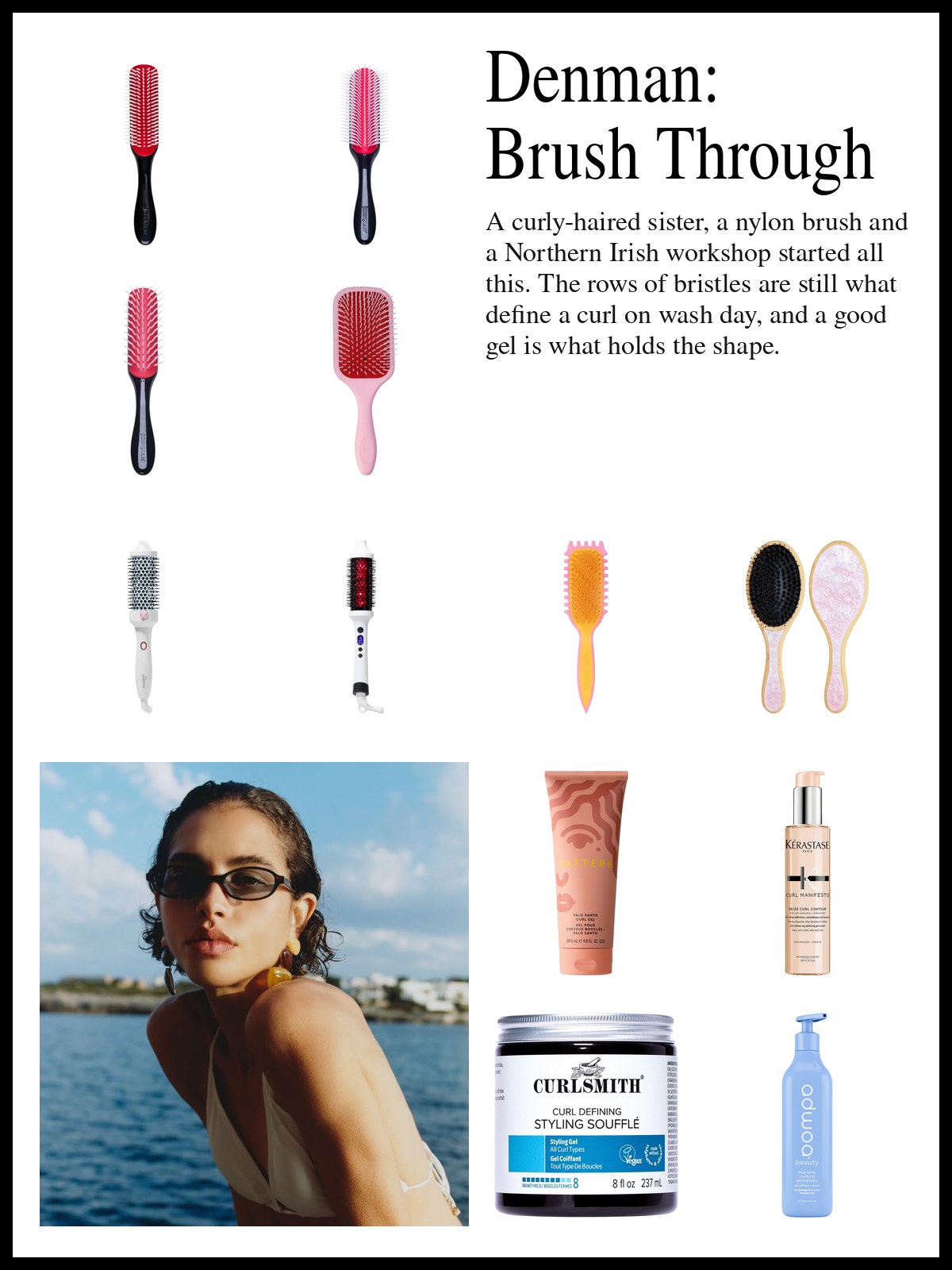
That history makes sense of the brushes, which look almost stubbornly simple. The D3 The Original Curl Definer and Styler is the one most people picture, rows of nylon bristles, and it is the one I hand to anyone starting out. The D4 has nine rows, so it covers more hair per pass, and the D31 Freeflow is a shape made to let hair run through more freely.
The D38 is a detangling and styling paddle, the one I would use before the curl work begins. Smooth the paddle through in sections and save the rows for the day you want definition, because curls that are brushed dry usually turn into a cloud. I like to feel the bristles glide through soaking hair with conditioner still in it, then watch the strands gather into clumps as I go. That little moment of hair snapping into a curl is the reason people keep these brushes for decades.


Other brushes for other jobs
Not every job on wash day wants a curl brush, and I have a small drawer of other tools for the rest. Some are for adding lift, some for smoothing, and a few for the days I want my hair to behave like a straight blowout.
Mane's It's Giving Body is a large hot thermal round brush, made for volume and bounce at the roots. BondiBoost's Infrared Heated Thermal Round Brush is another heated round brush, handy for a quick set. Drybar's Brush Crush is a heated straightening brush, easy for a single pass when you do not want to break out a full iron.
T3's AireBrush is a one-step smoothing and volumizing blow dry brush, the tool to reach for when you are short on time. Emi Jay's flat dual-bristle brush is a smoothing brush for the days you want hair sleek. Bounce Curl's Slick-Dense Define Edgelift Brush is a small brush made for edges.
The test with any of these is the tension. Hold hair only firmly enough that you can feel it, never so hard it tugs. If you feel yanking, the tool is too small for the section or the hair is still too wet. I also clean the brush head after each session, because a clogged round brush drags and leaves the ends rough. Keep the heated ones on a low setting for the first pass and let the brush do the shaping, not the temperature.
Other styling and paddle brushes

It's Giving Body Large Hot Thermal Round Brush
Mane
$118

Infrared Heated Thermal Hot Round Brush
BondiBoost
$125

Slick-Dense Define Edgelift Brush
Bounce Curl
$30

Flat Smoothing Dual-Bristle Hair Brush
Emi Jay
$52

AireBrush One-Step Smoothing and Volumizing Blow Dry Brush
T3
$149.99

The Brush Crush Heated Straightening Brush
Drybar
$149
Gels that brush through cleanly
A curl brush and a gel are a pair. Without a gel, the bristles pull hair apart into fuzz. With one, they clump the strands into neat, glossy ringlets, so the choice of gel matters as much as the brush.
Pattern Beauty's Palo Santo Curl Gel Crème is a soft gel-cream for coils and waves. Kérastase's Curl Manifesto Curl Defining Gel-Cream is a gel-cream, the lighter feel of the group. Curlsmith's Strong-Hold Styling Gel is the firm one, the choice for a long day outside or a style that must last past the second day.
L'Oréal Professionnel's Curl Expression Leave-In Jelly is a defining jelly. Ouidad's Climate Control gel is made for heat, humidity and frizz on curly hair. adwoa beauty's Blue Tansy Clarifying Gel Shampoo is not a styler at all, it is the reset for buildup, which is the thing that makes gels flake.
What I would skip: brushing through a gel once it has begun to dry, and heavy layers on hair that has not been cleansed lately. Rake product in while hair is soaking, brush section by section, then leave it alone until it is fully dry. If the ends feel crunchy afterward, that is the gel cast, and it softens as soon as you scrunch it out with a drop of oil or a little water on your palms.
Curl gels to brush through

Palo Santo Curl Gel Crème
Pattern Beauty
$29

Curl Manifesto Curl Defining Gel-Cream
Kérastase
$52

Curl Defining Strong-Hold Styling Gel
Curlsmith
$28

Blue Tansy Clarifying Gel Shampoo
adwoa beauty
$19.6

Curl Expression Defining Leave-In Jelly
L'Oréal Professionnel
$38

Advanced Climate Control Heat & Humidity Anti-Frizz Gel for Curly Hair
Ouidad
$26
Wash day, start to finish
Here is my wash day in four beats. Cleanse, condition and detangle with the paddle, gel while the hair is soaking, then use the curl brush in sections and stop. The impulse to keep going is the enemy of definition.
Let the curls dry undisturbed, in the air or under a diffuser, and only break the cast when everything is completely dry. Keep the routine unhurried, because wash day goes better when you are not racing the clock. Rinse your brushes in warm water and clear the bristles regularly, since product buildup is what makes hair snag. If you have sudden hair loss, or a scalp that is sore or flaky for weeks, a doctor is a better next stop than another gel. Once you have a rhythm, you will know within a wash or two whether a brush and gel pair is doing its job, and you can stop tinkering. If you want to keep browsing, I also put together Why Curls Get Thirsty and The Best Conditioner for Curly Hair, From Rinse Outs to Co Washes.






