The Ordinary glycolic acid toner is the bottle that made a lot of us learn what an exfoliating acid does. Here are that toner and its close relatives, the other acids on the same shelf, and the barrier creams and sunscreens that make an acid night a calm one.
The Ordinary Glycolic Acid and the Acid Shelf Around It, Explained Slowly
The name glycolic acid was coined in 1848 by the French chemist Auguste Laurent, and the acid was first prepared in 1851 by Adolph Strecker and Nikolai Sokolov. It occurs naturally in sugarcane, sugar beets, pineapple, cantaloupe and unripe grapes, which is a charming fact to keep in your pocket the next time someone calls acids unnatural. The Ordinary glycolic acid toner is the version most of us met first, and when it went TikTok-famous the brand renamed it, from November 10 in 2023, as Glycolic Acid 7% Exfoliating Solution.
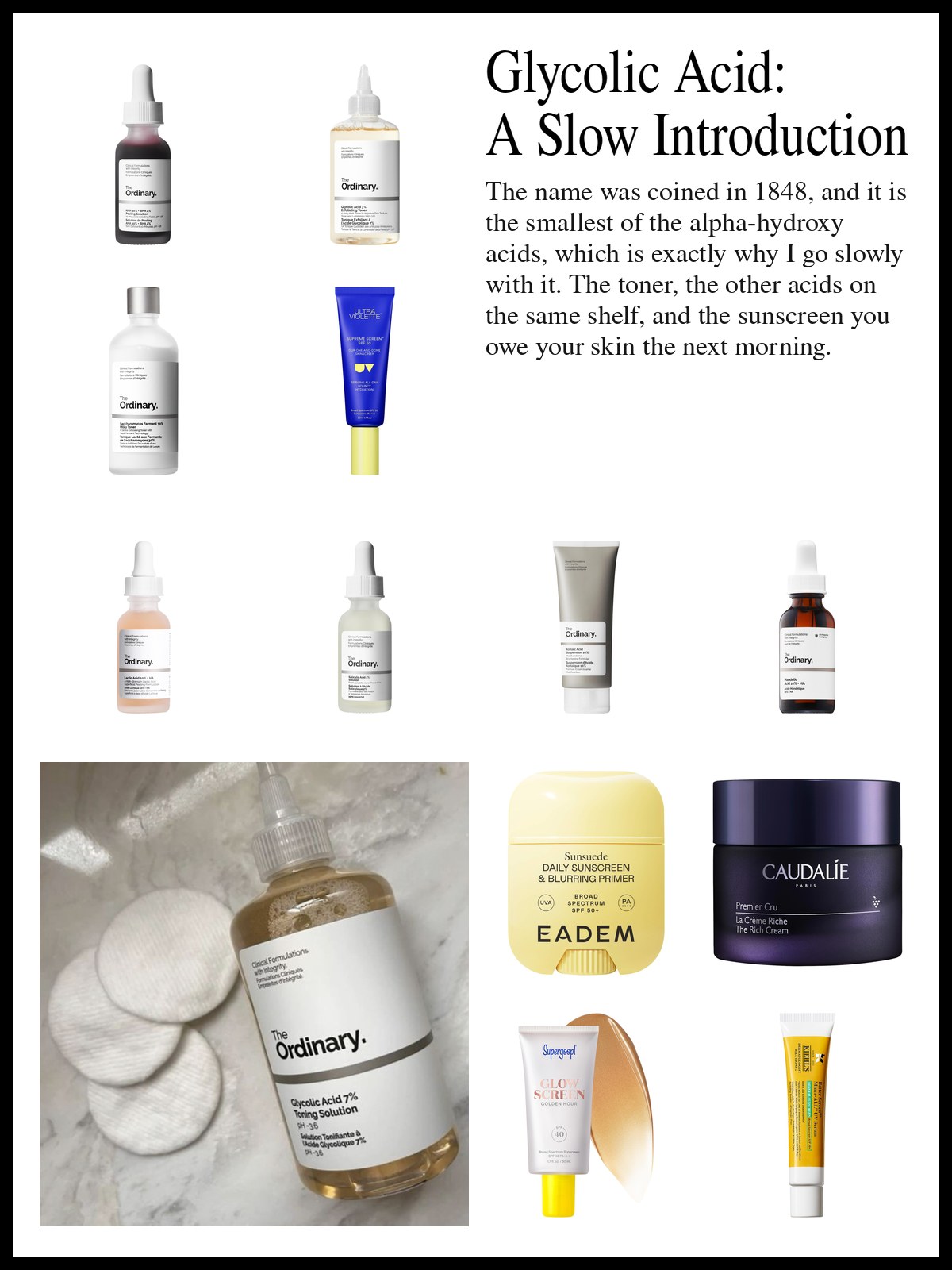
The first grid is the family that grew up around it. The Glycolic Acid 7% Exfoliating and Brightening Daily Toner is the gentlest way in: a liquid you sweep over clean skin at night, then leave alone. I would start with two evenings a week, not seven, and watch how your cheeks feel the following morning. The AHA 30% + BHA 2% Peeling Solution is the opposite end. It is a short contact treatment, and the numbers in the name should tell you it is not for a Tuesday when you feel adventurous. Use it rarely, follow the directions on the pack, and never on the same night as anything else active.
Between the two sits the Saccharomyces Ferment 30% Milky Toner, a softer, hydrating option for gentle exfoliation. It is the one I would hand to somebody who found the clear toner too brisk. Skin that has been exfoliated should feel smooth and calm, and it should never feel hot.


The rest of the acid family
Once you are comfortable with glycolic acid, the rest of the shelf makes more sense, because each acid has a different job.
Lactic Acid 10% + HA 2% is a serum made for uneven texture, and lactic acid is generally thought of as the softer cousin of glycolic. Mandelic Acid 10% + HA is another gentle exfoliating serum, and I would try it first if your skin sulks at stronger acids. Salicylic Acid 2% Solution is an exfoliating serum for blemish-prone skin. Azelaic Acid Suspension 10% is a cream for redness and blemish-prone skin, and it feels more like a moisturizer than an acid, so it is the one I would try on a sensitive week.
Then there are two formats that are easy to overlook. The Salicylic Acid 2% Masque is a clay and charcoal mask for blemish-prone skin, a short-contact ritual, and the Salicylic Acid 0.5% Body Serum takes the same idea to the chest, back and upper arms, where bumps and breakouts often gather.
My rule for all of them is one acid at a time. The temptation is to build a stack because every bottle looks so friendly. Pick a single evening for each, write it on a note in your phone, and treat the rest of the week as rest days. If you get stinging that lingers, peeling or a tight shiny look, stop and let skin recover.
Other The Ordinary acids

Lactic Acid 10% + HA 2% High-Strength Exfoliating Serum for Uneven Texture
The Ordinary
$9.2

Salicylic Acid 2% Solution, Exfoliating Serum for Acne
The Ordinary
$6.7

Azelaic Acid Suspension 10% Cream for Redness and Blemish-Prone Skin
The Ordinary
$28.8

Mandelic Acid 10% + HA Gentle Facial Exfoliating Serum for Hydration
The Ordinary
$7.8

Salicylic Acid 2% Masque Clarifying Charcoal & Clay Mask for Blemish Prone Skin
The Ordinary
$13.8

Salicylic Acid 0.5% Body Serum Exfoliating Treatment for Acne
The Ordinary
$15
Moisturizer and sunscreen for the morning after
An acid night only works if the mornings and the moisturizer are kind to your skin, so this last grid is really the important one.
Caudalie's Premier Cru Skin Barrier Rich Moisturizer, with bio-ceramides, is what I put on after an exfoliating evening. It is rich and refillable, and it is made to support the skin barrier. Then comes sunscreen, because exfoliated skin is more sensitive to sun and daily protection is not optional. Supergoop's Glowscreen SPF 40 has hyaluronic acid and niacinamide and has a glowy name and a glowy finish. Kiehl's Better Screen is a mineral UV serum at SPF 50. Ultra Violette's Supreme Screen is a facial sunscreen, moisturizer and primer in one at SPF 50. Tatcha's The Milky Sunscreen is SPF 50+ with encapsulated ectoin and vitamin E, and it is a milky formula. Eadem's Sunsuede is an SPF 50+ stick that doubles as a blurring primer, and it is the one I keep in my bag for reapplying.
What I would skip: skipping sunscreen because it is cloudy, and using a retinol or a second exfoliant on the same night as an acid. Also skip scrubbing with a gritty product the day after. Acids already do the sloughing. Apply sunscreen generously, and again if you are outdoors for hours.
Barrier creams and SPF for acid nights

Sunsuede SPF 50+ Lightweight Sunscreen & Blurring Primer Stick
Eadem
$32

Premier Cru Skin Barrier Rich Refillable Moisturizer with Bio-Ceramides
Caudalie
$119

Glowscreen SPF 40 Sunscreen with Hyaluronic Acid + Niacinamide
Supergoop
$38

Better Screen Miner-all UV Serum Mineral Sunscreen SPF 50
Kiehl's Since 1851
$36

Supreme Screen SPF 50 Facial Sunscreen Moisturizer and Primer
Ultra Violette
$36

The Milky Sunscreen Broad Spectrum SPF 50+ with Encapsulated Ectoin + Vitamin E
Tatcha
$50

Play Everyday Lotion SPF 50 with Sunflower Extract
Supergoop
$28

UV Solutions Hydrating Sunscreen SPF 50 with Hyaluronic Acid
Clinique
$39
A calendar for acid nights
Here is how I would run a week if I were starting from zero. One night, the glycolic toner. Two nights later, a hydrating serum and a rich moisturizer with no acid at all. A third evening, maybe a mandelic or lactic serum if the first one felt easy. Every morning, sunscreen.
That leaves two or three rest nights, and those are not wasted. They are how skin gets used to exfoliation. Introduce only one new product every couple of weeks, so that if something stings you know the culprit. Patch test behind the ear or along the jaw first. Persistent redness, burning or a rash is a reason to stop and talk to a doctor. Keep a note of which night you used what, because memory is unreliable at eleven at night and skin keeps the score. Acids can be a lovely part of a routine, and they work best when they are the quietest thing on the shelf. If you want to keep browsing, I also put together Pantene Shampoo, Explained.






