If your hair seems to repel everything you put on it, low porosity hair is a likely reason, and the answer is lighter products, not more of them. This edit covers clarifying shampoos, water-based leave-ins and milks, and light oils and masks that sit nicely on a tightly closed cuticle.
Low Porosity Hair: Why Water Beads Up and What Actually Gets In

Hair porosity is how readily hair absorbs and keeps water, products and treatments, and it comes down to the state of the cuticle, the outer protective layer of each strand. The cuticle is a set of overlapping layers, a bit like shingles on a roof, and porosity is usually split into low, medium and high. The word itself comes from the tiny pores seen in the structure of porous hair. With low porosity hair, those shingles lie flat and close, which means water resists going in, and products tend to sit on the surface.
You may recognize the signs. Water beads on your hair in the shower, it takes ages to dry, and rich creams leave it feeling greasy but not soft. The answer is rarely a heavier product. It is a regular reset, then lighter layers.
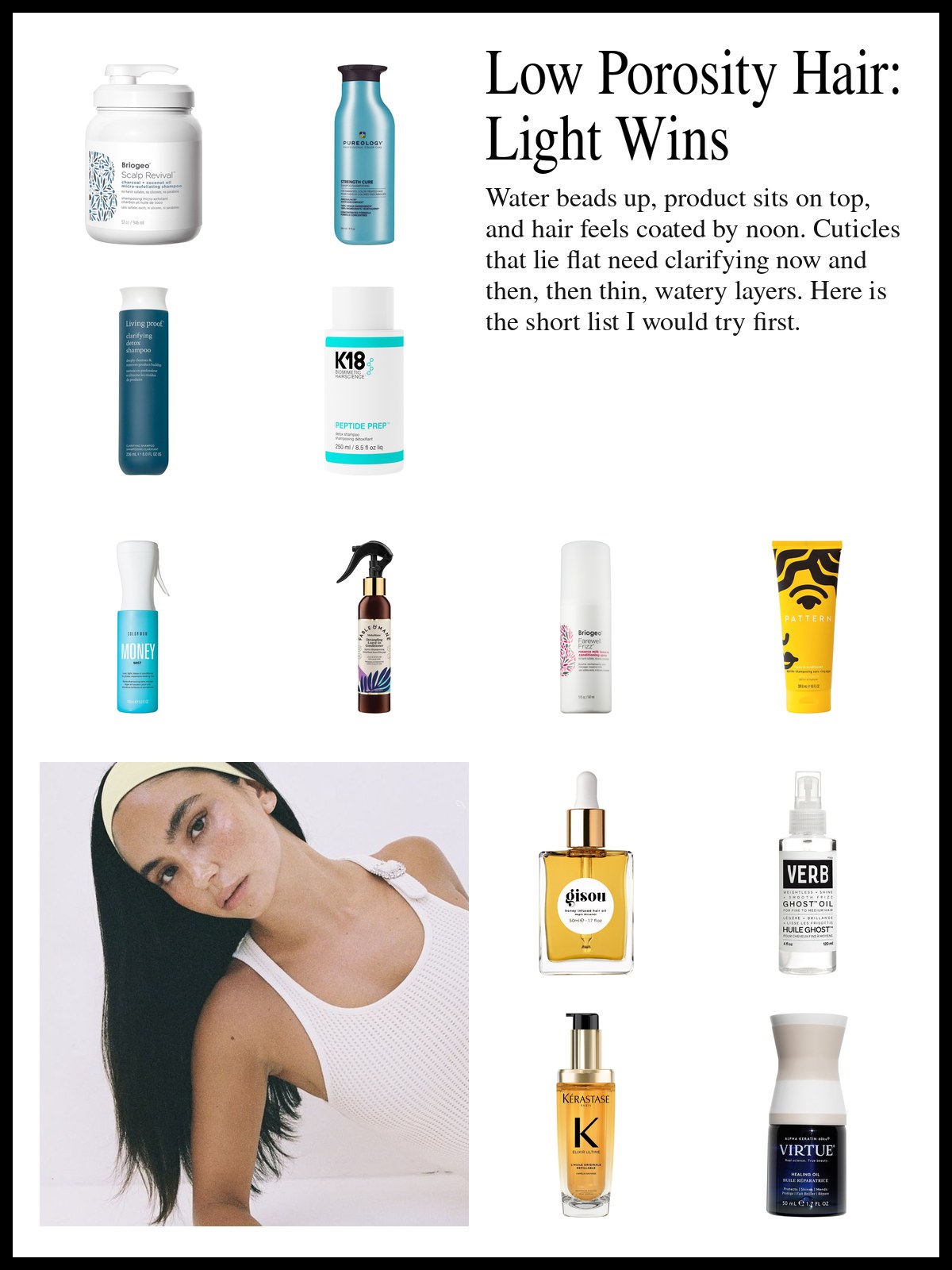
That is why this first grid is all shampoos that clarify or lightly exfoliate. Briogeo's Scalp Revival Charcoal and Coconut Oil scrub shampoo lifts buildup at the scalp. Living Proof's Clarifying Detox Shampoo and K18's Peptide Prep Clarifying Detox Shampoo are the straightforward resets. Bumble and bumble Sunday Clarifying Shampoo is the one I would use after a run of heavy styling. Pureology's Strength shampoo and Oribe's Hair Alchemy Strengthening Shampoo are made for damaged or tired hair, for weeks when it is not coated.
Use a clarifier every other week at most, and follow with conditioner on the lengths only.
Lightweight and clarifying shampoos

Scalp Revival Charcoal + Coconut Oil Micro-exfoliating Scalp Scrub Shampoo
Briogeo
$107.2

Strength Cure Shampoo for Damaged Hair
Pureology
$39

Clarifying Detox Shampoo
Living Proof
$22.8

PEPTIDE PREP Clarifying Detox Shampoo
K18 Biomimetic Hairscience
$39

Hair Alchemy Strengthening Shampoo
Oribe
$150

Sunday Clarifying Shampoo
Bumble and bumble
$86.4

Clarifying Shampoo
Moroccanoil
$30

Full Shampoo
Living Proof
$36
Water-based leave-ins and milks
After a proper reset, the next question is what to put back. My answer is water first, then a little emollient, in that order. A watery leave-in tends to sit less heavily than a thick cream, and milks and mists are made for that.
Color Wow's Money Mist is a spray you can use on damp hair and then forget. Gisou's Honey Milk Active Repair is also a mist, so it goes on in a light layer. Briogeo's Farewell Frizz Rosarco Milk is a milk leave-in aimed at frizz. RŌZ's Milk Hydrating Leave-In Serum is a hydrating leave-in for the ends. The MahaMane Detangling Leave-in from Fable & Mane makes wet combing easier, and Pattern Beauty's leave-in for curls and coils is made for tighter patterns, so it is the one to try if your hair is curly.
A trick worth trying: apply on wet hair, in the shower or right after, so the product is diluted and spreads evenly.
Press it in, don't rub, and use half of what feels normal. Comb through with your fingers or a wide-tooth comb so the product spreads evenly instead of pooling at the ends. Then wait a minute before adding anything on top. If the hair still feels coated an hour later, you used too much, and next time you can halve it again. The goal is hair that moves, not hair that feels wet all day long.
Water-based leave-ins and milks

Money Mist Leave In Conditioner
Color Wow
$30

MahaMane Detangling Leave-in Conditioner
Fable & Mane
$30

Farewell Frizz Rosarco Milk Leave-In Conditioner
Briogeo
$25

Leave-In Conditioner for Curls & Coils
Pattern Beauty
$29

Milk Hydrating Leave-In Conditioner Hair Serum
RŌZ
$52

Honey Milk Active Repair Leave In Conditioner Mist
Gisou
$32

Strength & Shield Leave in Conditioner
Virtue
$38

Run Through Detangling Hair Primer
Oribe
$39
Light oils and deeper masks
Oils come last, because their job is shine and softness, not moisture. On hair that resists water, a heavy oil simply sits on the surface and attracts lint. A light one, applied sparingly, gives shine without weight.
Verb's Ghost Weightless Oil is made to fight frizz and add shine without a greasy finish, which is the whole brief for this kind of hair. K18's Molecular Repair Hair Oil is the one I would use by the drop. Gisou's Honey Infused Hair Oil is another to use sparingly. Kérastase Elixir Ultime, in its refillable bottle, is a shine oil for dry ends. Virtue's hydrating hair oil and Pureology's Hydrate Glow Catcher Hair Oil are both made for moisture and shine, so I would try them on the mid-lengths and ends of dry hair, not the roots.
What I would skip: layering three or four heavy butters and oils on wash day, and applying any oil to dry hair that already feels coated. If your hair feels stiff or dull, go back a step and clarify before reaching for more product. Also skip leaving any conditioning mask on far longer than the label says. I would also keep oil off the scalp unless it is a product made for it, since that is where buildup begins. Finish by scrunching in the last of the oil and leaving hair alone; touching it all day only adds more product where it is not needed.
Light oils and deep-conditioning masks

Honey Infused Hair Oil
Gisou
$41.4

Ghost Weightless Oil to Fight Frizz and Enhance Shine
Verb
$28.8

Elixir Ultime Refillable Hydrating Hair Oil for Shine
Kérastase
$64

Hydrating Healing Hair Oil
Virtue
$46

Molecular Repair Hair Oil
K18 Biomimetic Hairscience
$65

Hydrate Glow Catcher Hair Oil For Moisture and Shine
Pureology
$37

Ghost Hair Mask
Verb
$22

Gold Lust Nourishing Frizz Reduction Hair Oil
Oribe
$42
A gentle weekly rhythm
Here is the rhythm I would try. Clarify every second or third wash, condition the ends, add a water-based leave-in to wet hair, then a drop of oil once it is nearly dry. Give it a month before you decide. In practice, that means one clarifying wash, four ordinary washes, and a lot of patience while your hair learns to let things in.
Keep notes about how your hair feels on day two, since that tells you the truth about buildup. A quick test is to mist a clean, dry section with water and see whether the droplets bead up on top. That is one clue, so trust how your hair actually behaves in the shower too. If hair is suddenly breaking, thinning or your scalp is sore, see a doctor or stylist before changing anything else.